Skip to content
Welcome, thoughtbot's Giant Robots listeners!Start here
Strait of Hormuz
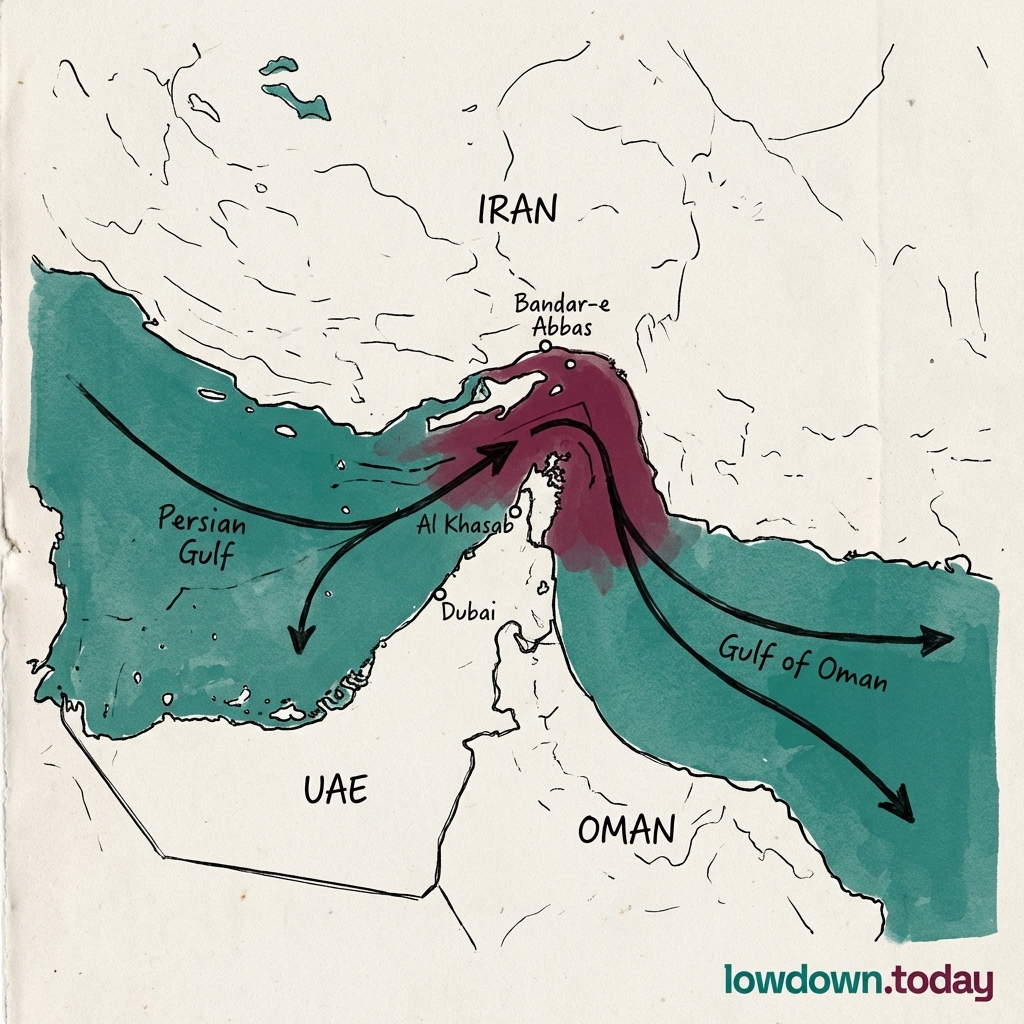
AI-generated illustration
Nation / PlaceIR

Strait of Hormuz

33km chokepoint for a fifth of global oil and LNG; contested amid Iran conflict.

On 11 September, the strait of Hormuz carried about 20 US-facilitated transits a day, but only six appeared on transponders, leaving passage through the 33km waterway difficult to assess.

Last refreshed: 22 September 2026 · Appears in 7 active topics

Key Question

Three trackers can't agree on Hormuz traffic: is anyone counting real ships anymore?

Timeline for Strait of Hormuz

#180 30 Sept

Held some 23 million barrels of Iranian crude behind it

Iran Conflict 2026: Iran loads no crude for a whole month
#180 29 Sept
#180 29 Sept

Carried four struck tankers over 28 and 29 September

Iran Conflict 2026: Al Funtas is struck and files no report
#180 28 Sept

Carried at least four loaded Qatar-linked carriers in late September

Iran Conflict 2026: QatarEnergy suspends gas as ships move
#180 28 Sept
View full timeline →

Background

the strait of Hormuz is a 33km maritime channel between Iran and Oman. It is the sole SEA exit for Gulf hydrocarbon exporters including Saudi Arabia, Kuwait, Iraq, the United Arab Emirates, Qatar and Iran. Its geography makes it a transport chokepoint, not a political authority or shipping service.

Iran signed but did not ratify the treaty provision guaranteeing transit passage through international straits. On 12 July, the Revolutionary Guard struck the GFS Galaxy and declared the strait closed; the reported legal basis relied on that unresolved position.

Control of access also has a financial dimension. On 30 July, the US Treasury named the HormuzSafe scheme and Persian Gulf Marine Insurance Company as sanctions-evasion vehicles. The episode shows why navigation in the strait depends on insurance and official claims as well as geography.

Key Issues
Transit verification

Traffic remains hard to verify

On 11 September, UK Maritime Trade Operations counted about 20 US-facilitated transits a day through southern Hormuz, yet only six appeared on ship transponders. Traffic was roughly 90% below the pre-war level of 138 daily crossings, leaving the strait of Hormuz's operational picture incomplete for shipowners and insurers.

The measurement problem extends to cargo volumes. On 2 September, US Energy Secretary Chris Wright said more than 17 million barrels had crossed by ship on 31 August, while tracker Samir Madani put Arabian Sea outflow at about 9.14 million barrels. The higher figure included pipeline volumes that bypass the strait, so the two counts do not measure the same passage.

Maritime routing

Routing remains politically contested

On 5 August, Iran and Oman announced new coordinates for ships using the strait of Hormuz, but neither government published a chart or legal text. Masters therefore had no single route they could treat as authoritative, while insurers lacked a document from which to price passage.

The same day, Iranian state media said eight negotiating rounds had produced preliminary approval for a maritime-corridor draft. Approval by The Supreme Leader and Supreme National Security Council was still required, leaving the arrangement unfinished. For the strait, routing remains tied to wider political authority rather than a settled navigation rule.

Common Questions

Reference

How much of Europe's gas supply depends on the Strait of Hormuz staying open?
Europe holds no direct pipeline exposure to the strait, but its LNG imports include Qatari cargoes that transit Hormuz, making the chokepoint a recurring source of price risk rather than physical supply risk.Source: european-energy-markets
What is the BIMCO CONWARTIME clause and why does it matter for Hormuz?
Conwartime is a standard shipping clause that allows charterers to refuse voyages into declared war-risk zones. It remains triggered across Gulf Charter contracts, meaning operators can legally decline Hormuz transits regardless of political agreements.Source: BIMCO
How much of the world's oil goes through the Strait of Hormuz?
Before the 2026 conflict, roughly 20 million Barrels Per Day (around 20% of global traded crude oil) plus 20% of global LNG transited the strait daily. The IEA called the 2026 disruption the largest supply shock in oil market history.Source: IEA
Has the Strait of Hormuz been closed before?
the strait was not formally closed during the 1984-88 Iran-Iraq Tanker War, but Iran and Iraq attacked roughly 500 commercial vessels in The Persian Gulf. The US ran Operation Earnest Will convoys from 1987 to escort reflagged Kuwaiti tankers. The 2026 closure is the first time Iran has enforced a near-total transit ban.
Why is the Strait of Hormuz so strategically important?
It is the only maritime exit for all six major Gulf oil producers: Saudi Arabia, Kuwait, Iraq, UAE, Qatar, and Iran. There is no functioning bypass at scale: Iran struck the Habshan-Fujairah pipeline in March 2026, leaving the strait as the sole viable route for roughly 20% of global oil supply.
Where exactly is the Strait of Hormuz?
the strait of Hormuz is a 33 km wide passage between Iran to the north and Oman and the UAE to the south, connecting The Persian Gulf to The Gulf of Oman and the Arabian Sea. It sits between approximately 26°N and 27°N Latitude.
What is the Hormuz toll system?
The IRGC charges up to $2 million per large tanker for transit through a 5-mile corridor in Iranian territorial waters. Ships are vetted by country tier, required to change flags and use VHF passcodes, and escorted by IRGC patrol vessels. The Majlis is legislating the toll into domestic law.
Why did P&I clubs cancel and then rebuy Hormuz war-risk cover in August 2026?
Twelve leading P&I clubs cancelled ancillary regional war-risk extensions after reinsurers withdrew backing, then arranged replacement buyback cover at current market prices within three days, Lloyd's List reported on 18 August. Ordinary Protection and Indemnity cover was unaffected throughout.Source: Lloyd's List
Why do Kpler and S&P Global give different Hormuz transit counts?
Kpler counted six commodity-vessel crossings on 18 August and five on 16 August, but S&P Global Commodity Insights put 16 August at a single ship. Kpler publishes what it counts; S&P Global has not disclosed the vessel universe behind its figure, so the two counts cannot be reconciled.Source: Kpler / S&P Global Commodity Insights
Was anyone killed in the Strait of Hormuz in August 2026?
One CREW member died when an unclaimed projectile struck an outbound vessel's engine room on 18 August. UKMTO logged it as Warning Attack 115-26; no vessel name, flag, operator or attacker has been published.Source: UKMTO / Al Jazeera
How did the July 2026 US-Iran strike halt affect European gas prices?
TTF front-month gas fell about 8%, from a three-year high near €63.50/MWh on 24 July to €58.40 by 27 July, during the four-day pause in US strikes on Iran. That pause ended on 29 July when US strikes resumed after IRGC missiles hit Muwaffaq Salti Air Base in Jordan, illustrating how Hormuz-linked risk sentiment moves European gas benchmarks even without any change in physical throughput.Source: Lowdown
How much oil does Iran export through the Strait of Hormuz in 2026?
Iran's oil exports fell below 300,000 Barrels Per Day in May 2026, down from 1.84 million bpd before the war. Revenue lost since April amounts to approximately $5.8 billion, with 67 million barrels stranded inside The Gulf.Source: Kpler / Lloyd's List
What are war-risk insurance premiums for ships in the Strait of Hormuz?
Lloyd's Joint War Committee held its Strait of Hormuz war-risk designation unchanged at $10-14 million per voyage as of 26 May 2026, declining to de-list despite crude oil futures falling below $100. The divergence between futures traders (WHO reprice on headlines within minutes) and insurers (WHO require formal de-escalation) is the defining pricing tension of the conflict.Source: Lloyd's / Lowdown Update 108
How long would it take to reopen the Strait of Hormuz after a ceasefire?
The Pentagon estimates up to six months for mine clearance after a Ceasefire, based on HASC briefings from 22 April 2026. Aramco's CEO said oil market normalcy would not return until 2027 if the blockade continues past mid-June. A deal signed in late May 2026 would therefore not restore full traffic until late 2026 at earliest.Source: Pentagon / Aramco / Lowdown
What is Britain doing at the Strait of Hormuz?
On 13 May 2026, the UK formally committed Typhoon aircraft, HMS Dragon, mine-clearance vessels, and drones to the 51-nation Northwood Coalition mandated to protect Merchant shipping and Conduct POST-Ceasefire mine clearance.Source: UK Ministry of Defence
How does the Persian Gulf Strait Authority work?
Iran created the Persian Gulf Strait Authority (PGSA) on 5 May 2026 as a named state body. Vessels must register, submit destination, flag history, cargo value, and CREW nationalities, then pay a transit toll in yuan or stablecoins before receiving clearance. The Majlis is legislating the regime into permanent Iranian domestic law.Source: IRGC / Majlis
What is the Northwood Hormuz coalition and when can it deploy?
A 51-nation Coalition co-led by Britain and France was reclassified from planning to established on 20 April 2026. Over 30 nations sent planners to Northwood on 22-23 April to build the operational framework. Deployment is conditioned on 'a sustainable Ceasefire': the Coalition cannot operate alongside the US blockade while hostilities continue.Source: GOV.UK / UK MoD
Why are thousands of seafarers trapped at the Strait of Hormuz?
The Persian Gulf Strait Authority suspended the Oman-IMO evacuation corridor on 25 June 2026 after an IRGC drone struck the Ever Lovely inside it. Around 11,000 seafarers were left without an approved exit route. A second vessel, the tanker Kiku, was struck on 27 June.Source: IMO / PGSA / CENTCOM, June 2026
Why did the US bomb Qeshm Island in June 2026?
CENTCOM struck missile and drone storage on Qeshm Island and a coastal radar near Sirik on 26 June, citing IRGC drone attacks on the Ever Lovely and Kiku inside the IMO SAFE corridor as a clear Ceasefire violation. It was the first US kinetic strike on Iranian soil since the Islamabad MoU.Source: CENTCOM statement, 26 June 2026
Why did Iran fire on Indian tankers that had clearance to transit?
IRGC gunboats fired on the Sanmar Herald and Jag Arnav on 18 April after both vessels received prior radio clearance from Iranian authorities. The incident, captured in intercepted bridge transmissions, confirmed that IRGC command-and-control over the strait is not unified.
How long will it take to clear mines from the Strait of Hormuz?
A minimum of 40-50 days to sweep navigable channels, with full clearance extending to six months. The IRGC itself cannot locate all placements, complicating even cooperative demining.Source: Pentagon HASC briefing
Source Material
