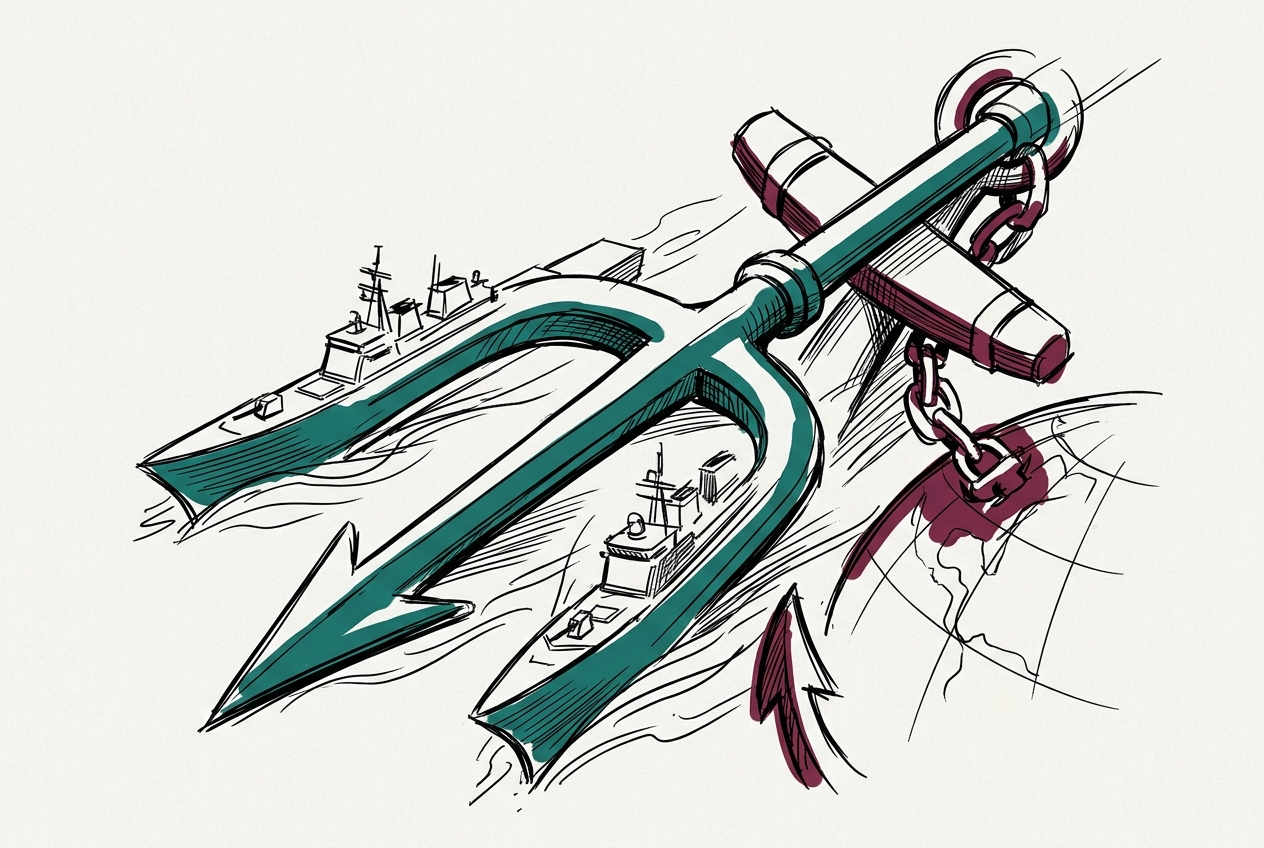
US Navy
World's largest navy by tonnage; Hormuz conflict, Baltic seabed surveillance, and AUKUS autonomous fleet expansion.
On 28 August, the US Navy said it had cleared two Hormuz shipping lanes of Iranian mines, but Iran disputed the claim days later.
Last refreshed: 22 September 2026 · Appears in 4 active topics
Has the US Navy's Hormuz operation actually changed Iran's strategic calculus?
Timeline for US Navy
Mentioned in: Kraken trials a Saab radar picket boat
Autonomous Systems: Land & SeaAnnounced production awards for 30 MUSVs
Autonomous Systems: Land & Sea: US Navy buys 30 robot boats from 3 yardsOperated the vehicle Iran said it had seized
Autonomous Systems: Land & Sea: Iran claims to hold a US Kingfish robotInterdicted the three sanctioned tankers earlier in the war
Iran Conflict 2026: Three seized tankers near American portsMentioned in: Birdon builds an MUSV, buyer undisclosed
Autonomous Systems: Land & SeaBackground
The US Navy is the maritime warfare branch of the United States Armed Forces and the world's largest navy by displacement tonnage. It operates a global fleet that combines carrier aviation, submarines, surface combatants, logistics and increasingly uncrewed systems. Its Middle East presence centres on the Fifth Fleet in Manama, Bahrain.
Mine clearance, escort work and maritime interdiction place the Navy at the operational centre of any attempt to keep shipping moving through the strait of Hormuz. In June, Navy destroyers entered the strait for mine-clearance work while CENTCOM and the Islamic Revolutionary Guard Corps gave conflicting public accounts of access and risk.
The US Navy also develops autonomous maritime systems with allies and commercial suppliers. Its BALTOPS use of Iver3 showed how uncrewed undersea systems can join routine allied maritime operations.
The Navy keeps Hormuz lanes contested
On 28 August, Admiral Brad Cooper credited US Navy dive and special operations Teams with clearing Iranian mines from two Hormuz routes, with aircraft from four services supporting the operation. The Navy published neither a mine count nor a route chart, leaving commercial operators without an Independent clearance record.
On 2 September, Iran said fresh mines had been laid in the same corridor overnight, directly challenging the Navy's account. On 3 September, tanker operators were still using a longer southern route near Oman's coast under US guidance. For the Navy, clearance remains an operational task that must be maintained and demonstrated, not a one-time declaration.
The Navy broadens undersea autonomy
From 8 to 10 June, the Navy operated an Iver3 autonomous underwater vehicle off Latvia during BALTOPS, the first time an uncrewed underwater system took a core role in the exercise's 55-year history. The deployment put seabed surveillance and mine-related practice inside a multinational allied exercise.
On 15 July, the Defence Innovation Unit selected Norway's Kongsberg Discovery and Oceaneering International to develop concepts for a large uncrewed submarine intended for Navy use, with plans due in the third quarter of 2026. The choice gives the Navy a foreign supplier alongside an American partner as it develops larger autonomous undersea systems.
The Navy keeps Hormuz lanes contested
US Navy mine clearance Strait of Hormuz 2026?
Reference
How does the US Navy plan to defend against drone swarms?
What is AUKUS Pillar II and how does it involve the US Navy?
How many carrier strike groups does the US Navy have?
Can the US Navy keep operating after the WPR deadline?
US Navy Iranian port blockade enforcement?
How large is the US Navy compared to other navies?
Why is the US Navy operating underwater drones in the Baltic?
What did the US Navy do in the Strait of Hormuz in 2026?
IRIS Dena sinking US submarine 2026?
US Navy convoy escort Hormuz capacity shortage?


