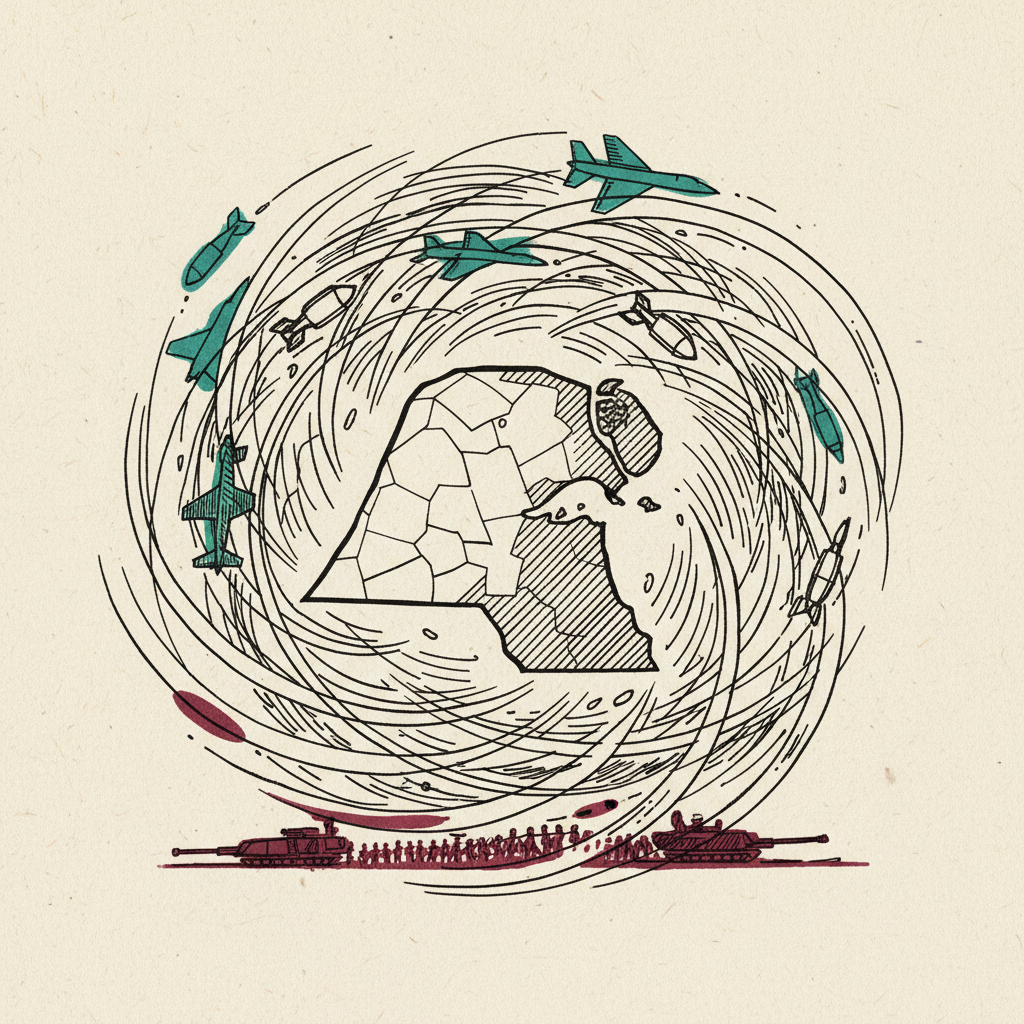
Gulf War
1990-91 US-led coalition war that expelled Iraq from Kuwait; the template for modern precision air campaigns.
The 1990-91 Gulf War remains the reference case for US-led air campaigns in The Gulf, shaping comparisons with the Iran conflict in 2026.
Last refreshed: 22 September 2026 · Appears in 1 active topic
Why does the Gulf War remain the template that every US air campaign is measured against?
Timeline for Gulf War
Mentioned in: Struck states answer in their own words
Iran Conflict 2026Mentioned in: Navy says it cleared two Hormuz lanes
Iran Conflict 2026Mentioned in: US and Kuwait meet, agenda unpublished
Iran Conflict 2026Mentioned in: Iran bills the world for Hormuz oil
Iran Conflict 2026Mentioned in: Trump calls off the Sunday strike
Iran Conflict 2026Background
The Gulf War was the 1990-91 US-led coalition campaign that expelled Iraqi forces from Kuwait after Iraq's invasion. Its combination of a sustained air campaign and a short ground offensive made it a lasting reference point for military planners, governments and markets assessing later Gulf conflicts.
The conflict also demonstrated the political value of a broad Coalition, Gulf basing and clearly stated war aims. Iraq fired Scud missiles during the campaign, while Coalition air power sought to reduce Iraq's ability to continue attacks. Later coverage has used that pattern cautiously when assessing reduced Iranian missile salvoes in 2026.
Its significance lies in the benchmark it created, not in a direct match with every later war. In April 2026, a large fall in Brent Crude was explicitly compared with the 1991 Gulf War. The comparison shows how the conflict remains part of the shared frame for judging military escalation and energy shocks.
Reference
Did the 1991 strikes destroy Iraq's nuclear programme?
Who led the 1991 Gulf War coalition?
What did the 1991 Gulf War do to oil prices?
Was the Gulf War the last time the UN Security Council approved a war?
Why did the coalition not remove Saddam Hussein in 1991?
What started the Gulf War in 1990?
How is the 2025 Iran strike campaign like the 1991 Gulf War?


Written with AI from Lowdown's published reporting. Not individually reviewed by an editor. Updated 22 September 2026. Editorial standards.