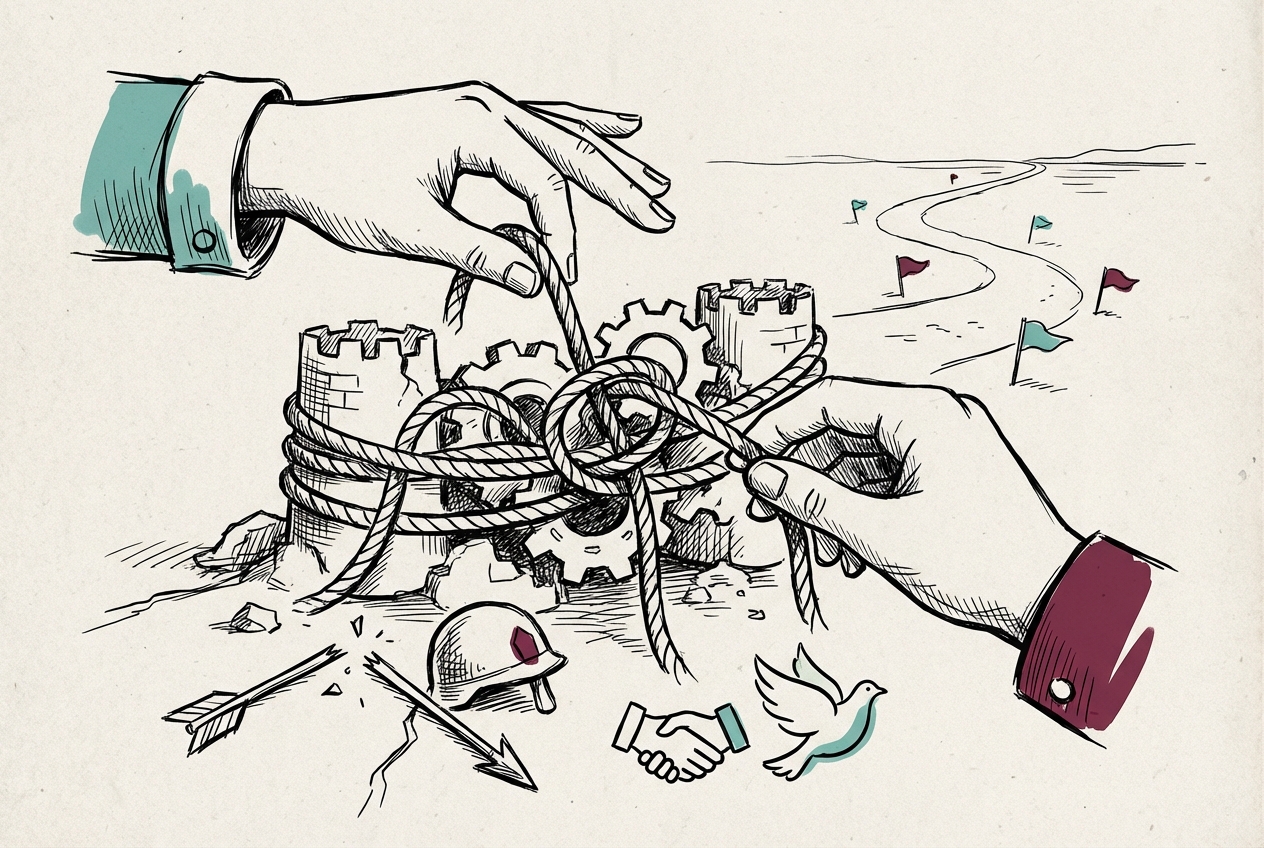
De-Escalation
Reduction in conflict intensity; in energy markets, the unwinding of an embedded risk premium.
de-escalation keeps arriving as a price move that fails to hold: on 31 July Brent gave back the gain it had priced on tanker-blockade fears, echoing round-trips recorded since April.
Last refreshed: 3 August 2026
Can Iran's divided leadership agree to de-escalation before the war becomes uncontainable?
Timeline for de-escalation
Brent gives back its escalation gain
Iran Conflict 2026Urals into India narrows to $1-2
European Oil MarketsSaudi Red Sea bypass fell 41% before blockade
European Oil MarketsFirst net long of the rally on 06765T
European Oil MarketsTTF round-trips back above €50
European Energy MarketsBackground
As a concept, de-escalation names two separate processes that only sometimes move together: diplomatic signalling between governments, and the unwinding of a risk premium embedded in energy prices. In the 2026 Iran conflict the two have rarely synchronised. Diplomats opened channel after channel from April Onward without producing a signed Iran-specific instrument, while oil and gas prices reacted to every rumour of a stand-down regardless of whether one existed.
Foreign Minister Araghchi's shuttle diplomacy through Islamabad, Muscat and Doha runs on a different clock to the IRGC, which has repeatedly acted first and left the diplomats to catch up. Qatar's expulsion of Iranian attachés in March, after a missile strike on Ras Laffan, removed The Gulf's last neutral security channel with Tehran even as economic mediation continued elsewhere.
For energy markets the concept has settled into a tradeable pattern rather than a one-off event: a de-escalation signal, verbal or physical, produces an immediate price move that then unwinds as flow data fails to confirm it. Brent's fall on the first Ceasefire bet in June showed the mechanism at its clearest, moving on probability rather than any change in Iran's compressed exports. The single durable fact underneath all of it: well into the war, zero Iran-specific instruments had been signed.
Price gains keep reversing fast
de-escalation enters energy markets as a price, not just a headline. On 31 July, Brent gave back the gain it had priced in on tanker-blockade fears, repeating a pattern rather than breaking it.
The same round-trip shows in gas. TTF settled near €50 on 9 July, dipped to €48.80, then climbed back to €50.50 by 13 July, tracking Gulf shipping-risk headlines rather than any change in Europe's own supply. For de-escalation, the lesson holds across both markets: prices absorb the signal within days and give it back just as fast, well before any signed instrument arrives to confirm it.
Signals move faster than signatures
CENTCOM ended enforcement of its Iran blockade one day early on 18 June, after 66 days, with two carrier strike groups still on station and no drawdown order. It cost Washington nothing: mines and insurers already held Hormuz shut, so the early end read as compliance while every lever of pressure stayed in place.
Three weeks earlier, Iran had fired a Ballistic missile at Kuwait, the first Gulf Arab state struck in the war, while its diplomats continued shuttle talks elsewhere. The two tracks do not reconcile: signalling moves on a fast, cheap clock; each side's actual instruments, military or diplomatic, move much slower or not at all.
Did the US and Iran fully halt hostilities in July 2026?
What happened at the Iran peace talks in Doha on 30 June 2026?
Has Iran signed a formal ceasefire with the United States in 2026?
Was there a ceasefire in the 2026 Iran conflict?
Are there peace talks happening with Iran?
What does the IRGC 'end of self-restraint' declaration mean?
Why did Pezeshkian reverse his de-escalation message?
Which countries are trying to broker a ceasefire in the Iran war?
What is de-escalation in the Iran conflict?
Has Iran agreed to a ceasefire in 2026?
Is Trump willing to negotiate with Iran?


