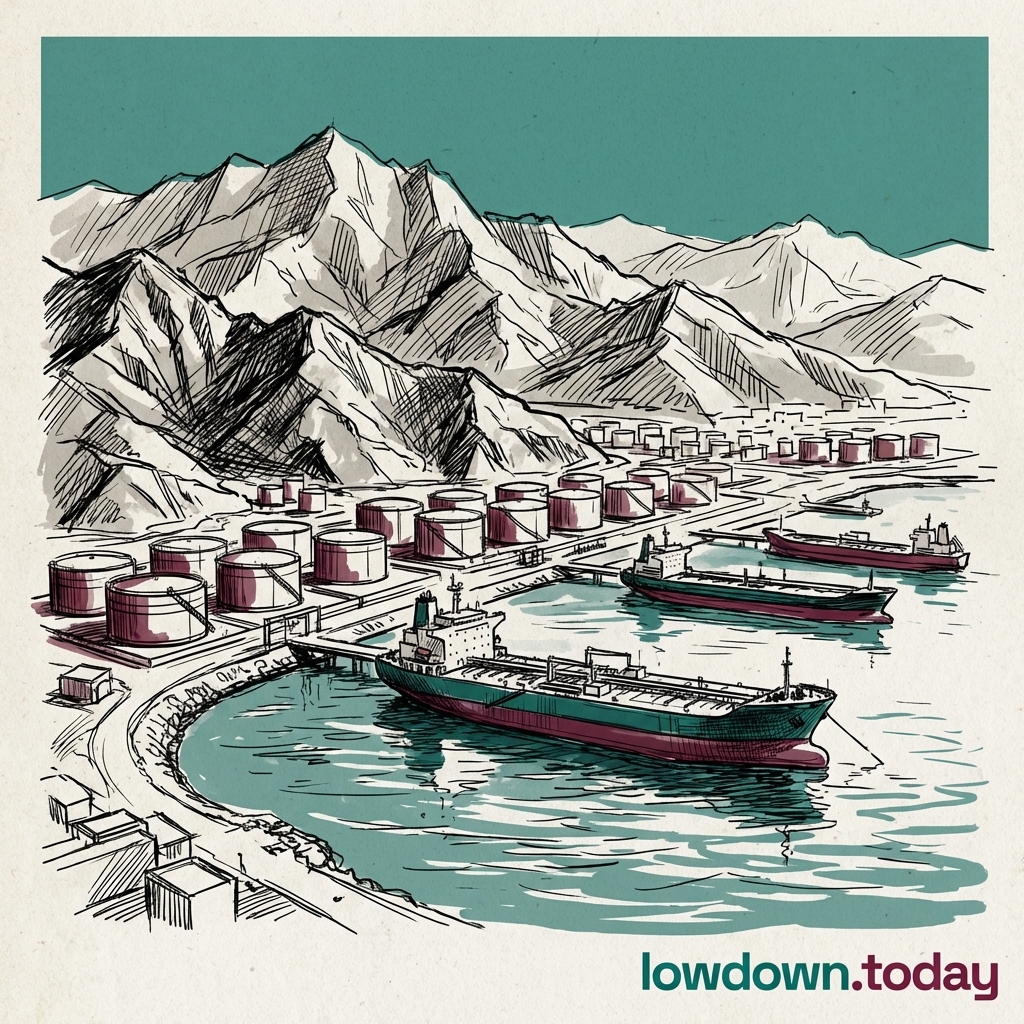
Fujairah
UAE's Hormuz-bypass hub; ADNOC targeting 4 million bpd capacity by 2027, up from 1.62 million today.
Fujairah, the UAE's Hormuz-bypass bunkering hub, saw light distillate stocks collapse 37% to a record low of 1.121 million barrels in The Week to 20 July, S&P Global Platts reported, leaving Mediterranean refiners with less spare fuel to draw on.
Last refreshed: 20 August 2026 · Appears in 2 active topics
If ADNOC doubles Fujairah throughput by 2027, does the Strait of Hormuz lose its leverage as a chokepoint?
Timeline for Fujairah
Mentioned in: Qatar brings the US answer to Araghchi
Iran Conflict 2026Drew down product stocks by 2.08 million barrels in the week to 28 September
Iran Conflict 2026: Supertanker hire passes $1.2m a dayMentioned in: Navy says it cleared two Hormuz lanes
Iran Conflict 2026DP World builds around the strait
Iran Conflict 2026Mentioned in: UAE says an Iranian missile hit its vessel
Iran Conflict 2026Background
Fujairah is the only emirate on The Gulf of Oman coast, east of the Hajar Mountains and outside the strait of Hormuz. That geography makes it the Arab world's second-largest oil bunkering hub, holding roughly 14% of global bunkering capacity: tankers transiting to or from The Persian Gulf refuel there without entering the strait.
The emirate hosts a pipeline terminal Fed by the Abu Dhabi Crude Oil Pipeline (ADCOP), giving Abu Dhabi a Hormuz-Independent export route for crude, and its Khor Fakkan container terminal handles Gulf of Oman traffic that never needs to transit Hormuz at all. The ADCOP bypass pipeline had reached 71% utilisation, with roughly 440,000 barrels a day of spare capacity routing crude overland to the Indian Ocean coast. ADNOC treats Fujairah as the structural hedge against Hormuz Chokepoint risk, backing the pipeline with a 42-million-barrel underground storage cavern designed to buffer the hub against terminal disruption.
That dual role, bunkering hub and bypass artery, is why Fujairah's own storage and export data function as a standing signal of Gulf supply conditions Independent of whatever the strait of Hormuz itself is doing. The event record includes and.
It absorbed the war's opening barrage
Fujairah's oil bunkering terminal caught fire twice in March 2026 after sustained IRGC drone and missile strikes, with loading suspended after the second hit on 16 March, three days after the first. The UAE tallied 1,900 intercepts over seventeen days of concentrated attack, including 298 ballistic missiles and 1,606 drones, by 15 March.
Interception debris, not a direct hit, killed a Bangladeshi farm worker in Fujairah's al-Rifaa area on 1 April, one of the conflict's earliest foreign-national civilian deaths. Targeting the very bypass route that reduces Iran's own use over Hormuz exposed a strategic contradiction that shaped the hub's later build-out.
Its own product stocks keep hitting lows
Light distillate stocks at Fujairah collapsed 37% to a record low of 1.121 million barrels in The Week to 20 July, S&P Global Platts reported, with total product stocks down 16% to an eight-week low of 8.492 million barrels.
The drawdown leaves the region's main bunkering and re-export hub with less spare product just as Suez and Bab el-Mandeb disruption makes it harder for Mediterranean refiners to backfill their own shortfalls from Fujairah's stores, a role the hub has swung in and out of all year as its fuel-oil and distillate balances lurch between build and drain.
What is the Fujairah oil terminal and why does it matter for the Iran war?
Why was Fujairah targeted during the Iran conflict?
Where is Fujairah and what is its strategic importance?
How much oil goes through Fujairah compared with the Strait of Hormuz?
Is ADNOC building new oil infrastructure to bypass Hormuz?
What is the Fujairah oil terminal?
