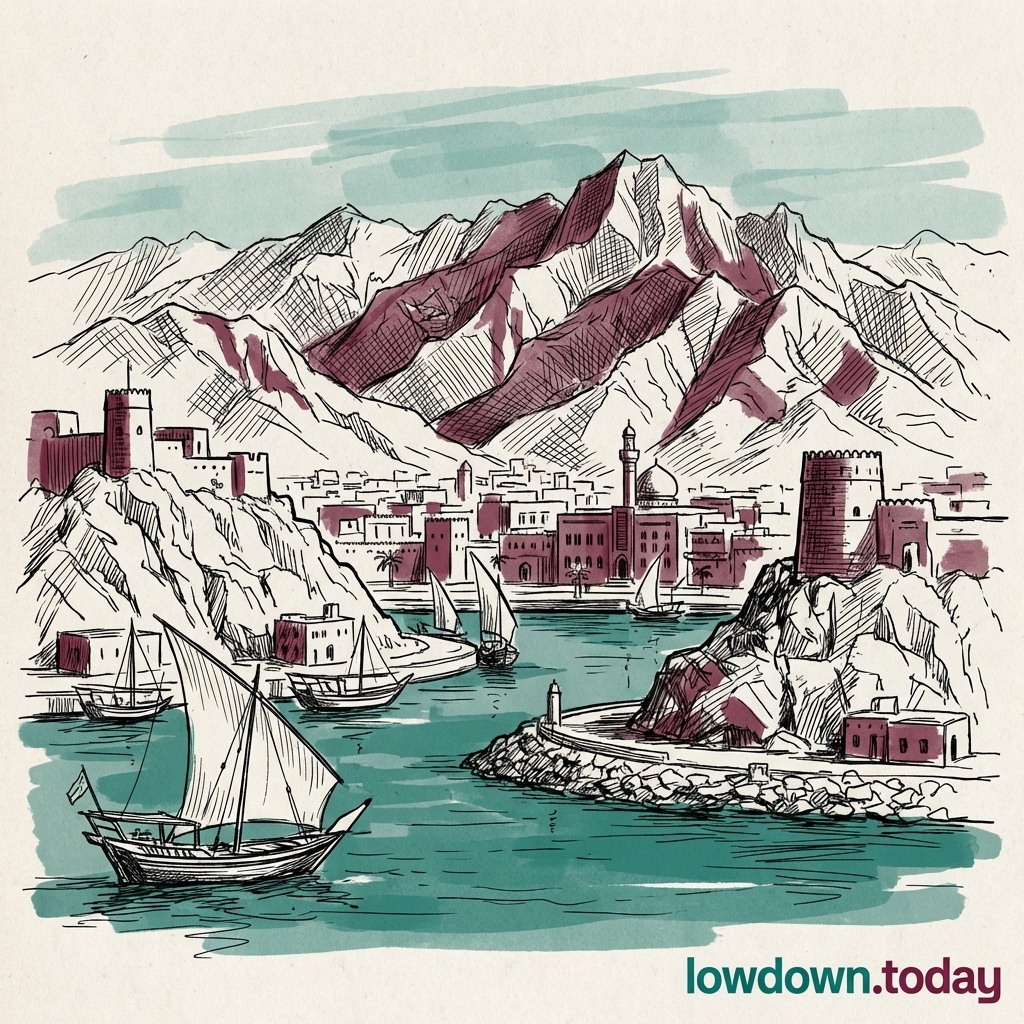
Oman
Neutral Gulf sultanate; longtime Iran-US backchannel whose Hormuz transit corridor Iran struck on 7 July.
Oman is hosting the only live Iran-US channel over the Strait of Hormuz, with talks in Muscat on 18 July and a four-nation truce proposal it co-signed with Qatar, Egypt and Pakistan on 22 July.
Last refreshed: 24 July 2026 · Appears in 4 active topics
Did the US blockade override the Iran-Oman shipping deal Muscat had just brokered?
Timeline for Oman
Mentioned in: 6,000 crew stranded in Hormuz, UN says
Iran Conflict 2026Mentioned in: Baghdad and Tehran deny ceasefire trip
Iran Conflict 2026Mentioned in: Iran files its own ten-day truce
Iran Conflict 2026Co-submitted the ten-day ceasefire proposal
Iran Conflict 2026: Four mediators table a ten-day truceNamed victim state in the resolution
Iran Conflict 2026: Mentioned in: Qatar files a UN claim against IranBackground
Oman occupies the south-eastern tip of the Arabian Peninsula, its northern coast forming the southern shore of the strait carrying roughly a fifth of the world's daily oil trade. Under Sultan Qaboos (1970-2020) and his successor Haitham bin Tariq, Oman built its Foreign Policy around studied neutrality: maintaining diplomatic relations with Iran through every round of US sanctions, hosting the secret pre-negotiations that produced the 2015 JCPOA framework, and serving as the primary US-Iran backchannel since at least 1981. Its Ibadi Islamic identity gives it theological distance from both the Sunni-Shia divide and the Iran-Saudi rivalry, making it trusted by Tehran and tolerated by Washington simultaneously; no other Gulf state occupies both positions at once.
Oman's claim to authority over Hormuz rests on geography rather than politics: its coastline runs the length of the strait's southern half, roughly 33 kilometres of channel, placing any transit-management scheme Muscat proposes inside sovereign waters neither Tehran nor Washington can simply override by force. Tehran and Muscat confirmed active talks on 18 May 2026 to build a joint Hormuz transit system, a mechanism the US-led Coalition cannot dismiss as a unilateral Iranian claim precisely because Oman's own waters give it a legal basis Iran's permit body lacks. Foreign Minister Badr Albusaidi is the channel's operational face; Sultan Haitham is the strategic principal who determines how FAR Muscat bends.
Oman hosts the war's last live channel
Muscat keeps carrying the negotiation the wider war has stalled elsewhere. Iran's foreign minister, Abbas Araghchi, led a delegation to Oman-hosted talks on 18 July, with the agenda narrowed to reopening the Strait of Hormuz rather than the wider conflict.
Oman then widened its own role. On 22 July it joined Qatar, Egypt and Pakistan in submitting a joint ten-day Ceasefire proposal to Washington and Tehran that would reopen Hormuz navigation while wider talks continue, even as Iran filed a separate, competing truce text of its own the same day.
Hormuz traffic empties off Oman's coast
The strait Oman's own coastline defines has gone quiet on its doorstep. Weekly crossings fell 66% to 53 in the week to 20 July, down from 157 the week before, with tanker and gas-carrier transits alone dropping from 90 to 30, according to Lloyd's List Intelligence.
The collapse has reached Oman's own waters directly. UK Maritime Trade Operations reported a vessel burning off the Omani coast overnight on 20 July, with no vessel name or cause confirmed, one more unresolved incident in the corridor Muscat's own legal claim rests on.
Did Iran and Oman agree to jointly manage Hormuz shipping in July 2026?
Why did Iran say it attacked a ship near Oman on 7 July?
Why did the US threaten Oman with sanctions over the Strait of Hormuz?
Is Oman still mediating between Iran and the US?
Did Iran attack Oman during the 2026 conflict?
Why has Oman been the mediator between Iran and the West for so long?




