Royal Navy
UK naval service; HMS Dragon deployed to Hormuz; leading the 26-nation coalition from PJHQ Northwood.
Last refreshed: 18 May 2026 · Appears in 2 active topics
HMS Dragon sailed without rules of engagement published — what authorises a NATO warship in a non-NATO operation?
Timeline for Royal Navy
Mentioned in: AUKUS names two American sea robots
Autonomous Systems: Land & SeaDeployed crewless minehunter toward Strait of Hormuz under new autonomy doctrine
Autonomous Systems: Land & Sea: Robot minehunter now sails for HormuzMentioned in: Brent breaks $100 as insurers hold
Iran Conflict 2026Mentioned in: UK sends GBP 115M to Hormuz drones
Drones: Industry & DefenceMentioned in: US prime digs into UK seabed war
Autonomous Systems: Land & Sea- What is the Royal Navy doing in the Strait of Hormuz?
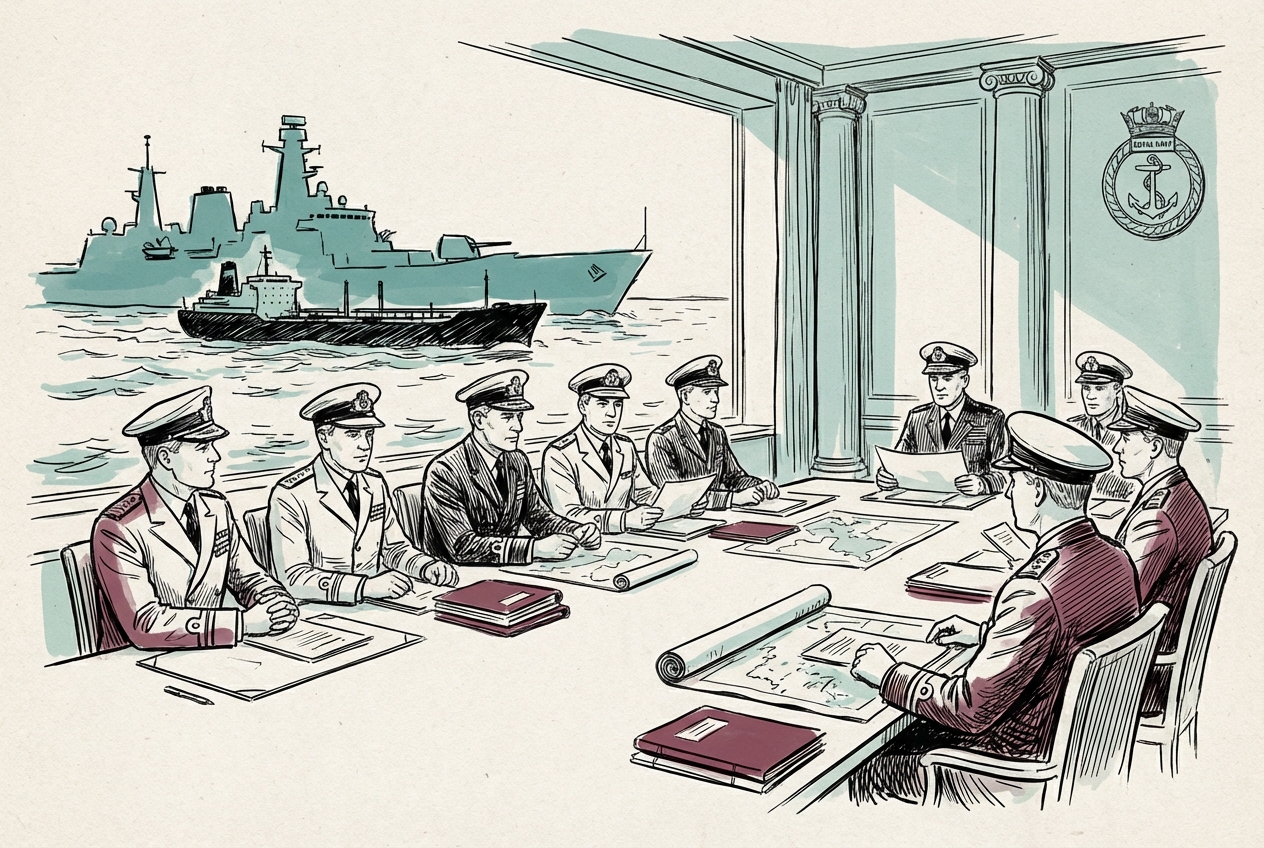
- The Royal Navy is hosting and operationally leading a 51-nation Maritime Freedom of Navigation Initiative from Northwood, the UK Permanent Joint Headquarters. Rules of engagement were drafted there on 20 April 2026 and the mission was reclassified from planning to established the next day, with a mandate covering vessel protection, operator reassurance and mine clearance.Source: GOV.UK joint statement; Lowdown
- Why is the US not part of the Hormuz coalition?
- Washington declined a seat at the Northwood rules-of-engagement table. Macron and Starmer co-lead a 51-nation mission writing the live legal framework for the strait under which US and European vessels must operate, whether or not the Pentagon publishes its own text.Source: Lowdown
- What is the Royal Navy doing about Russia's shadow fleet?
- Since 26 March 2026 the Royal Navy has held a mandate from the JEF Helsinki summit to board and interdict sanctioned shadow fleet vessels in British territorial waters, effectively closing the English Channel to more than 600 sanctioned Russian-linked tankers.Source: JEF Helsinki summit; Lowdown
- How many ships does the Royal Navy have?
- Approximately 33,000 personnel and a surface fleet built around two Queen Elizabeth-class aircraft carriers, six destroyers and seven frigates. Hunt-class minehunters and dedicated mine clearance divers are now deployed under the Hormuz mine-clearance mandate.Source: Royal Navy / Lowdown
- Can the Royal Navy close the English Channel to shadow tankers?
- The Channel is only 34 km wide at Dover, making boarding operationally straightforward inside British territorial waters. Much Channel traffic passes through international waters, so circumnavigation adds 2,000+ nautical miles per voyage and erodes the margin between sanctioned and market-price oil.Source: Lowdown
- Where is HMS Dragon deployed in May 2026?
- HMS Dragon, a Type 45 destroyer, was redeployed from the Eastern Mediterranean to the Middle East on 9 May 2026 for a potential Hormuz mission under the UK-France Coalition. The MoD confirmed the deployment as 'prudent planning' but published no rules of engagement.Source: UK MoD / The National
- What is the Royal Navy's role in the Hormuz blockade?

- The Royal Navy is leading the European-flagged 51-nation Coalition's Hormuz planning from Northwood. The mandate covers protecting merchant vessels, mine clearance, and armed convoy escorts — contingent on a sustainable Ceasefire.Source: Lowdown
- How many ships does the Royal Navy have in 2026?
- The Royal Navy operates two Queen Elizabeth-class carriers, six Type 45 destroyers, and eight frigates, with approximately 33,000 personnel. Whether that fleet can sustain simultaneous Channel, Atlantic, and Hormuz deployments is the central operational question.
- Why is the Royal Navy closing the English Channel to Russian tankers?
- Following the JEF Helsinki summit on 26 March 2026, the Royal Navy received authority to board and interdict over 600 sanctioned Russian shadow-fleet vessels in UK waters, targeting oil revenue that funds the Ukraine war.Source: Lowdown
- What is HMS Dragon doing in the Strait of Hormuz?
- HMS Dragon, a Royal Navy Type 45 air-defence destroyer, was redeployed from the Eastern Mediterranean to the Middle East on 9 May 2026 as part of the UK-led 26-nation Hormuz Coalition. The MoD confirmed the deployment but published no rules of engagement.Source: UK Ministry of Defence / The National
- Is the Royal Navy leading the Hormuz coalition?
- Yes. The Royal Navy leads the 26-nation Multinational Military Mission that convenes at PJHQ Northwood. Defence Secretary Healey co-chaired the 12 May planning meeting with French counterpart Vautrin. The US was explicitly not in the planning room.Source: Lowdown iran-conflict-2026
- What is the Royal Navy's role in Hormuz and what rules of engagement apply?
- HMS Dragon has been redeployed to the Middle East and the Royal Navy leads the 26-nation Coalition. No unified rules of engagement have been published; the deployment trigger is 'as soon as conditions permit, following a sustainable Ceasefire.'Source: UK Ministry of Defence
- What is Operation KIPION?
- Operation KIPION is the Royal Navy's permanent Gulf mission, based at HMS Jufair in Bahrain since 1980. It provides a standing maritime presence in the Persian Gulf and Gulf of Oman, and is the institutional basis for the Royal Navy's rapid Hormuz deployment.
Background
The Royal Navy is the principal maritime warfare service of the United Kingdom's Armed Forces, with approximately 33,000 personnel and a surface fleet built around two Queen Elizabeth-class aircraft carriers (HMS Queen Elizabeth and HMS Prince of Wales), six Type 45 air-defence destroyers, and eight Type 23/26 frigates. It maintains a standing Gulf presence under Operation KIPION, anchored at Bahrain's HMS Jufair base since 1980, and contributes to NATO standing maritime forces and carrier strike groups. The fleet has deep institutional experience in maritime interdiction from counter-narcotics operations in the Caribbean and counter-piracy in the Gulf of Aden.
The Royal Navy is now operationally central to the European response to Iran's Hormuz blockade. HMS Dragon, a Type 45 air-defence destroyer with Sea Viper missile systems, was redeployed from the Eastern Mediterranean to the Middle East on 9 May 2026 after previously conducting Wildcat helicopter counter-drone operations there since late March. The Ministry of Defence confirmed the deployment as 'prudent planning' but published no vessel name, sail date, rules of engagement, or tasking order at the time; The National in Abu Dhabi broke the story. The MoD named HMS Dragon, Typhoon fighters, autonomous mine-clearance vessels and reconnaissance drones for the 40-nation Hormuz mission on 13 May after Defence Secretary Healey and French counterpart Vautrin co-chaired the Coalition planning meeting on 12 May.
The Royal Navy's institutional leadership of the Hormuz Coalition convenes at PJHQ Northwood (UK Permanent Joint Headquarters), where over 30 nations' military planners gathered on 22-23 April to translate the Paris posture into an operational plan covering warships, armed convoy escorts, mine-hunting drones, radar coverage, and intelligence-sharing. The Coalition now numbers 26 formal signatories (12 May joint statement). France pledged 80% frigate readiness as the first quantitative tempo commitment by any member. Italy forward-deployed two MCM vessels on 17 May — the first physical hardware from a continental European nation. The deployment trigger remains 'as soon as conditions permit, following a sustainable Ceasefire'; no unified rules of engagement have been published.
The Northwood framework is the first operational case of a UK-led Coalition filling a planning vacuum Left by a deliberate US non-participation decision. The United States was explicitly not in the Northwood planning room and was to be 'briefed on the outcome' — a structural inversion of the normal US-European command relationship. The Royal Navy's ability to sustain this Coalition leadership role under the Macron-Starmer Maritime Freedom of Navigation Initiative is the defining European military-autonomy test of 2026.
