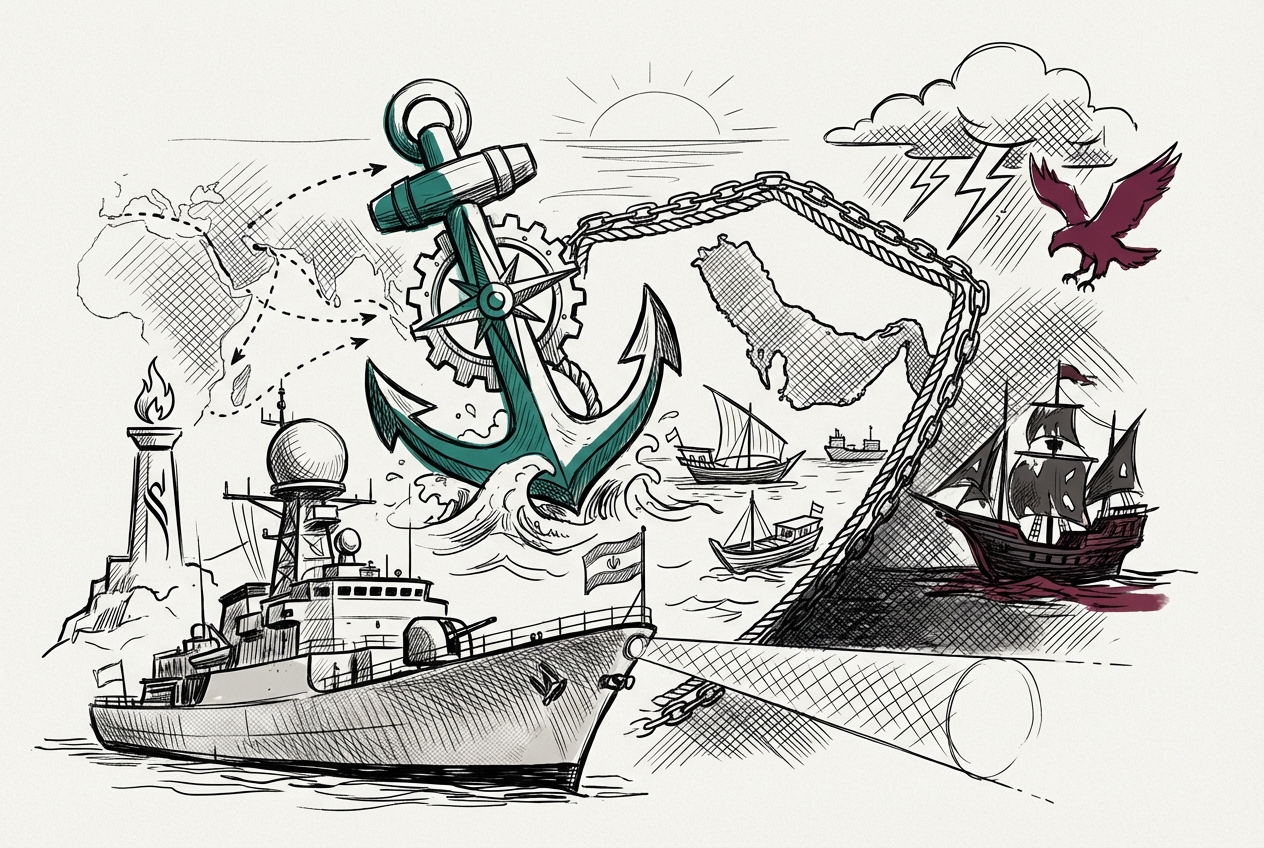
The IRIN lost its first frigate in 38 years: what is left of Iran's blue-water capability?
Timeline for Iranian Navy
Mentioned in: 140 US sorties, zero signed paper
Iran Conflict 2026Mentioned in: Majlis reviews €50m Trump bounty bill
Iran Conflict 2026Mentioned in: Iran: 22 political executions in six weeks
Iran Conflict 2026Mentioned in: White House asserts US not at war with Iran
Iran Conflict 2026Mentioned in: Khamenei claims 'new management' of Hormuz
Iran Conflict 2026Background
The Iranian Navy (IRIN) is Iran's conventional naval force, subordinate to the joint armed forces and distinct from the IRGC Navy. It operates surface combatants, submarines, and support vessels, with its modern fleet built around domestically produced Moudge-class frigates. Founded in 1923 as the Imperial Iranian Navy, it was reconstituted after the 1979 Revolution. The IRIN operates blue-water missions beyond The Persian Gulf, unlike the IRGC Navy which specialises in asymmetric Gulf and Hormuz operations.
The IRIN lost its first surface combatant in combat since Operation Praying Mantis in April 1988 when the frigate IRIS Dena sank 40 nautical miles south of Galle, Sri Lanka. Sri Lanka recovered 32 critically wounded sailors; the fate of approximately 148 remaining CREW was unknown. CENTCOM confirmed the sinking; Sri Lankan defence officials assessed the attack as consistent with a submarine strike, with no formal attribution from either the US or Iran.
The IRIN is structurally distinct from the IRGC Navy, which controls the asymmetric fast-boat and drone-boat force in The Persian Gulf and Strait of Hormuz. The two naval arms report to separate command structures. By Day 60 (28 April 2026), the IRGC Navy had continued Hormuz operations independently, while the IRIN's loss of IRIS Dena deep in the Indian Ocean has left questions about its capacity to project blue-water force without escort cover. The sinking remains unattributed, leaving the escalation calculus deliberately ambiguous — both Iran and the US have incentives to avoid formal acknowledgement.
What is the Iranian Navy (IRIN)?
What happened to IRIS Dena?
What is the difference between the Iranian Navy and the IRGC Navy?
When was the last Iranian warship sunk before 2026?
Who sank IRIS Dena?
What happened to the IRIS Dena?


