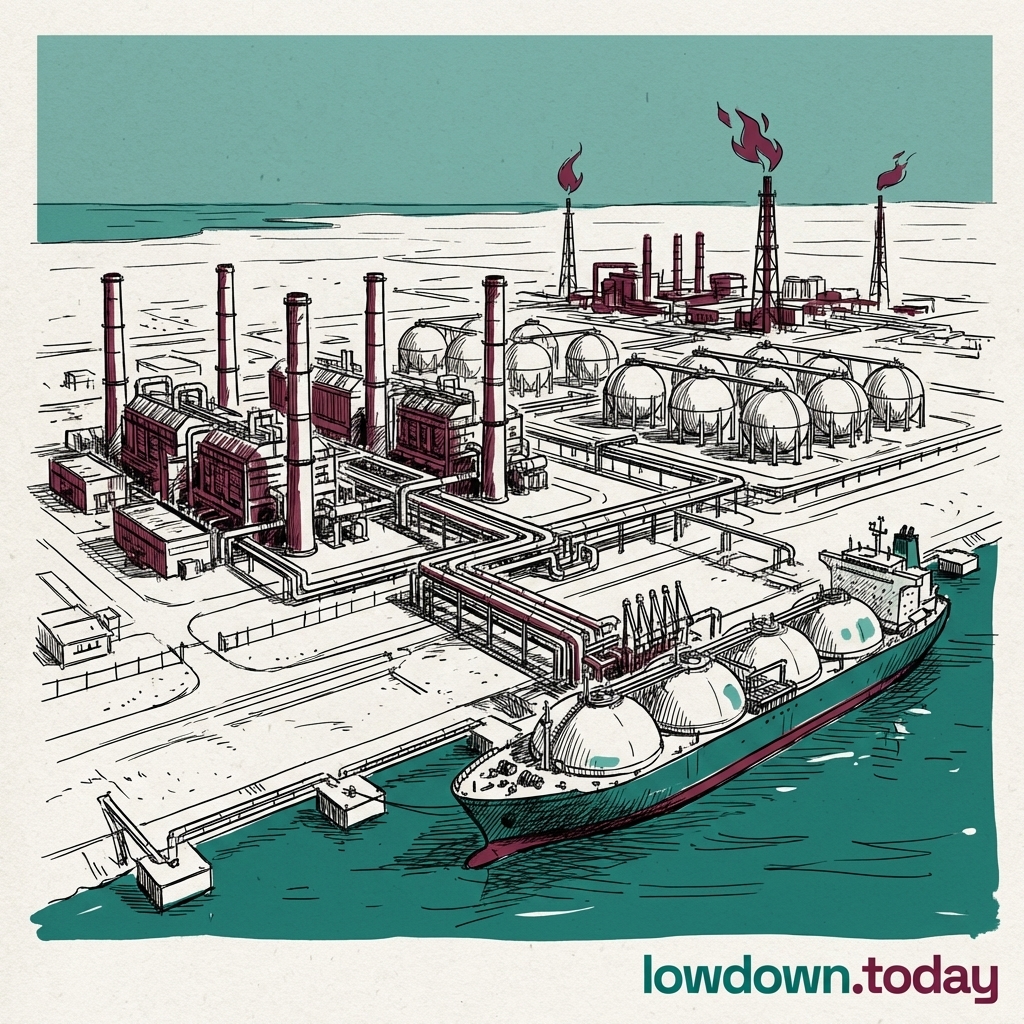
Ras Laffan Industrial City
Qatar's LNG export hub; 14 trains, ~17% global LNG capacity; struck by Iran March 2026, Force majeure declared.
As of 20 August 2026, Ras Laffan Industrial City remains Qatar's LNG export hub; 14 trains, ~17% global LNG capacity; struck by Iran march 2026, Force majeure declared.
Last refreshed: 20 August 2026 · Appears in 2 active topics
With two trains gone, can Ras Laffan ever supply Europe at pre-war levels?
Timeline for Ras Laffan Industrial City
Loaded the cargoes that crossed Hormuz while running below capacity
Iran Conflict 2026: QatarEnergy suspends gas as ships moveMentioned in: DP World builds around the strait
Iran Conflict 2026Mentioned in: Seven filings put a price on Hormuz
Iran Conflict 2026Mentioned in: IRGC claims Hormuz closed; CENTCOM denies it
European Energy MarketsMentioned in: TTF back over €50 on withdrawn cargo
European Energy MarketsBackground
Ras Laffan was built from 1996 on Qatar's northeastern coast to exploit the North Field, the world's largest single gas reservoir, shared with Iran's South Pars. The complex has become the operational centre of Qatar's LNG export economy: 14 liquefaction trains with roughly 77 million tonnes of annual capacity, about 17% of world LNG export capacity, run by state operator QatarEnergy. Long-term contracts tie the facility to buyers in Japan, South Korea, China, India and Europe, and QatarEnergy had committed to expanding capacity to 126 million tonnes a year before the 2026 conflict.
Iranian strikes in March 2026 destroyed two of the fourteen trains, a structural loss now expected to cap Ras Laffan's output at around 80% of nameplate for three to five years regardless of when the wider Strait of Hormuz dispute is resolved. No Qatari LNG transited the strait between 28 February and early April 2026, and QatarEnergy declared Force majeure on contracts including Belgium, Italy and Poland.
Reference
What is the North Field?
What is Ras Laffan Industrial City?
Can Ras Laffan reach pre-war LNG output after Hormuz reopens?
Is Ras Laffan still shut down?
How many LNG trains at Ras Laffan were destroyed by Iran?
Was Ras Laffan attacked by Iran?
When did Iran strike Ras Laffan and what was damaged?
What share of Europe's gas supply comes from Ras Laffan?
Why did European gas prices spike in March 2026?



