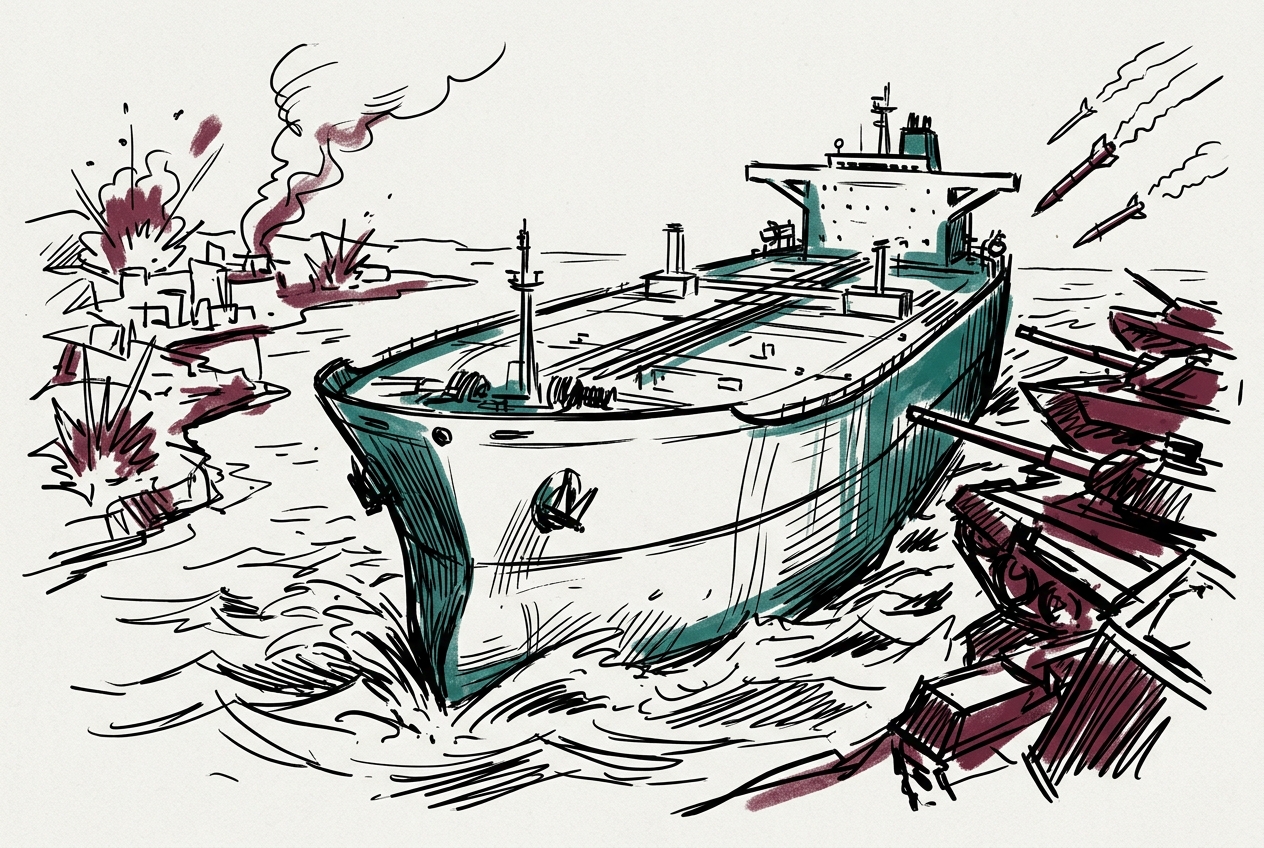
VLCC
200,000-320,000 DWT supertanker carrying 20% of global crude; hit hardest by Hormuz closure and CENTCOM blockade.
Last refreshed: 27 April 2026 · Appears in 1 active topic
Seven supertankers are waiting at Chabahar outside the blockade — what happens when they decide to move?
Timeline for VLCC
Mentioned in: Brent breaks $110, ADNOC bypasses Hormuz
Iran Conflict 2026Mentioned in: Iran runs Hormuz as a favours system
Iran Conflict 2026Mentioned in: Five vessels, no AIS: Hormuz goes dark
Iran Conflict 2026Mentioned in: Delhi stays silent seven days on OFAC designations
Iran Conflict 2026Mentioned in: Seven VLCCs at Chabahar, three at Hormuz
Iran Conflict 2026- What is a VLCC?
- A VLCC (Very Large Crude Carrier) is a supertanker of 200,000 to 320,000 deadweight tonnes used for long-haul crude oil transport. Around 800 VLCCs carry roughly 20% of global crude supply, primarily on routes from the Persian Gulf to Asia and Europe.Source: IMO / industry classification
- How much did VLCC charter rates rise during the Iran war?
- Charter rates quadrupled to ,000 per day by late March 2026, up from roughly ,000 pre-war. War-risk insurance premiums added a further .6 to million per voyage, making each VLCC transit through the Strait of Hormuz extremely costly.Source: Lowdown
- Why are VLCCs routing via Chabahar instead of Hormuz?
- By 20 April 2026, seven VLCCs were detected near Chabahar on Iran's Makran coast, which sits outside US interdiction zones, while only three vessels transited Hormuz that day. Chabahar offers an emerging non-Hormuz outlet for Iranian-linked crude moving toward Asian markets.Source: Windward / Lowdown
- Has any country committed warships to escort VLCCs through Hormuz?
- No. All five countries Trump named for a Hormuz escort Coalition — Australia, Japan, the UK, Germany, and France — formally declined within 72 hours. A subsequent G7-adjacent joint statement expressed readiness to contribute but named no ships, no timeline, and no specific commitments.Source: Lowdown
- What is the difference between a VLCC and a shadow fleet tanker?
- A VLCC is a vessel class defined by size (200,000–320,000 DWT). shadow fleet tankers are vessels operating outside Western insurance and regulatory frameworks to evade sanctions; they can be VLCCs or smaller. Sovcomflot reflagged 56% of its fleet to avoid EU seizure, using VLCC-class ships in both legitimate and shadow trades.Source: Windward / EU
- What is a VLCC and how big is it?
- A Very Large Crude Carrier (VLCC) is a supertanker of 200,000 to 320,000 deadweight tonnes, designed for long-haul crude oil transport. Around 800 VLCCs carry approximately 20% of global crude supply. They cannot transit the Panama Canal and require deep-water ports.Source: shipping industry
- How much does it cost to ship oil through the Strait of Hormuz now?
- Charter rates for VLCCs quadrupled to $800,000 per day in 2026, and war-risk premiums added $3.6 to $6 million per voyage. The IRGC imposed transit tolls of up to $2 million per VLCC on top of these costs.Source: Lloyd's List / shipping brokers
- How are Russian oil tankers connected to the Hormuz crisis?
- Russia's Sovcomflot and affiliated shadow-fleet operators use VLCC-class tankers reflagged to the Russian registry to transport Russian crude to Asian buyers outside Western sanctions. The same AIS-suppression and flag-change tactics Iran uses have been adopted by Russian-linked operators, making VLCC tracking central to both the Iran conflict and Russia-Ukraine sanctions enforcement.Source: Windward / EU Council
Background
A Very Large Crude Carrier is a tanker of 200,000 to 320,000 deadweight tonnes, purpose-built for long-haul crude oil transport. The VLCC class emerged in the late 1960s as oil majors sought economies of scale on routes from the Persian Gulf to refineries in Asia, Europe, and North America. Today, roughly 800 VLCCs carry approximately 20% of global crude supply, making them the arterial vessels of the international oil trade. Their size offers economies of scale but creates two constraints: they cannot transit the Panama Canal and they require deep-water ports, concentrating their routes through a small number of chokepoints.
The Strait of Hormuz closure hit VLCCs harder than any other vessel class. With tanker traffic through Hormuz down 90% from pre-war levels, charter rates quadrupled to $800,000 per day, and war-risk premiums reached $3.6 to $6 million per voyage. More than 3,000 vessels remained stranded across Middle Eastern waterways, with the IMO recording 20,000 seafarers stranded in the Persian Gulf. By 20 April 2026, seven VLCCs had been detected near Chabahar on Iran's Makran coast — entirely outside CENTCOM's port-interdiction geometry — while only three vessels transited Hormuz that day. On 25 April, the LPG tanker SEVAN was seized in the Arabian Sea — the first CENTCOM enforcement action outside the Strait of Hormuz itself, extending the blockade's effective perimeter to open-ocean routing. The pattern suggests operators are now routing as FAR east as the open Arabian Sea to avoid both the IRGC and CENTCOM.
VLCCs are simultaneously indispensable and indefensible: their sheer size prevents rapid rerouting, yet no navy has committed to escort protection at scale. Russian shadow-fleet operators including Sovcomflot vessels reflagged to avoid sanctions have exploited the same transit infrastructure, making the VLCC the fulcrum of both the Hormuz crisis and the sanctions-evasion debate in both the Iran and Russia-Ukraine conflicts.
