Skip to content
Briefings are running a touch slower this week while we rebuild the foundations.See roadmap
Washington
Nation / PlaceUS

Washington

Shorthand for the US executive branch; 59-day zero-instrument record on the Iran war it launched.

Last refreshed: 18 May 2026 · Appears in 5 active topics

Key Question

Fifty-nine days of war with zero signed instruments — is Washington governing through posts alone?

Timeline for Washington

View full timeline →
Common Questions
What does Washington mean in Lowdown's coverage?
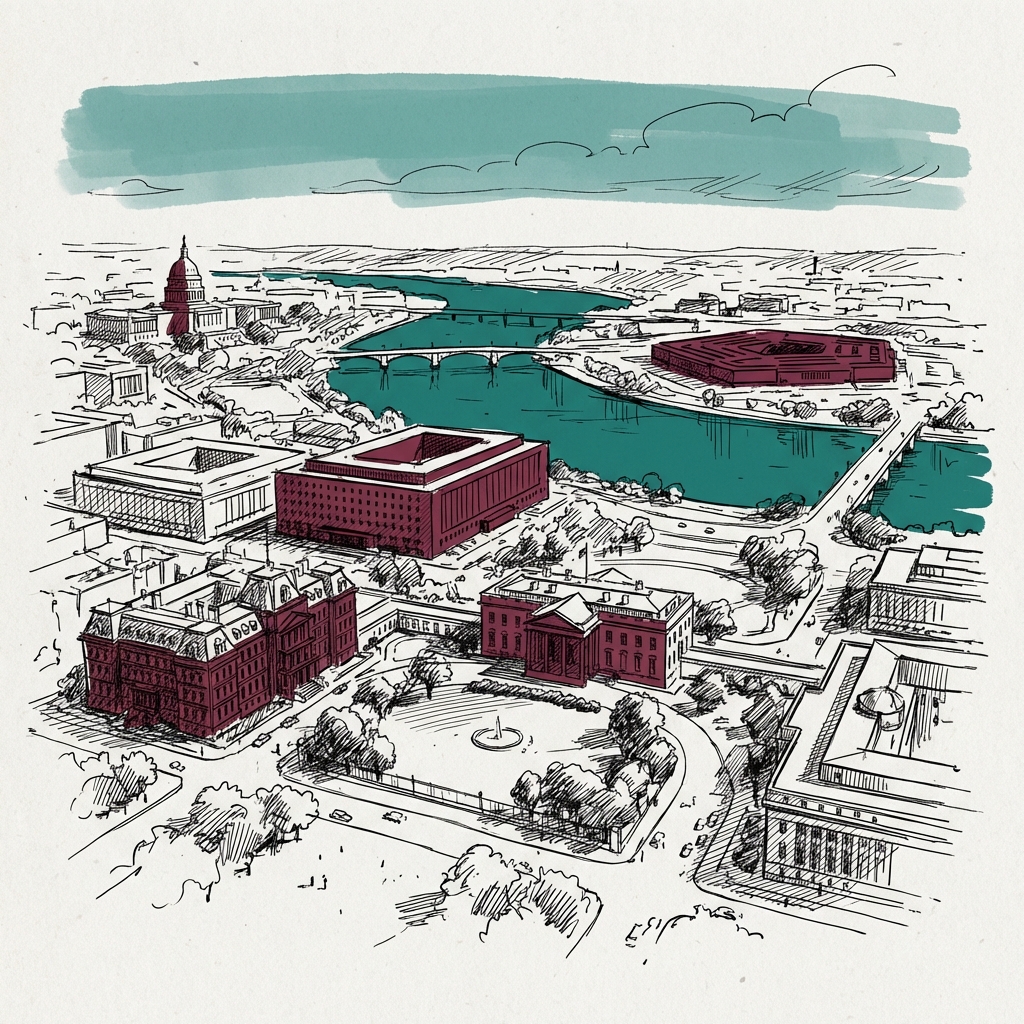
Washington is shorthand for the US executive branch: the Trump White House, the Pentagon, State Department, and National Security Council. It covers the apparatus making US policy on Iran, elections, and international diplomacy.Source: Lowdown
Has Washington signed any executive orders on the Iran war?
No. The White House presidential-actions index recorded zero signed Iran executive instruments across 50 days of war as of 19 April 2026. The most recent signed paper is an 18 April EO on mental-illness treatment.Source: White House presidential-actions index
Has Washington given up on opening the Strait of Hormuz?
In writing, yes. The whitehouse.gov Clear and Unchanging Objectives page omits Hormuz reopening from official US war aims. The carrier reposition on 7 April and Northwood drafting independent Hormuz ROE reinforce the climbdown operationally.Source: Lowdown
Why is Congress threatening to pass an Iran AUMF?
Operation Epic Fury has run 50 days without congressional authorisation. Senator Murkowski is drafting an AUMF while Senator Hawley has committed to a floor push if the war is not over by Day 60, the 29 April WPR deadline. Thirteen senators have co-sponsored a WPR resolution.Source: Bloomberg / Senate records
Why has Trump not signed any executive orders about the Iran war?
As of Day 59 (27 April 2026), the White House presidential-actions index records zero Iran-related signed executive instruments. Trump has governed the war entirely through Truth Social posts and verbal orders, none of which have been published in the Federal Register.Source: White House presidential-actions index
What is the War Powers Resolution deadline for the Iran war?
The 60-day War Powers Resolution clock expires on 1 May 2026, sixty days from Trump's 2 March congressional notification of hostilities. The Senate rejected five WPR resolutions; Senator Murkowski's AUMF is the alternative vehicle.Source: US Senate records
How is the US managing Russian sanctions while fighting Iran?
Treasury extended Russia's GL-134B seaborne-oil waiver on 19 April — the same day Iran's GL-U lapsed without renewal, creating the first signed Russia-yes, Iran-no asymmetry in US sanctions policy text.Source: OFAC / Federal Register
What three military options against Iran did the US leak in May 2026?
Axios reported three options under White House review on Day 74: resume bombing at 25% intensity, a special-forces operation to seize Iranian uranium stockpiles, and a ground operation to take control of the Hormuz strait. No signed order existed for any of them.Source: Axios

Background

Washington is shorthand throughout these briefings for the US executive branch, particularly the White House, the Pentagon, and the State Department. On 19 April 2026 the gap between stated aim and signed instrument reached its sharpest expression: OFAC's General License U (GL-U) lapsed at 00:01 EDT with no renewal, no replacement, and no Federal Register notice, while Treasury simultaneously extended Russia's GL-134B waiver, producing Day 50 of the Iran war with zero signed Iran presidential instruments on the White House presidential-actions index. By Day 59 (27 April 2026) the record still showed zero: Trump signed Enbridge pipeline permits and energy-sector Presidential Determinations, but the signing pen had not touched the war. Earlier in the conflict, the whitehouse.gov 'Clear and Unchanging Objectives' page silently dropped Hormuz reopening from official US war aims, putting in writing what the carrier reposition on 7 April expressed operationally.

On the domestic front, Washington pursued simultaneous legal and administrative campaigns: a DOJ suit against 29 states for voter registration data, three federal court injunctions blocking seven provisions of the ballot executive order, and a Senate standoff over the SAVE Act as Majority Leader Thune refused the nuclear option. On the war authorisation front, Senator Murkowski targeted 28 April to formally introduce an Iran AUMF, with Senators Collins, Tillis, and Curtis on record as backers; the five War Powers Resolutions that preceded the bill all failed. Washington is not monolithic: the DOJ pursues one agenda while federal courts, the Senate, and allied capitals pursue their own.

By Day 74 (11 May 2026), Washington's verbal-escalation pattern had solidified: three military options were leaked via Axios (resume bombing at 25% intensity, special-forces uranium seizure, Hormuz ground takeover) while no new signed instrument appeared on the presidential-actions index. OFAC's simultaneous Economic Fury round — targeting four Hong Kong shells to exploit a gap ahead of the Trump-Xi summit — reflected a deliberate calibration of economic pressure to diplomatic timing. Washington's structural problem across theatres remains the gap between stated aim and operational reality: allied capitals and Tehran are both planning on the assumption that Washington cannot enforce what it announces.

On Cuba, Washington's policy authoring split three ways in May 2026. Executive Order 14404 (1 May) was formally numbered that week and grants personal-designation authority separate from EO 14380's secondary-tariff fuel architecture. Three authoring officials now run parallel tracks: Treasury Secretary Scott Bessent authors the OFAC personal-sanctions track (Lastres Morera SDN, 7 May; Cuba GL 1, 7 May); Secretary of State Marco Rubio personally bridges the Vatican humanitarian track after a 9 May audience with Pope Leo XIV; the State Department runs the bilateral channel opened 10 April with Cuban Deputy Foreign Minister Carlos Fernández de Cossío García del Toro. A back-channel through Castro grandson Raúl Guillermo Rodríguez Castro remains active alongside. Congressional opposition broadened on 14 May when 32 House Democrats led by Rep. Delia Ramírez sent a joint letter warning against US military action against Cuba, joining Senators Kaine, Schiff and Gallego who lost a 51-47 discharge vote on S.J.Res.124 on 29 April.

Source Material