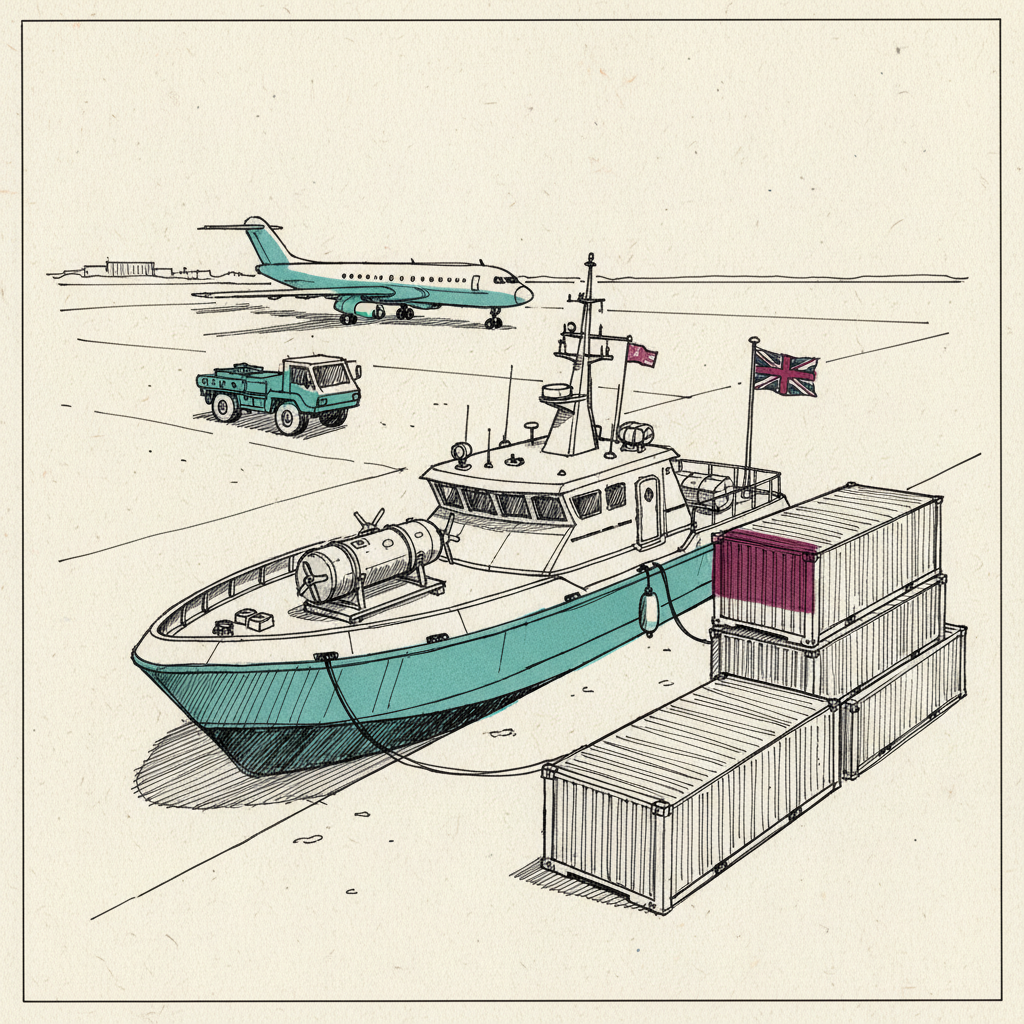
RNMB Ariadne
Royal Navy's 12-metre uncrewed minehunter, fitted with Thales TSAM sonar, in the Anglo-French MMCM programme.
RNMB Ariadne, the Royal Navy's autonomous minehunter, sits embarked aboard RFA Lyme Bay in Omani waters: Oman authorised UK-French clearance of roughly 80 Iranian mines near Hormuz in early July 2026, a mission a tanker attack on 7 July stalled before her sonar logged a single contact.
Last refreshed: 22 September 2026 · Appears in 1 active topic
Has RNMB Ariadne actually begun clearing mines in or near the Strait of Hormuz?
Timeline for RNMB Ariadne
Mentioned in: The mothership Britain has not bought
Autonomous Systems: Land & SeaMentioned in: Thales locks Exail in, closing in 2028
Autonomous Systems: Land & SeaMentioned in: Ocean Infinity: 13,000 hours, no crew
Autonomous Systems: Land & SeaMentioned in: Belgium's twelve robots come with cables
Autonomous Systems: Land & SeaMentioned in: UK to buy three Norway motherships
Autonomous Systems: Land & SeaBackground
RNMB Ariadne is the Royal Navy's autonomous minehunter, a 12-metre crewless boat fitted with Thales's towed synthetic aperture sonar and a remotely operated neutraliser, designed so no sailor need work above a live mine during clearance.
She is the UK end of the joint Anglo-French Maritime Mine Countermeasures programme, funded on Britain's side to roughly £184 million, working alongside her French-crewed sister boat Sirius. Her role has grown more central as the Royal Navy's crewed fleet has shrunk: HMS Chiddingfold, in service since 1984, was retired on 13 July 2026 alongside two Type 23 frigates, leaving vessels like Ariadne to carry more of the mine-hunting load.
Britain is separately buying three Norwegian-built motherships, at £90 million inside a roughly £1.3 billion four-year programme, to launch, recover and control minehunters like Ariadne at SEA, a bottleneck the Ministry of Defence now regards as more pressing than the drones themselves.
Ariadne's Hormuz clearance run stays parked
Ariadne proved the mothership-recovery concept on 27 May 2026, docking into RFA Lyme Bay off Gibraltar in the Royal Navy's first at-sea recovery of a crewless minehunter. She then paired with France's Sirius at Toulon in early June, an unprecedented shared-deck trial for the two navies' crewless minehunters, before Lyme Bay carried her into the Gulf on 23 June under escort.
Oman authorised clearance of its southern Hormuz approach in early July, precisely the task her TSAM sonar and remote neutraliser were built for. The order never reached her: a tanker attack on 7 July froze the mission before she began, and there is no confirmed sign since that the hunt has resumed.
Hormuz clearance mission remains stalled
Why did the Hormuz mine-clearance mission stall after Oman authorised it?
What is the Anglo-French MMCM programme?
What sonar does the Royal Navy minehunter Ariadne use?
Did RNMB Ariadne successfully dock inside its mothership?
What is RNMB Ariadne and what does it do?

