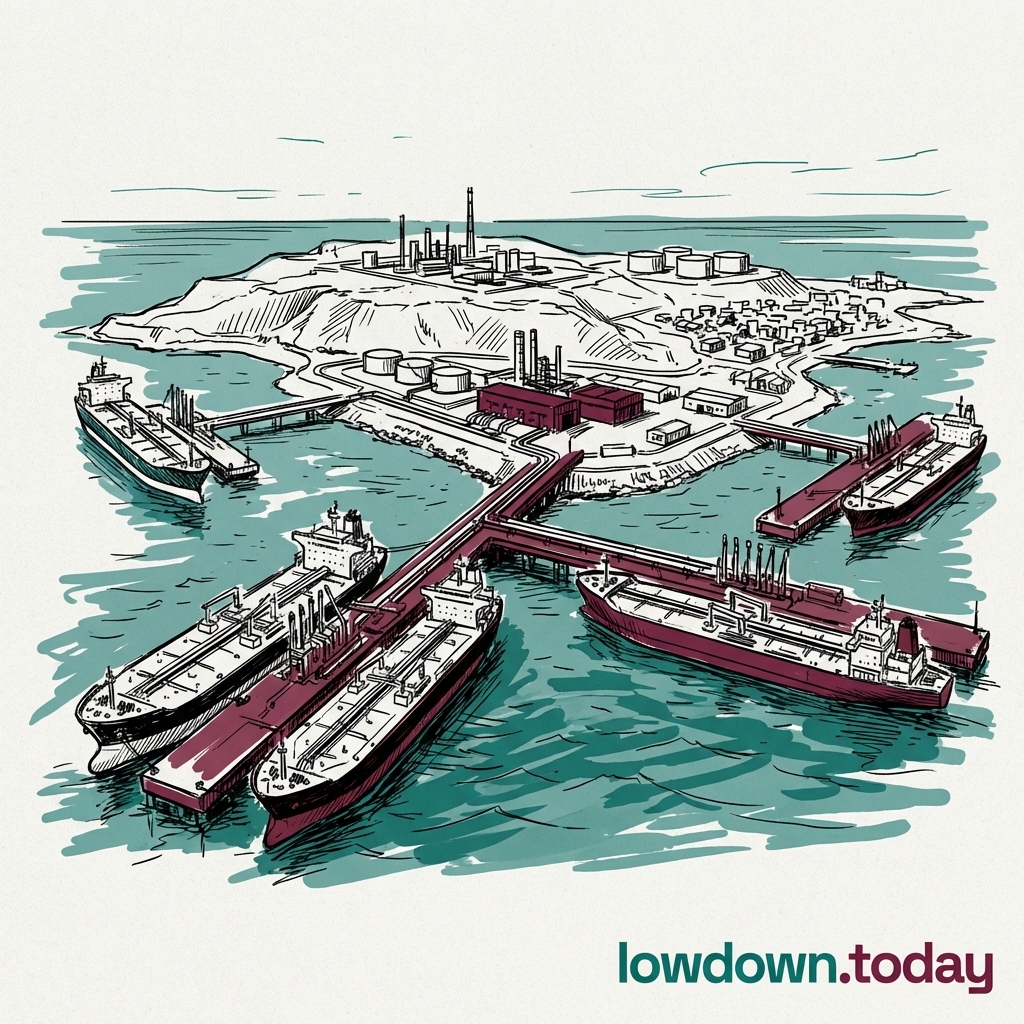
Kharg Island
Iran's main crude export terminal, the central economic lever in the 2026 conflict.
On 4 July, a sanctioned tanker loaded 1.87 million barrels of Iranian crude at Kharg Island, keeping the terminal central to Tehran's ability to sell oil through The Gulf.
Last refreshed: 22 September 2026 · Appears in 2 active topics
Why is a sanctioned tanker still loading barrels at Kharg for China?
Timeline for Kharg Island
Loaded no supertanker for at least a fortnight to mid-September
Iran Conflict 2026: Iran loads no crude for a whole monthMentioned in: CENTCOM disables five Iranian oil tankers
Iran Conflict 2026Mentioned in: CENTCOM disables two Iranian tankers, destroys a third
Iran Conflict 2026Mentioned in: Hormuz crossings fall by two thirds
Iran Conflict 2026Mentioned in: Fourth night of strikes hits Abadan
Iran Conflict 2026Background
Kharg Island is an Iranian island terminal in The Persian Gulf and the country's principal crude-export hub. Reporting on 24 March described it as handling roughly 90% of Iranian crude exports. That concentration makes the island an economic choke point: cargoes loaded there depend on Gulf shipping routes to reach buyers.
Kharg combines commercial oil infrastructure with military significance. On 14 March, US strikes hit military positions on the island while sparing the oil terminal. Its significance lies in the concentration of export capacity in one defended location, where disruption, blockade or control can affect Iranian oil revenue more directly than attacks on dispersed assets.
Kharg sustains shadow fleet exports
Between 23 June and 4 July, a Guyana-flagged tanker under US sanctions loaded an assessed 1.87 million barrels of Iranian crude at Kharg Island. Its broadcast location signal imitated an anchor-swing pattern, while satellite imagery showed the vessel loading.
The episode made Kharg's role more than a measure of Iranian export capacity. On 4 July, it was the physical point where a sanctioned cargo entered the market despite restrictions, with the terminal's traffic and nearby vessel movements becoming evidence of whether Tehran could keep selling crude.
Kharg Island becomes a seizure target
On 24 March, three Pentagon sources said US planners were actively considering an amphibious seizure of Kharg Island. The reported plan paired a Marine landing with combat engineers repairing the airstrip for follow-on airborne forces, reflecting the terminal's concentration of Iranian export capacity.
Iran responded on 25 March by mining Kharg's beaches against a possible landing. By 1 April, analysts warned that limited US minesweeping capacity and Iran's mainland missile and drone forces could make a seizure costly without reopening Hormuz. For Kharg, the commercial terminal and the island's defences had become inseparable.
Why did the US strike Kharg Island?
Is Iran still exporting oil from Kharg Island in July 2026?
How much oil passes through Kharg Island per day?
Why is Kharg Island so important to Iran?
What happened to Kharg Island in the Iran-Iraq War?
Is the US planning to seize Kharg Island?
What is Kharg Island?


