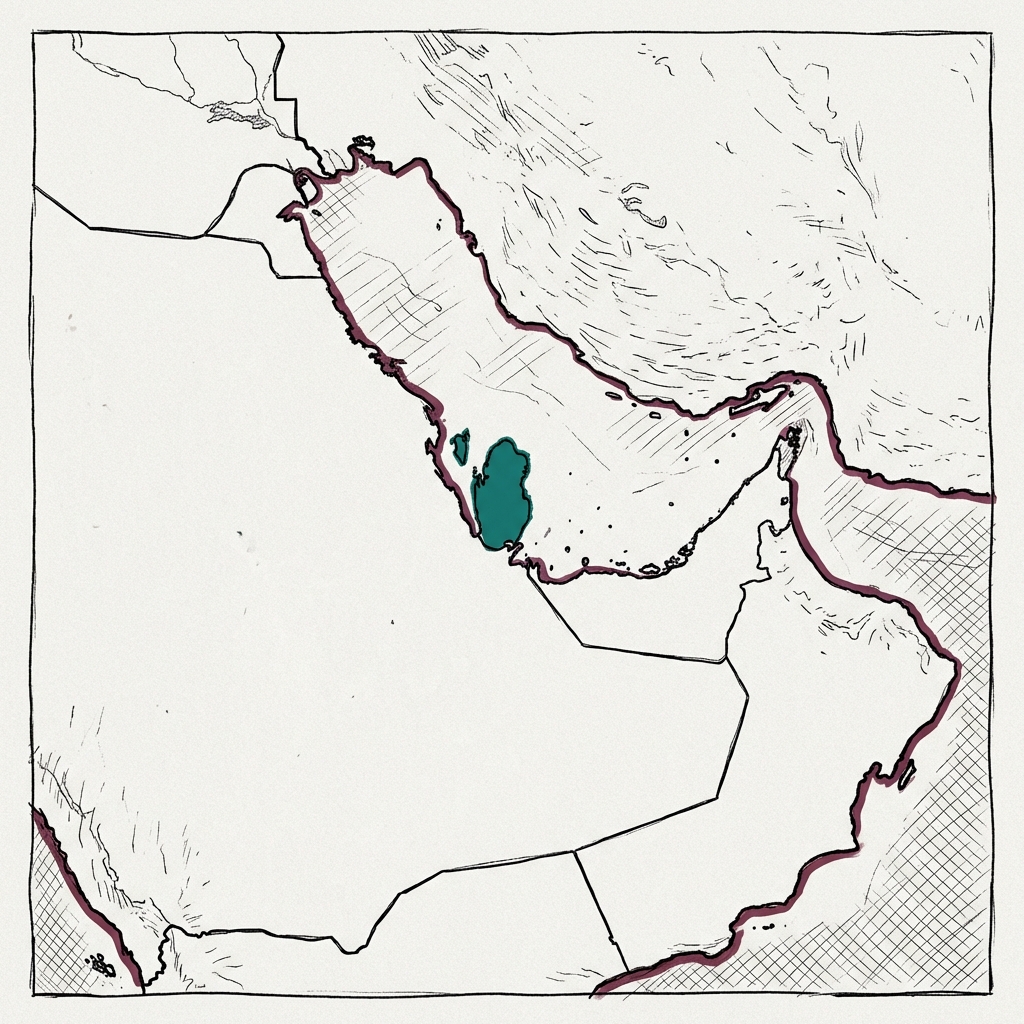
Qatar
Gulf state hosting CENTCOM; world's third-largest gas reserves; mediating Iran talks while absorbing Iranian strikes on Ras Laffan.
Qatar filed formal letters with the United Nations on 21 July cataloguing three Iranian attacks on its territory since 7 July, while co-tabling a fresh ten-day ceasefire proposal with Egypt, Pakistan and Oman on 22 July.
Last refreshed: 24 July 2026 · Appears in 6 active topics
Can Qatar keep mediating Iran talks while absorbing Iranian strikes on its own gas infrastructure?
Timeline for Qatar
Mentioned in: Barcelona's FIFA cheque falls by a third
2026 FIFA World CupMentioned in: Iran files its own ten-day truce
Iran Conflict 2026Co-submitted a ten-day ceasefire proposal to Washington and Tehran
Iran Conflict 2026: Four mediators table a ten-day truceFiled compensation letters at the UN Security Council
Iran Conflict 2026: Qatar files a UN claim against IranMentioned in: NBCU counts the tournament in minutes
2026 FIFA World CupBackground
Qatar is a Gulf state whose position in the Iran war is defined by three things it cannot separate: it hosts the US-coordinated Doha channel that remains the only live negotiating track between Washington and Tehran; it holds a share of Iran's frozen overseas funds, capped by sanctions rules it does not control; and it shares the world's largest gas field with Iran, which puts its own Energy infrastructure inside the conflict's blast radius.
That exposure is concrete, not abstract. QatarEnergy's Ras Laffan complex, which supplies close to a fifth of global LNG, had two production trains destroyed by strikes early in the conflict, a loss that caps recovery at 83% of capacity for three to five years . Hormuz's naval-escort regime, not diplomacy, now sets the pace at which that capacity can return.
Doha's mediator role predates this war, and its ability to keep talking to both Washington and Tehran while absorbing strikes from one and disputing money with the other is the through-line of its current standing: a small state whose leverage rests on being useful to everyone at once.
Qatar absorbs Iran's widening strikes
Iran's Revolutionary Guard extended its retaliation campaign onto Qatari soil on 9 July, claiming a strike on a Qatari satellite antenna as part of a barrage that also hit Jordan, Bahrain and Kuwait the same day. Doha kept mediating anyway: it can protest and negotiate at once because it shares the world's largest gas field with Iran and still holds $6bn of Tehran's frozen funds .
Qatar answered through law rather than force, filing UN letters on 21 July that catalogued three Iranian attacks since 7 July and reserved its right to self-defence under the UN Charter without acting on it . Emir Tamim bin Hamad Al Thani has ordered no retaliatory strike in the twelve days since, leaving the 21 July filing as Doha's only recorded response.
Qatar holds Iran's frozen billions
Qatar's Foreign Ministry confirmed on 3 July that the $6bn of frozen Iranian funds it holds had not moved, contradicting President Pezeshkian's claim two days earlier that the money was already heading to Tehran. The gap is not political theatre: Pezeshkian has no authority over sanctions relief, and the sum is capped by US Treasury rules Doha cannot exceed .
Doha kept the channel open regardless: its Foreign Ministry co-signed a fresh ten-day Ceasefire text on 22 July, sent to Washington and Tehran alongside Cairo, Islamabad and Muscat, aimed at reopening Hormuz while wider talks continue . It is the latest of several such bids Doha has co-signed since spring, none of which has yet reopened the strait.
Reference
Will Qatar co-host the 2026 FIFA World Cup?
Did Qatar host the 2022 FIFA World Cup?
Why does Qatar host the US military if it has ties to Iran?
Why did Iran strike Qatar's Ras Laffan if they share the North Field gas reserves?
What is Ras Laffan and why does it matter?
Why did Iran strike Qatari territory in 2026?
What happened to Qatari LNG after Iranian strikes?
Did Qatar sign the Hormuz coalition statement in May 2026?
What are the frozen Iranian assets Qatar holds?
Is Qatar mediating between the US and Iran?


