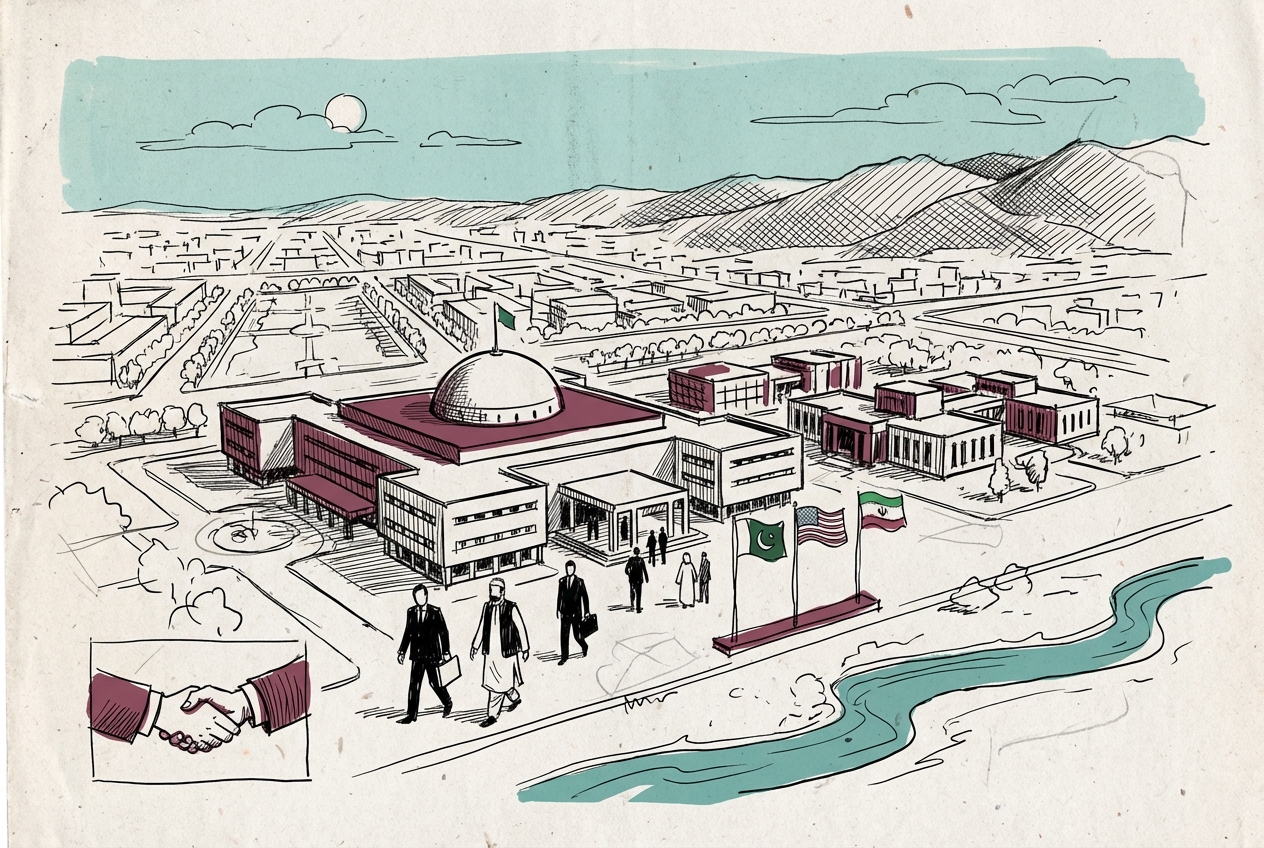
Islamabad
Pakistan's capital; diplomatic venue that gave its name to the 2026 US-Iran Memorandum of Understanding.
Islamabad brokered the memorandum bearing its name, but on 8 July Iran's own negotiator declared it breached, and on 22 July Pakistan tabled a fresh truce text alongside a rival Iranian version filed the same day.
Last refreshed: 20 August 2026 · Appears in 1 active topic
Why does the Islamabad MOU bear this city's name when talks moved to Switzerland?
Timeline for Islamabad
Hosted one of the three designated Cavalier companies
Iran Conflict 2026: Treasury names 10 Iran missile suppliersMentioned in: IAEA still cannot locate Iran's uranium
Iran Conflict 2026Mentioned in: Oman and Japan press for safe passage
Iran Conflict 2026Mentioned in: Tehran won't extend the Islamabad clock
Iran Conflict 2026Mentioned in: Eleven dead in south Lebanon strikes
Iran Conflict 2026Background
Islamabad is Pakistan's planned capital, built in the 1960s at the foot of the Margalla Hills, with a population of around 1.1 million. Adjacent to Rawalpindi, the seat of Pakistan's military headquarters, it hosts the ISI intelligence service, the full diplomatic corps, and the institutional levers of a state that holds both major non-NATO ally status with the United States and a long land border with Iran.
That dual geography, Western-alliance frameworks sitting beside direct Iranian proximity, is the structural reason Pakistan became the mediator of choice for US-Iran negotiations: JD Vance has flown to Islamabad for shuttle diplomacy during the talks, while Army Chief Asim Munir has made repeated personal trips to Tehran to keep the channel open.
Moves made 'in Islamabad' are, in practice, made by a civil-military consensus rather than the civilian government alone: the Prime Minister's office, the Rawalpindi-based Chief of Army Staff, and an ISI that maintains contacts with both the IRGC and the CIA. That concentration of levers, not any single ceremony, is why an unrelated venue's diplomatic text still carries this city's name.
Its named memorandum is now disputed
The memorandum signed in mid-June carries Islamabad's name because Pakistan brokered the framework, not because the ceremony happened there: JD Vance and Ghalibaf signed digitally at Burgenstock on 15 June, and Trump signed in Versailles two days later. By 8 July that authorship was in open dispute: Iran's own signatory, Parliament speaker Ghalibaf, posted that Washington had breached the memorandum, and hardline MPs threatened a constitutional complaint over a document Iran's Majlis never ratified.
Islamabad's implementation-conduit role faced its sharpest test yet on 22 July, when Pakistan joined Qatar, Egypt and Oman in tabling a fresh ten-day Ceasefire proposal, only for Iran to file a competing text of its own the same day rather than accept it.
Its named memorandum is now disputed
Why is Pakistan mediating between the US and Iran in 2026?
Is the Islamabad memorandum between the US and Iran still standing?
How does Islamabad's Iran mediation affect European gas prices?
Why did the US-Iran talks in Islamabad collapse?
Did the Islamabad US-Iran talks produce a ceasefire?
What did Pakistan's defence minister say about Israel?
Does the Islamabad MOU end the Iran war?
Why did Pezeshkian visit Islamabad after the Iran deal?
What role did Pakistan play in the Iran-US talks?
When was the Islamabad MOU signed?
Why is the Iran deal called the Islamabad Memorandum?
Why did Islamabad talks fail?
Did Pakistan expand its regional diplomacy beyond the Iran-US talks?


