Skip to content
You can now search across every topic, entity and event.What's new
Iran Conflict 2026
19AUG

One ship or five? Hormuz counts split

2 min read
18:42UTC

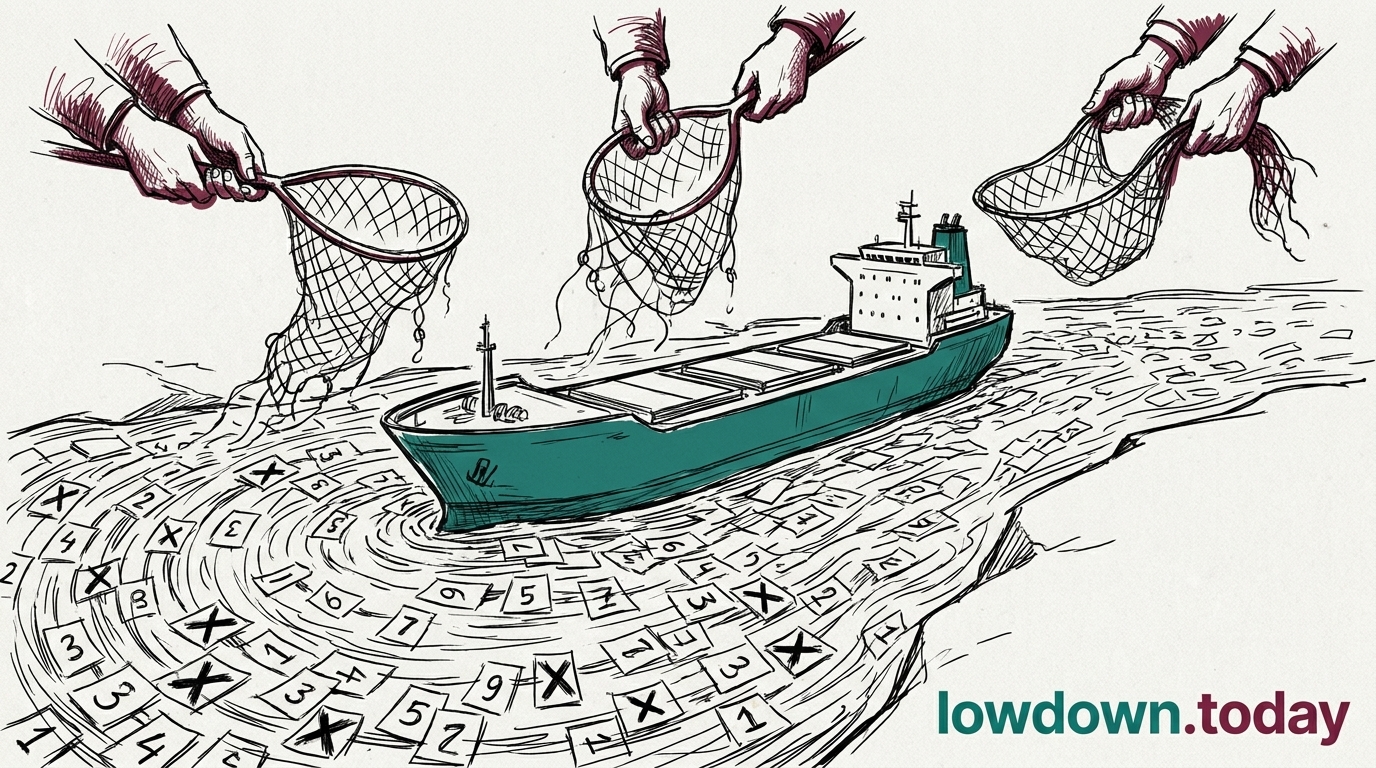
S&P Global logged a single vessel through Hormuz on 16 August and called it a record low. Kpler counted five the same day, and only one of the two has published what it counts.

ConflictDeveloping
Key takeaway

Two providers gave the same day counts of one and five; only Kpler discloses its universe.

S&P Global Commodity Insights counted one vessel crossing the Strait of Hormuz on 16 August, described the figure as a record low, and put the previous day at eight 1. Our own record already carried a different number for that date. Kpler, which tracks commodity vessels, meaning tankers and bulk carriers rather than all shipping, counted five crossings in the same water on the same day .

Kpler's later readings continue the series. It put 18 August at six crossings, against nine on 17 August and a ten-day daily average of eleven 2. That is 45 per cent below its own average, an arithmetic step we have taken on Kpler's two published figures rather than a percentage Kpler states.

One and five are not the same count of the same strait on the same day. The S&P Global page would not open on four separate fetch routes, so the vessel universe behind its figure cannot be laid against Kpler's. Of the names attached to Hormuz numbers this week, only Kpler has published what it counts. Windward is not a third tally at all: it measures how many ships have stopped transmitting, which is the mechanism rather than the count.

The divergence has a precedent two months old. US Central Command (CENTCOM, the American military command covering the Middle East) counted 55 merchant ships through the strait on 22 June against Kpler's 12, a 43-ship gap our energy desk traced to vessels hugging the Omani shoreline with their transponders switched off . June's version sat between a navy and a commercial tracker, an easy difference to explain away. This week's sits between two commercial providers selling to the same customers.

A war-risk underwriter prices a Hormuz voyage against the number of movements that actually occur. Hand that underwriter two incompatible denominators and the premium drifts towards the worst plausible reading rather than the measured one. The charterer pays that difference, and pays it whether the true figure is one ship or five.

Deep Analysis

In plain English

Companies that track ships crossing the Strait of Hormuz publish daily counts so traders and insurers can judge how risky the route is. On 16 August, S&P Global Commodity Insights said only one ship crossed, calling it a record low. But another firm's count for the same day gave a different number, and neither company explains exactly how it counts ships or which vessels it includes. That disagreement matters because these counts get used to set the cost of shipping and insuring cargo through the strait. If the real number is unclear, nobody outside the tracking firms can be certain how dangerous the route currently is.

Deep Analysis
Root Causes

Commodity data providers compete commercially on the accuracy of their vessel counts, which gives each an incentive to keep its underlying methodology proprietary rather than publish it for cross-checking. That commercial secrecy is what makes today's divergence between S&P Global's figure and the existing commodity-vessel count for 16 August unresolvable from public information.

Vessels that go AIS-dark, turning off their tracking transponders, are invisible to any counting method built on that signal , so every tracker's number understates true crossings by an amount neither firm can quantify.

What could happen next?
  • Risk

    Traders and insurers who rely on a single provider's Hormuz transit count risk misjudging how open the strait actually is, since S&P Global's figure and the existing commodity-vessel count for 16 August do not agree.

First Reported In

Update #172 · The strait nobody can count, insure or pay

S&P Global Commodity Insights· 19 Aug 2026
Read original
Causes and effects
This Event
One ship or five? Hormuz counts split
Underwriters, charterers and governments are all pricing a chokepoint whose traffic nobody can independently verify.
Different Perspectives
Shipping and insurance market
Twelve P&I clubs cancelled war-risk extensions after reinsurers pulled back on 18 August and rebought cover within three days, Lloyd's List reported, while S&P Global logged one Hormuz crossing on 16 August against Kpler's five for the same day. The market is pricing a route it cannot independently count, against an Iranian insurer that has not stopped operating.
Oman
Oman
Oman co-administers the Strait of Hormuz's insurance and toll regime alongside Iran under the Islamabad MOU, and was separately named as the target of a bombing threat Axios attributed to Trump on 19 August. No Omani government statement on either matter is on the record.
United States
United States
Axios reported on 19 August that Donald Trump posted a map labelling the Strait of Hormuz as US territory and separately threatened to bomb Oman if it obstructed US objectives. Neither claim carries an order or a deployment behind it, so the map reads as posture rather than a tasked military instruction.
France
France
Paris expelled two Iranian embassy agents on 18 August under the one power that requires it to publish no evidence, citing a July incident it now calls a premeditated assault on its own staff. Iran's rival account, of a secret meeting Paris had weeks of warning about, has not been answered by the Quai d'Orsay.
United Arab Emirates
Abu Dhabi halted all trade, commercial exchange and financial transactions with Iran on 18 August, closing the dirham channel Tehran has used to absorb sanctions pressure. Iran's foreign ministry called the missile allegation behind the move baseless on 19 August, but the UAE has not answered that denial with any further statement or reversal.
Iran
Iran
Iran's foreign ministry says it declared two French embassy staff persona non grata on 19 August, a day after France, for conduct it says breached the Vienna Convention. Majlis security committee chair Ebrahim Azizi cast the dispute as one more entry in a French ledger running back to contaminated blood, INSTEX and snapback.