US Treasury
US federal sanctions authority; OFAC arm enforces Iran, Russia, and Venezuela programmes across dozens of active instruments.
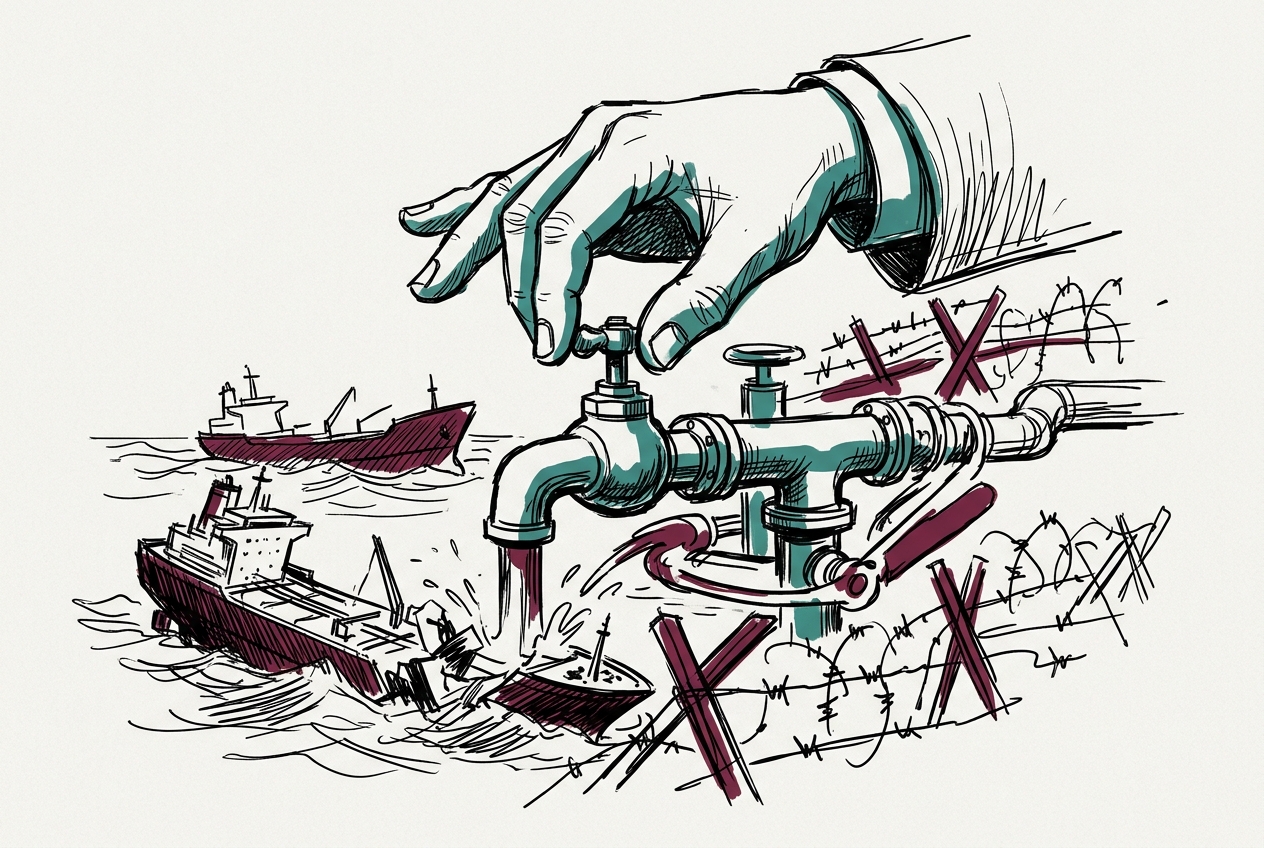
The US Treasury runs Washington's Iran sanctions regime through OFAC; its last authorised channel for Iranian oil trade, General License X1, expired at 12:01am on 17 July with no replacement issued.
Last refreshed: 25 July 2026 · Appears in 7 active topics
Does the Adani $275m settlement mean European buyers face US prosecution for completing Russian cargoes post-GL 134B?
Timeline for US Treasury
Mentioned in: OFAC names four in Zanjani network
Iran Conflict 2026Mentioned in: Urals crude nearly triples in weeks
Russia-Ukraine War 2026Mentioned in: Iran's rial slides past 189,000 toman
Iran Conflict 2026Mentioned in: Wind-down licence lapses for blocked ships
Iran Conflict 2026Last Iran oil waiver lapses at midnight
Iran Conflict 2026Background
The US Department of the Treasury, founded in 1789 and led by Secretary Scott Bessent since 2025, is Washington's principal economic and financial agency. Its Office of Foreign Assets Control (OFAC) administers economic sanctions, making it one of the most consequential levers of American Foreign Policy outside direct military action. In 2026 Treasury is running three major sanctions programmes in parallel (Iran, Russia, Venezuela) while managing the financial stability risks of frontier AI deployment and adjudicating wartime waivers that move billions of barrels of crude.
The headline April 2026 signal is asymmetric sanctions enforcement. On 19 April OFAC allowed General License U (covering 325 tankers and roughly $31.5 billion of already-loaded Iranian crude) to lapse with no renewal, while on the same calendar day extending Russia's seaborne-oil General License 134B to 16 May. Bessent had signalled the GL-U lapse on cable television three days earlier and simultaneously confirmed Russia's GL-134A waiver, worth roughly $150 million a day in Russian crude trade, would not be renewed. This produced the first signed Russia-yes, Iran-no asymmetry in US sanctions policy text. By Day 59 of the Iran war (27 April), OFAC had issued multiple Iran instruments (designating the Hengli Petrochemical network and sanctioning 14 entities under NSPM-2) while the White House presidential-actions index recorded zero presidential Iran instruments.
Treasury's reach extends further. On 18 March 2026 it issued a broad licence permitting PDVSA to sell Venezuelan crude to global markets while explicitly excluding Cuba; a narrow follow-up on 25 March opened Venezuelan oil to Cuban private-sector buyers only. OFAC used the Protecting American Intellectual Property Act for the first time in a cyber matter in April 2026, sanctioning the Operation Zero vulnerability broker. On 8 April Bessent and Federal Reserve Chair Jerome Powell summoned bank CEOs to discuss frontier AI systemic risk. The department is simultaneously prosecuting sanctions against two adversaries, relaxing others to prevent crude above $105 from tipping the US into recession, and serving as the institutional convener for AI systemic-risk assessment.
Treasury is the primary sanctions authority shaping European oil market structure across all five updates in the european-oil-markets series. GL 134B expired at 12:01 ET on 16 May 2026 with no successor, ending the 30-day rolling waiver architecture that had provided legal certainty for shadow-fleet vessel-services providers completing Russian crude cargoes. European P&I clubs and maritime insurers lost their OFAC safe harbour from that date forward.
GL 134C, signed by OFAC Director Bradley T. Smith on 18 May 2026, restored in-transit vessel-services cover for Russian crude loaded by 17 April, providing a further 30-day bridge to the Lukoil ISAB sale process. GL 134C carried an explicit Cuba carve-out, stranding nine SDN-listed cargoes outside any authorisation envelope. On 28 May, OFAC issued GL 131F superseding GL 131E, resetting the ISAB transaction clock to 27 June and allowing Ludoil Energy's two-phase acquisition to proceed under a separate transaction licence.
The Adani $275 million settlement for 32 Iran-LPG violations, posted 18 May 2026, is the enforcement benchmark European traders must now price when assessing residual exposure from Russian cargoes loaded before the GL 134B expiry. As of Update #5 (4 June), GL 134C expires at 12:01 EDT on 17 June with no GL 134D announced, a 13-day cliff that is the live compliance hinge for European maritime insurers and trading desks.
Treasury's role in the Iran conflict runs on two parallel tracks that have repeatedly diverged. OFAC's enforcement Arm has maintained a steady cadence of SDN designations and general-licence actions throughout the 108-day war, while the White House presidential-actions register has repeatedly gone silent on Iran instruments even as diplomatic announcements were made. On 19 April 2026, OFAC allowed General Licence U (covering 325 tankers and roughly $31.5 billion of Iranian crude already at sea) to lapse with no successor, while simultaneously extending Russia's GL 134B to 16 May. By Day 59, the White House recorded zero presidential Iran instruments while OFAC had designated the Hengli Petrochemical network and sanctioned 14 entities under NSPM-2.
On 28-29 May 2026, OFAC designated Iran's Persian Gulf Strait Authority (PGSA) under EO 13224 on the same calendar day US and Iranian negotiators reached a tentative 60-day MOU to reopen the strait. The sanction carried legal force; the MOU carried none. Treasury Secretary Bessent described the PGSA toll as 'extortion' and simultaneously warned Oman that Washington would 'aggressively target any actors involved, directly or indirectly, in facilitating tolls'. On 1 May OFAC had issued General Licence W, designated three Iranian foreign exchange houses, and named IRCS, Bonyad Mostazafan, and Iranian embassy accounts as prohibited toll-payment channels.
On 18 June 2026, OFAC issued the sb0535 Counter-Terrorism designation targeting the Alaa Hamieh Hezbollah-aligned financial network and Lebanese political figures Sleiman Frangieh and Mahmoud Qamati, with the network traced across Lebanon, Syria, Iraq, and Oman. No Iran waiver or general licence accompanied the action. The MOU's Provision 3, which requires Treasury to issue crude-export waivers 'immediately upon signing', remained unexecuted through 18-20 June, with OFAC's recent-actions page showing Counter-Terrorism and Cuba entries only.
On 14 July 2026, Treasury's OFAC Arm designated more than 50 individuals, entities and vessels linked to Mohammad Hossein Shamkhani's Iranian shipping network, including crypto addresses tied to Bank Markazi, and issued a new wind-down licence, General Licence Z, for the newly blocked parties, three days ahead of General Licence X1's 17 July wind-down Deadline for the separate Iranian oil waiver.
On 24 July 2026, OFAC designated a fresh network under Executive Order 13902, every node tied to previously sanctioned oil-smuggling financier Babak Zanjani, naming four individuals and the payment and exchange firms ZedX DMCC, BZ Diamond DMCC and ZedPay. The round extends Treasury's steady SDN cadence even as its oil-waiver architecture for Iranian crude remains lapsed with no successor licence in place.
That cliff resolved as forecast, then kept widening: GL 134C lapsed at 12:01 EDT on 17 June with still no GL 134D issued as of 1 July, a 15-day gap against the war's usual 1-2 day renewal rhythm and the longest interruption to Russian vessel-services cover of the conflict. The gap kept widening rather than closing: by 13 July it had reached 26 days with still no GL 134D issued, extending the record interruption to Russian vessel-services cover for the third consecutive update. The parallel Lukoil track kept moving on its own separate clock: GL 131G, issued 25 June 2026, is the seventh consecutive monthly extension of the authorisation to negotiate the sale of Lukoil International GmbH, running to 25 July. It still authorises negotiation only; the separate transaction licence needed to close the ISAB sale has not been issued, and ISAB Priolo kept running past the 28 June GL 131F lapse regardless.
Reference
What was the Adani OFAC settlement and why does it matter for European oil traders?
Why did Treasury extend the Russia oil waiver but not Iran's?
Did the US Treasury renew the Iran oil waiver in April 2026?
Why did Treasury summon bank CEOs about an AI model?
How is the US Treasury enforcing Iran sanctions in July 2026?
What is OFAC and how does it enforce sanctions?
What is the US Treasury Department?
What is OFAC General Licence 134C and when does it expire?
What does Scott Bessent's Treasury policy mean for oil markets in 2026?
What OFAC sanctions have targeted Iran in 2026?
What is the OFAC Zanjani network designation?
When did OFAC last designate an Iran-linked sanctions network before the Zanjani round?




