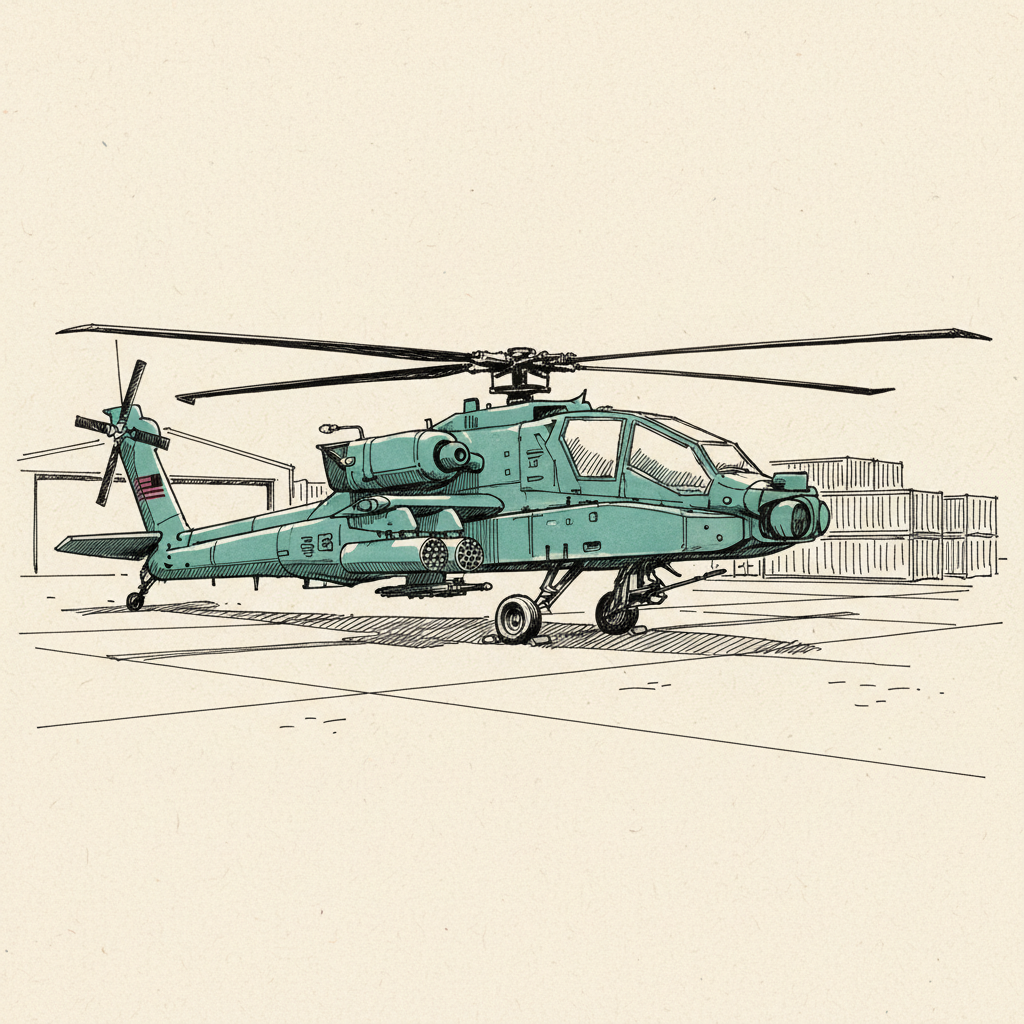
AH-64 Apache
Boeing attack helicopter; the US Army's primary rotary-wing strike platform, operating in both the strait of Hormuz and as the target aircraft for the UK's Project NYX loyal wingman programme.
Last refreshed: 9 June 2026 · Appears in 2 active topics
Was the 9 June Apache loss near Hormuz caused by hostile fire or mechanical failure?
Timeline for AH-64 Apache
Mentioned in: £5bn UK drone plan follows Healey exit
Drones: Industry & DefenceProvided the stated legal basis for the Article II self-defence claim
Iran Conflict 2026: Trump strikes Iran with no war authorityUS strikes four Iranian sites near Hormuz
Iran Conflict 2026Drone boat rescued the downed Apache crew
Iran Conflict 2026US Army Apache goes down near Hormuz
Iran Conflict 2026Background
The AH-64 Apache is the primary attack helicopter of the US Army, manufactured by Boeing since 1984. Designed for close air support and anti-armour operations, it carries a 30mm M230 chain gun, Hellfire missiles, and Hydra 70 rockets. With over 2,400 delivered to the US military and Allied Nations, it is the western standard for rotary-wing attack and has seen combat across Desert Storm, Iraq, and Afghanistan.
In the Iran conflict, Apaches deployed alongside A-10 Warthog aircraft for low-altitude maritime operations around the Strait of Hormuz, hunting IRGC fast-attack craft and intercepting drones. CENTCOM reported over 9,000 targets struck and 140 vessels destroyed across 25 days. On 9 June 2026, a US Army Apache went down near the strait of Hormuz; both crew members were rescued and the cause remained unconfirmed, with a CENTCOM report expected the following day. No party claimed the loss and hostile fire was not established, though the incident occurred in airspace where the IRGC had fired a seven-missile salvo at US Gulf bases just days prior.
Outside the Iran theatre, the Apache is central to the UK's Project NYX loyal-wingman programme. In May 2026, the UK Ministry of Defence selected four companies, Anduril Industries (UK), BAE Systems, Tekever, and Thales UK, for an assessment phase funded at £10 million, aimed at developing autonomous drone loyal wingmen for Apache helicopters, with down-select to two companies in autumn 2026 and an operational variant targeted for 2030. The Apache's role as the human-crewed anchor for an autonomous wingman pair makes it the test platform for the Royal Navy's "crewed where necessary, uncrewed wherever possible" doctrine.
What is the AH-64 Apache?
What is the AH-64 Apache doing in the Strait of Hormuz?
How does the AH-64 Apache compare to the A-10 Warthog?
Why is the US using slow helicopters in the Strait of Hormuz?
Has the AH-64 Apache ever been used against Iranian forces?
What happened to the US Apache helicopter near the Strait of Hormuz in June 2026?
What is Project NYX and which helicopters does it involve?
How is the AH-64 Apache being used in the Iran conflict in 2026?
Which countries operate the AH-64 Apache attack helicopter?



Written with AI from Lowdown's published reporting. Not individually reviewed by an editor. Updated 9 June 2026. Editorial standards.