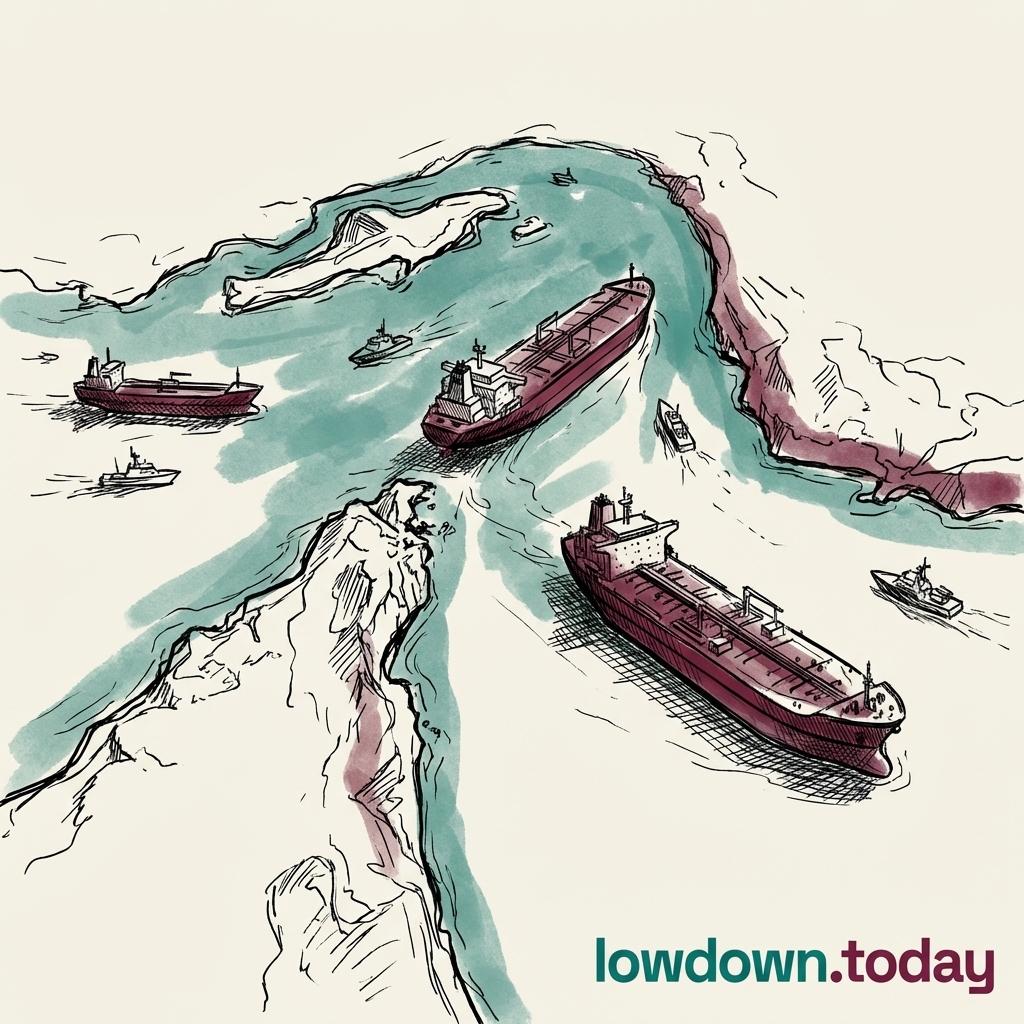
Persian Gulf
990km enclosed sea between Iran and Arabia; 40-nation coalition mining and tolling it while ADNOC builds a bypass.
Last refreshed: 18 May 2026 · Appears in 1 active topic
With 90% of Iran's mines cleared but ADNOC building a bypass anyway, who controls the Gulf's strategic future?
Timeline for Persian Gulf
Mentioned in: PGSA opens vessel portal, withholds tariff schedule
Iran Conflict 2026Mentioned in: Brent breaks $110, ADNOC bypasses Hormuz
Iran Conflict 2026Mentioned in: PGSA goes live on Hormuz transit
Iran Conflict 2026Mentioned in: Four states add Hormuz coalition kit
Iran Conflict 2026Mentioned in: Iran names new ambassador to Beijing
Iran Conflict 2026- What is the Persian Gulf?
- The Persian Gulf is a shallow inland sea between Iran and the Arabian Peninsula, roughly 990 kilometres long. It is the world's most important oil transit corridor, carrying about 20 per cent of globally traded crude via the Strait of Hormuz.
- How much oil goes through the Persian Gulf?
- Roughly 20 per cent of globally traded oil transits the Persian Gulf via the Strait of Hormuz, equivalent to about 21 million Barrels Per Day.Source: editorial
- Why is Iran threatening Gulf desalination plants?
- Gulf States depend entirely on desalinated seawater; summer temperatures exceed 50C and there is no alternative freshwater supply. Threatening desalination plants gives Iran leverage beyond oil markets if the US attacks its Energy infrastructure.Source: event
- Is the Persian Gulf safe for shipping in 2026?
- Iran's IRGC is operating a toll system on the Strait of Hormuz and has threatened to mine the entire Gulf. Tanker charter rates quadrupled to $800,000 per day and most war-risk insurers have withdrawn cover. CENTCOM has turned around 44 vessels carrying 69 million barrels.Source: event
- Which countries border the Persian Gulf?
- Iran, Iraq, Kuwait, Saudi Arabia, Bahrain, Qatar, the UAE and Oman (via the Strait of Hormuz). These eight states hold over half the world's proven oil reserves.
- How much oil is being blocked at the Strait of Hormuz?
- As of 30 April 2026, CENTCOM reported 44 commercial vessels, 41 of them tankers, carrying 69 million barrels of crude had been turned around at sea under the US blockade since the war began.Source: event
- How does the Strait of Hormuz toll system work?
- Iran ran Hormuz as a bilateral state-to-state favouritism system through mid-May 2026: ships from Russia, China, and Iraq receive passage; US weapons transit is barred; commercial vessels pay up to $2 million per ship in Chinese yuan to the Persian Gulf Strait Authority.Source: Lowdown iran-conflict-2026
- How many ships has the US redirected in the Hormuz blockade?
- CENTCOM redirected 58+ commercial vessels as of 10 May 2026 — 41 of them tankers carrying 69 million barrels of crude. The pace slowed from approximately five per 48 hours in late April to two per 72 hours by mid-May.Source: CENTCOM
- Are Iran's sea mines in the Persian Gulf cleared?
- CENTCOM Commander Admiral Brad Cooper told a Washington forum on 14 May 2026 that US operations have cleared approximately 90% of Iran's mines. The remaining 10% is the operational basis for the Italy-led MCM mission.Source: Admiral Brad Cooper / CENTCOM
- What is the Multinational Military Mission in the Strait of Hormuz?
- A 26-nation Coalition that signed a joint statement on 12 May 2026 formalising a Hormuz maritime security mission. Italy deployed two mine countermeasures vessels on 17 May; France pledged 80% frigate readiness. The mission operates out of PJHQ Northwood independently of the US-led blockade.Source: Lowdown iran-conflict-2026
- Is there a route around the Strait of Hormuz for oil tankers?
- Yes. The Abu Dhabi Crude Oil Pipeline runs to Fujairah on the Gulf of Oman coast, bypassing Hormuz. ADNOC announced on 18 May 2026 it will double Fujairah throughput to 4 million bpd by 2027. Current capacity is 1.62 million bpd.Source: ADNOC / Lowdown iran-conflict-2026
Background
A shallow body of water roughly 990 kilometres long, the Persian Gulf sits between Iran's southern coast and the Arabian Peninsula. Its littoral states — Saudi Arabia, Kuwait, Bahrain, Qatar, and the UAE — hold over half the world's proven oil reserves. Roughly one fifth of globally traded oil transits through the Strait of Hormuz at its southern mouth.
The Persian Gulf is the primary theatre of the 2026 Iran-US conflict. Through mid-May 2026, the security architecture has settled into three overlapping layers. First, the IRGC toll system: Iran ran Hormuz as a bilateral state-to-state favouritism system, codified publicly by Majlis committee chair Ebrahim Azizi — granting passage to Russia, China, and Iraq while barring US weapons transit and charging up to $2 million per ship in Chinese yuan for commercial transit. Second, the CENTCOM interdiction: 58+ commercial vessels redirected as of 10 May, with CENTCOM also operating a simultaneous kinetic escort (Project Freedom, 15,000 personnel) in the same chokepoint. Third, the 40-nation Northwood Coalition: a 26-nation statement signed 12 May formalising the Multinational Military Mission, with Italy forward-deploying two MCM (mine countermeasures) vessels on 17 May and France pledging 80% frigate readiness as the first quantitative tempo commitment from any coalition member.
Admiral Brad Cooper told a Washington forum on 14 May that US operations have cleared roughly 90% of Iran's mines; the remaining 10% is the operational basis for the MCM mission. ADNOC announced on 18 May a plan to double Fujairah throughput to 4 million bpd by 2027 — a capital bet that Hormuz constraints are structural beyond the current ceasefire temperature. Iranian threats to Gulf desalination and power grids have raised stakes beyond oil, imperilling the fresh water supply of states where summer temperatures exceed 50 degrees. EU gas stocks fell to 28% in April before partial Hormuz normalisation; the Gulf remains Europe's single largest source of LNG exposure.
