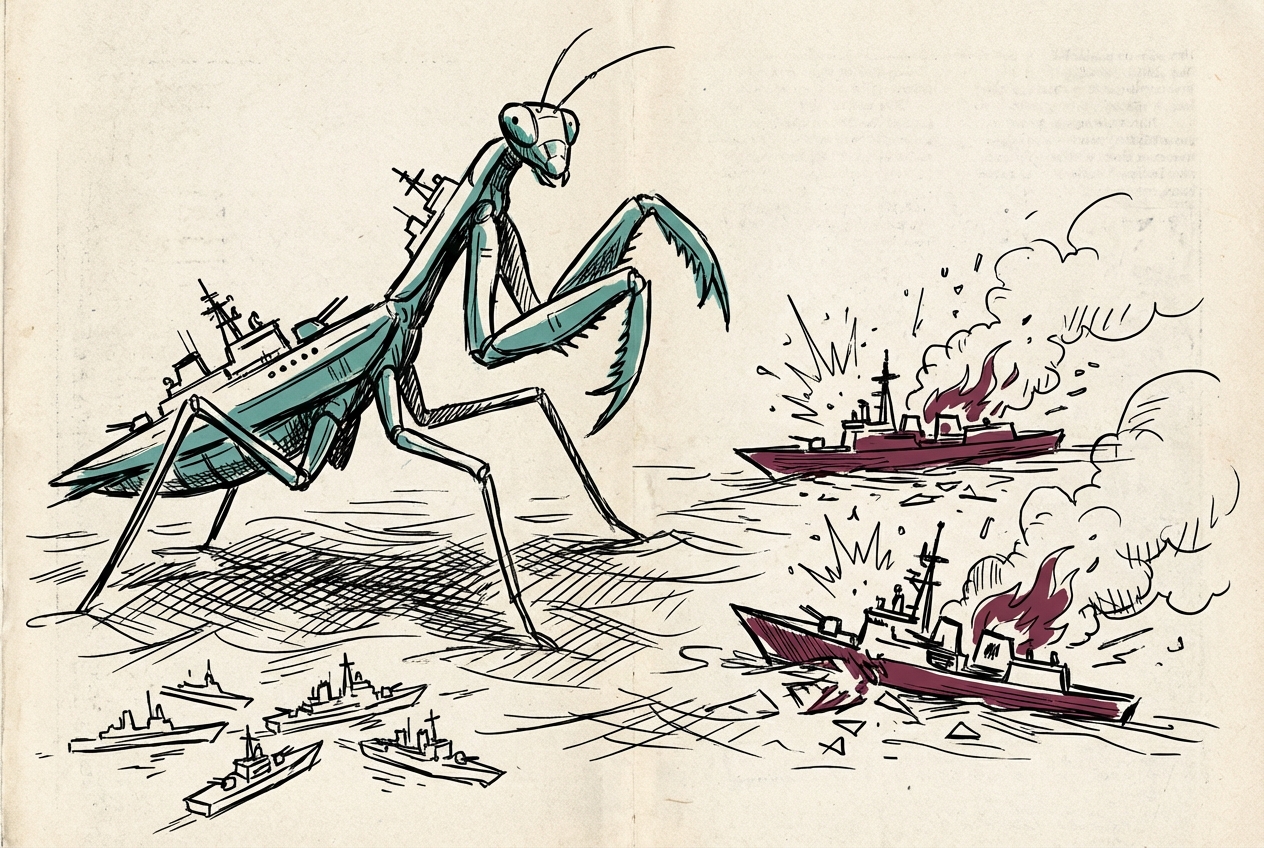
Operation Praying Mantis
1988 US Navy one-day battle in the Persian Gulf; largest US surface engagement since WWII; doctrinal precedent for 2026 Iran campaign.
Last refreshed: 7 May 2026 · Appears in 1 active topic
Why does every Iran-US naval confrontation get compared to a 1988 battle?
Timeline for Operation Praying Mantis
Mentioned in: F/A-18 disables tankers via smokestack on 8 May
Iran Conflict 2026Mentioned in: IRGC fires on US destroyers in Hormuz
Iran Conflict 2026US jet disables Iranian tanker rudder
Iran Conflict 2026Mentioned in: Truxtun and Mason run the gauntlet
Iran Conflict 2026Mentioned in: Project Freedom enters Hormuz on 4 May
Iran Conflict 2026- What was Operation Praying Mantis?
- Operation Praying Mantis was a US Navy operation on 18 April 1988 during the Iran-Iraq War. US forces sank two Iranian frigates and several smaller vessels in a single day in the Persian Gulf, in response to Iran mining international shipping lanes. It remains the largest US surface naval engagement since World War II.
- How does the 2026 Iran naval war compare to Operation Praying Mantis?
- Praying Mantis destroyed a handful of Iranian vessels in one day in 1988. By March 2026, the US had destroyed more than 130 Iranian naval vessels in 22 days, which CENTCOM called the largest naval attrition campaign in three weeks since World War II.Source: CENTCOM
- When was the last Iranian warship sunk before 2026?
- The last Iranian warship sunk in combat before 2026 was during Operation Praying Mantis in April 1988. In 2026, the frigate IRIS Dena became the first Iranian surface combatant sunk since then, torpedoed by a US submarine in the Indian Ocean.Source: CENTCOM
- Did Operation Praying Mantis end the Iran-Iraq War?
- No. Praying Mantis lasted one day and weakened Iranian naval forces but was not the direct cause of the Ceasefire. The Iran-Iraq War ended in August 1988, roughly four months after Praying Mantis, through a UN-brokered Ceasefire.
- How many ships did the US sink in Operation Praying Mantis?
- US forces sank two Iranian frigates (Sahand and Sabalan) and several smaller patrol and platform-based craft in the one-day operation on 18 April 1988. No US ships were lost.
- What happened in Operation Praying Mantis in 1988?
- On 18 April 1988, the US Navy launched a one-day retaliatory operation in the Persian Gulf after Iran mined the USS Samuel B. Roberts. US forces destroyed Iranian oil platforms and sank two Iranian frigates, suffering no ships lost. It remains the largest US surface naval engagement since the Second World War.Source: US Naval Institute / CENTCOM historical record
- Why is Operation Praying Mantis relevant to the 2026 Iran conflict?
- Praying Mantis is cited as the last time the Iranian Navy lost a surface combatant before 2026, and as the doctrinal template for US retaliatory action against Iranian naval forces in the Persian Gulf. The USS Spruance seizure of the Touska in April 2026 was described as the first kinetic seizure of an Iranian vessel since the 1988 Tanker War.Source: Lowdown Iran Conflict 2026 coverage
- What ships did the US sink in Operation Praying Mantis?
- The US Navy sank the Iranian frigates Sahand and Sabalan, and destroyed Iranian oil platforms Sassan and Sirri, as well as several smaller vessels. The US lost no ships.Source: US Naval Institute historical record
- What was Operation Earnest Will and how does it relate to Project Freedom?
- Operation Earnest Will (1987–88) was the US mission to escort Kuwaiti tankers through the Persian Gulf during the Iran-Iraq War; Praying Mantis was conducted under it. Project Freedom, launched in May 2026 with 15,000 US personnel, is considered its institutional successor: a named US escort operation in the same waterway, at FAR greater scale.Source: Lowdown Iran Conflict 2026 coverage
- How does the 2026 US-Iran naval campaign compare to Praying Mantis?
- Praying Mantis destroyed a handful of ships in one day with deliberate restraint; by May 2026 CENTCOM reported over 130 Iranian vessels destroyed or disabled across weeks of operations, with a US fighter disabling an Iranian tanker by gunfire. The 2026 campaign surpasses Praying Mantis in scale, duration, and tactical method.Source: Lowdown Iran Conflict 2026 coverage
Background
Operation Praying Mantis was launched on 18 April 1988 as a direct US Navy retaliation for Iranian mining of Persian Gulf shipping lanes during the Iran-Iraq War. The operation destroyed Iranian oil platforms Sassan and Sirri, sank the frigates Sahand and Sabalan, and eliminated several smaller vessels in a single day, with the US suffering no ships lost. It remains the largest American surface naval engagement since the Second World War and the last occasion — until 2026 — that the Iranian Navy lost a surface combatant in battle.
The operation followed the near-sinking of the USS Samuel B. Roberts by an Iranian mine on 14 April 1988, confirming the pattern — Iranian mining provoking a US kinetic response — that analysts in 2026 have cited as the doctrinal template for the current campaign. Praying Mantis was conducted under Operation Earnest Will, the broader 1987–1988 US mission to escort Kuwaiti tankers through the Gulf. The scale of the 1988 engagement was deliberately calibrated: Washington destroyed Iranian naval capability without triggering full escalation. That calibration became the template for measuring proportionality in subsequent Iran-US confrontations.
By 2026, the precedent has been FAR surpassed in scale and method. The USS Spruance seizure of the Iranian cargo ship Touska on 19 April was explicitly described as the first kinetic seizure of an Iranian vessel since the 1988 Tanker War. CENTCOM cumulative vessel redirections passed 130 ships destroyed or disabled; the July 2026 tanker disable by US fighter — rounds fired into the rudder of an Iranian-flagged vessel — extended the tactical repertoire beyond anything seen in 1988. Project Freedom, launched 3–4 May with 15,000 US personnel and 100-plus aircraft, represents the institutional descendant of Earnest Will: a named escort operation in the same waterway, three decades later at an order of magnitude greater force.
