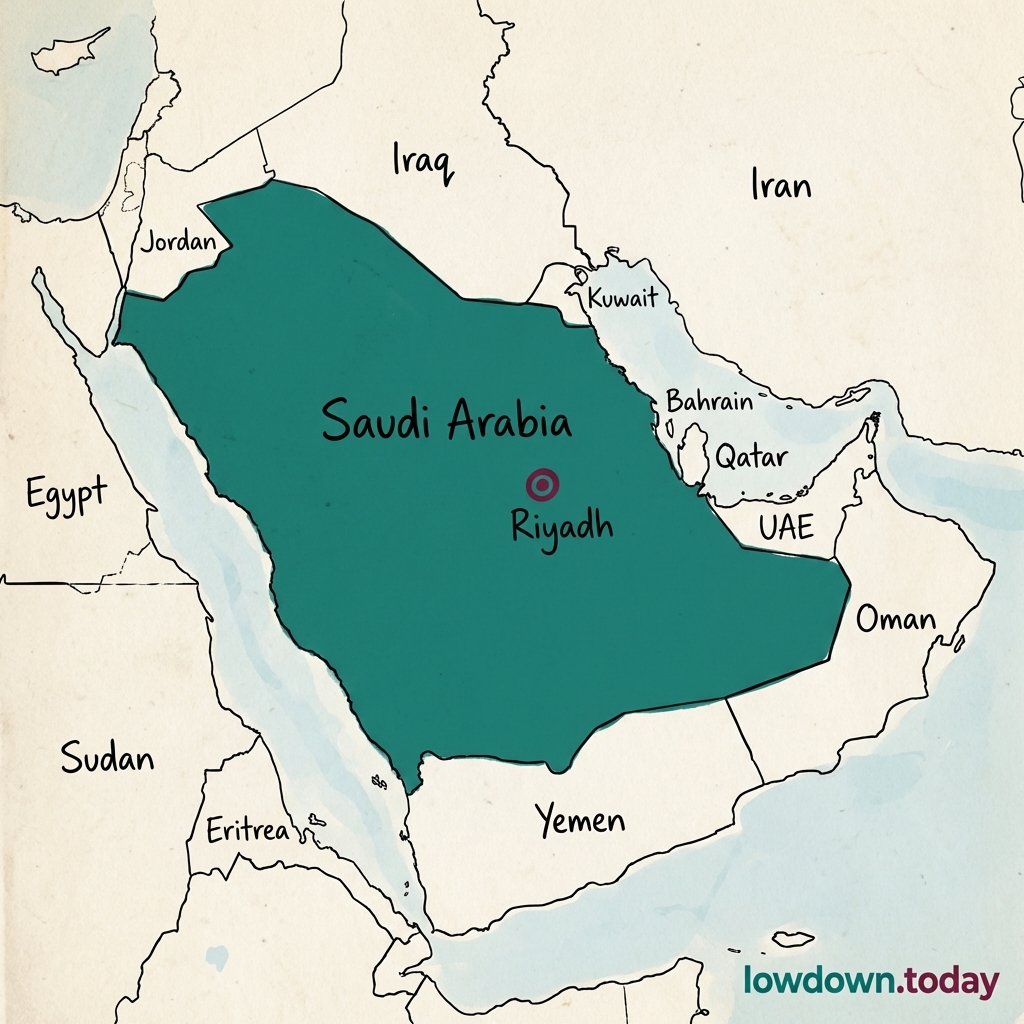
Saudi Arabia
World's largest oil exporter; OPEC+ anchor state; fiscal breakeven risen to $108-111 per barrel against Brent near $97.
Saudi Arabia's Aramco restarted Petroline on 22 September, twelve days after drones hit its pump stations, with flows rebuilding towards 4m barrels a day against 5.5m before the attack; the line is The Kingdom's only large Red Sea outlet avoiding Hormuz.
Last refreshed: 3 October 2026 · Appears in 7 active topics
Can Saudi Arabia balance OPEC+ output discipline with a fiscal breakeven above $108?
Timeline for Saudi Arabia
Became responsible for enforcing against a designated company on its soil
Iran Conflict 2026: Treasury names 10 Iran missile suppliersLobbied Washington to keep its naval blockade in place
Iran Conflict 2026: Qatar brings the US answer to AraghchiMentioned in: QatarEnergy suspends gas as ships move
Iran Conflict 2026Shipped the benchmark cargo priced at the record freight rate
Iran Conflict 2026: Supertanker hire passes $1.2m a dayRecovered its only large route to the Red Sea that avoids Hormuz
Iran Conflict 2026: Aramco restarts Petroline but not fullyBackground
Saudi Arabia is the world's largest crude exporter and the anchor of OPEC+. Its state oil company, Saudi Aramco, exports from Ras Tanura on The Gulf and from Yanbu on the Red Sea, linked by Petroline, which has a design capacity of 7m barrels a day. The Kingdom's fiscal breakeven oil price has risen to $108 to $111 a barrel.
The Hormuz crisis has turned those routes into a lever. On 18 September Aramco told European term customers they would receive no crude in October and sent about 60m barrels to Asian buyers instead.
Riyadh has also courted foreign residents. In June 2026 its Premium Residency Programme split work rights from the residence permit, requiring a separate work permit at a base fee of 100 riyals, and on 22 September added 31 services that tie holders' employment contracts, property purchases and imported vehicles to state digital systems.
Petroline runs below its design capacity
Drones struck Petroline, the East-West Pipeline, on the morning of 10 September. The Energy Ministry shut the line as a precaution and named no pumping station, damage figure or attacker. On 13 September Riyadh said it would not retaliate, at the request of Iraq's prime minister, while keeping the right to act later; the launch sites lay in Iraq near its border crossings with Iran.
Aramco restarted the line on 22 September. Flows are rebuilding towards about 4m barrels a day, against 5.5m before the attack and a design capacity of 7m. The shortfall matters because Petroline is the only large route that carries Saudi crude to the Red Sea port of Yanbu without crossing the Strait of Hormuz.
Saudi shipping loses its southern exit
Houthi radio warnings declared Bab al-Mandeb closed to Saudi shipping on 20 July 2026, and vessels changed course within 48 hours. Missiles and drones struck the Saudi-linked tankers Encelia and Layla on 22 July, and Saudi crude loadings through the strait collapsed, pushing exporters onto the Cape of Good Hope route or a doubled Suez passage.
Riyadh answered with force. Saudi jets hit Houthi military sites near Hodeidah on 24 July after an attack on the tanker NCC Masa, while the Coalition said the port stayed open. After drones launched from Iraqi territory targeted Eastern Province oil sites and Riyadh on 27 July, Saudi jets struck inside Iraq on 29 July, citing Article 51 of the UN Charter.
Saudi Arabia steers modest output rises
After the UAE left OPEC on 1 May 2026, Saudi Arabia led the seven-member voluntary-cut group that agreed a 188,000 barrel-a-day rise for June in a virtual meeting on 3 May. The group repeated the same increment for July, August and September. Actual output lagged FAR behind: Saudi production ran at about 7.25m barrels a day in April against a quota of 10.291m, and fell to 6.57m in May as the Hormuz crisis constrained deliveries.
The OPEC Secretariat's 2 August release recorded the September adjustment and set the next meeting for 6 September. It made no reference to the fourth-quarter pause that Reuters sources had reported on 28 July.
Reference
How does Yanbu let Saudi oil exports bypass the Strait of Hormuz?
Why did Saudi Arabia protest the Iran war on 10 May?
Why did Saudi Arabia not break from OPEC+ when the UAE left?
Why is Saudi Arabia welcoming a ceasefire while the UAE demands harder terms?
Has Saudi Arabia invoked Article 51 over the Iran conflict?
How much oil does Saudi Arabia produce compared to its OPEC quota?
Why is Saudi Arabia not joining the US coalition against Iran?
Is Saudi Arabia in the war against Iran?
What Iranian drone strikes has Saudi Arabia faced in 2026?


