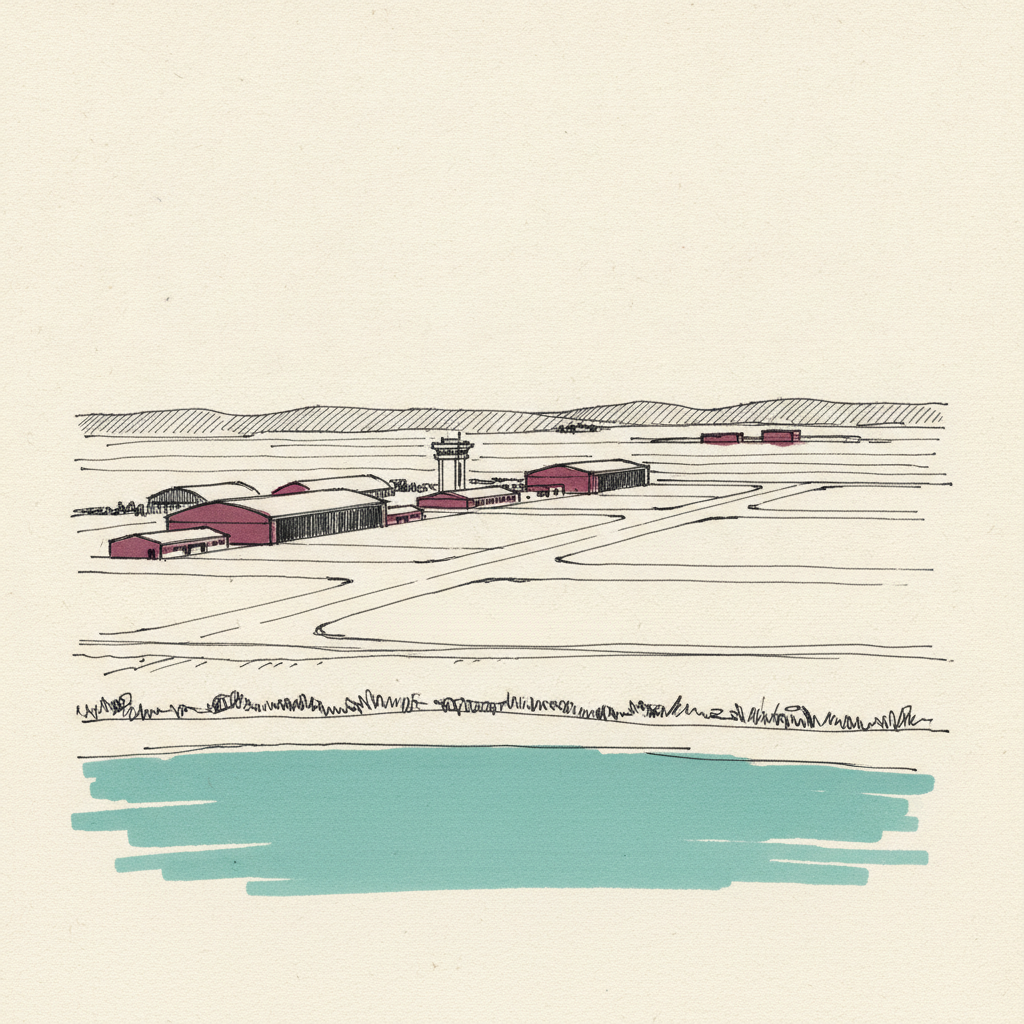
Azraq airbase
Jordanian airbase hosting US forces, struck three times by Iran in 2026, killing two soldiers.
Muwaffaq Salti Air Base in Jordan, hosting US forces, was struck for a third time in six weeks on 17-18 July 2026, when Iranian missiles and drones killed two named US soldiers, the first American deaths at a base Iran had not previously targeted.
Last refreshed: 3 August 2026 · Appears in 2 active topics
Did Iran's missiles actually destroy an F-35 hangar at Jordan's Azraq base, or did Jordan shoot them all down?
Timeline for Azraq airbase
Mentioned in: An IRGC adviser claims enemy-soil orders
Iran Conflict 2026Absorbed its fourth strike in seven weeks
Iran Conflict 2026: Bombing resumes hours after Jordan salvoMentioned in: Four dead Americans put back on the list
Iran Conflict 2026Mentioned in: 62 wounded vanish from Pentagon toll
Iran Conflict 2026The American death toll reaches 18
Iran Conflict 2026Background
Formally Muwaffaq Salti Air Base, the site sits in Zarqa Governorate, eastern Jordan, named for the adjacent desert town of Azraq, known otherwise for the Azraq Wetland Reserve, one of Jordan's few natural oases; the town itself has not been struck. The Royal Jordanian Air Force has flown F-16 Fighting Falcons from the base with its 1st, 2nd and 6th Fighter Squadrons since 1997.
Under the anti-ISIS Operation Inherent Resolve framework the United States stationed roughly 3,800 personnel and the 332nd Air Expeditionary Wing there, backed by a $265 million Pentagon expansion contract awarded in 2022. In January 2026 the US reinforced the base with 24 F-15E Strike Eagles from RAF Lakenheath's 494th Fighter Squadron, ahead of further additions of F-35As and A-10s before the June escalation with Iran.
The base's position gives it reach into both Iraqi airspace and Israel, making it a logistics and contingency hub central to the wider US regional posture, which is precisely why Iran has returned to it three times.
Azraq keeps drawing repeated Iranian strikes
Iran struck the base for the first time on 10 June 2026, part of its first three-country salvo alongside Bahrain and Kuwait; the Revolutionary Guard claimed an F-35 hangar destroyed, while Jordan reported all five incoming missiles intercepted with no casualties, an account the two sides have never reconciled. A second strike on 9 July, ten missiles against eight intercepted, made Jordan the first non-Gulf, no-coastline country drawn into Iran's retaliation.
The third strike, on 17 July, broke that pattern of clean interceptions: missiles and drones got through, killing two US soldiers. Three strikes in six weeks confirm the base as a repeatable target rather than a one-off warning, sitting outside The Gulf yet absorbing the same retaliation wave as Bahrain, Kuwait and Qatar.
Two US soldiers died at Azraq
The Pentagon named the two soldiers killed in the 17 July attack as 1st Lieutenant Tyler James Feehan, 25, and Private Isabella Gonzales, 19, both of Army Air and Missile Defense Command, the unit that operates the ground-based interceptors meant to stop exactly this kind of strike. A third soldier, reported missing, was reclassified as believed deceased on 21 July, taking the toll to 18.
The count tied to this single attack has since become contested: the Department of War cut the war-wide death toll to 14 on 24 July, then restored it to 18 two days later with no explanation for either change. The confusion sits downstream of the strike on this base, not of any dispute about what happened here.
Reference
Where is Azraq airbase located?
What is Muwaffaq Salti Air Base used for?
Is Azraq a town or an air base?
Does Jordan have F-35s at Azraq air base?
Is Azraq airbase the same as Muwaffaq Salti Air Base?
What is Azraq known for?
Where is Azraq in Jordan?
What US forces are based at Muwaffaq Salti Air Base in Jordan?
Why was Azraq in the news in July 2026?
Did the IRGC claim Jordanian help for the Azraq strike?
How many missiles hit Azraq airbase?
Why did Iran attack Azraq airbase in Jordan?
How many times has Azraq air base been hit by Iran?
Did Iran hit the Azraq air base in Jordan?
Were any US soldiers killed at Azraq air base?


Written with AI from Lowdown's published reporting. Not individually reviewed by an editor. Updated 3 August 2026. Editorial standards.