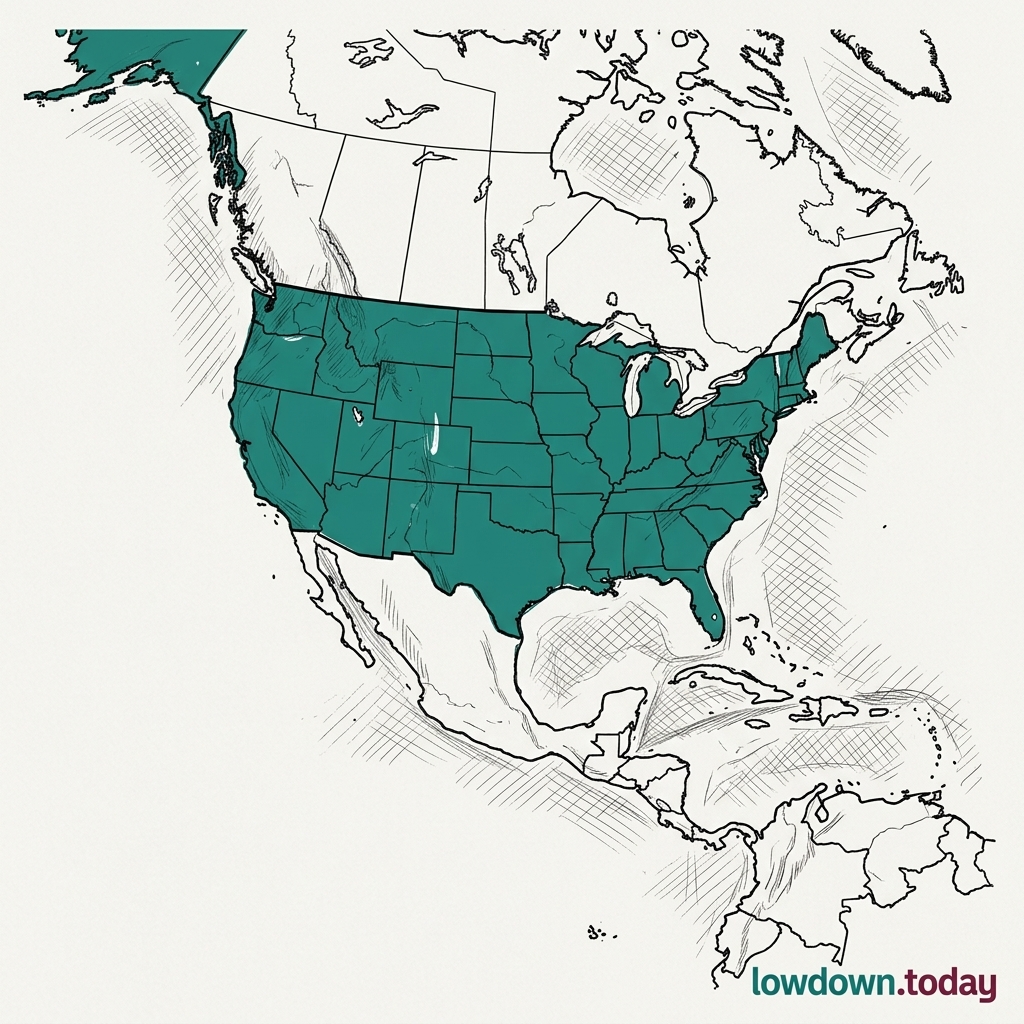
United States
Federal constitutional republic; world's largest economy and leading military power under President Trump.
The US Senate fell one vote short on 24 September, 49 to 50, of ordering American forces out of hostilities with Iran, while the naval blockade of Iranian ports begun on 14 July stayed in force.
Last refreshed: 3 October 2026 · Appears in 14 active topics
Can a constitutional republic sustain a 15,000-personnel war indefinitely without a single signed executive instrument?
Timeline for United States
Mentioned in: Zelenskyy ties elections to a ceasefire
Russia-Ukraine War 2026Mentioned in: Witkoff's Miami talks end a day early
Russia-Ukraine War 2026Opened its market to Russian-origin diesel
Russia-Ukraine War 2026: OFAC opens US market to Russian dieselMentioned in: Ten agencies name Beijing firm in hacks
Cybersecurity: Threats and DefencesMentioned in: Pentagon cuts a box from overseas forms
US Midterms 2026Background
The United States is a federal constitutional republic with the world's largest economy and armed forces of global reach. Authority is divided: the President directs Foreign Policy and commands the military, Congress controls appropriations and the power to declare war, and the courts review both.
The Iran war has made that division visible. Donald Trump, president since January 2025, has run the campaign through Central Command and delegated sanctions authority, signing no Iran instrument between 12 and 21 September even as his agencies designated a Russian bank and an Iranian exchange. On 30 September the last US troops left Erbil Air Base, ending the Iraq leg of Operation Inherent Resolve.
American power also runs through trade and sport. On 24 July Trump ordered a Section 301 investigation into EU digital rules, the same day a separate forced-Labour tariff of 10 to 12.5% took effect on about 60 economies. The United States co-hosted the 2026 World Cup with Canada and Mexico; Belgium knocked it out 4-1 in Seattle on 6 July.
Congress falls short of ending the war
The House passed H.Con.Res.89 by 214 votes to 208 on 23 July, directing the withdrawal of US forces from the Iran conflict under the War Powers Resolution, while the Senate killed a binding companion, S.J.Res.180, by 47 to 49 the same day. On 15 September The House voted on war powers again without forcing a withdrawal.
On 24 September the Senate rejected H.Con.Res.89 by 49 to 50. Rand Paul, Susan Collins, Lisa Murkowski and Thom Tillis crossed party lines, Tillis for the first time, citing economic cost and voter opposition. A concurrent resolution never reaches the President, so even a win would have registered congressional opinion rather than bound the executive.
The United States blockades Iran's ports
US Central Command began enforcing a blockade of Iranian ports at 8pm on 14 July, reversing its own statement two days earlier that the strait of Hormuz remained open; Brent rose to $87 and daily transits fell to about six ships. By 6 August it reported 49 vessels redirected, two disabled and two boarded.
The blockade has become a bargaining chip. Iran's six conditions of 8 August for reopening the strait included lifting it, and on 26 September Trump rejected a seven-day reopening plan that Qatar had carried from Tehran. Saudi Arabia and the United Arab Emirates want the blockade kept, and three seized tankers carrying close to 6 million barrels were weeks from American ports on 25 September.
Washington extends sanctions beyond Iran
On 4 September the Treasury blacklisted Turkey's Golden Global Yatirim Bankasi and two affiliates for moving Revolutionary Guard money, giving counterparties until 19 September to wind down. Russia's VTB Bank joined the US list on 14 September, when the State Department cited its branch offices inside Iran and the billions of dollars of Iranian assets it had shifted.
A further Treasury round on 29 September hit ten parts of a network buying missile and drone components for Tehran, centred on KavoshCom Asia R and D Group, including companies incorporated in Riyadh, Islamabad and Istanbul. Each round pushes US compliance pressure onto banks and suppliers in third countries, the place where Washington's financial reach extends furthest beyond its own territory.
Congress falls short of ending the war
How many ships has the US Navy seized in the Iran blockade?
Recently resolved
How much is the Iran war costing the United States?
Did the US halt military action against Iran in July 2026?
When did the United States suffer its first combat deaths in the Iran war?
Did the 2026 FIFA World Cup set an all-time attendance record?
Is AI taking jobs in the United States?
Did NATO allies refuse to help the US in Iran?
Was there a real measles exposure at a US airport in 2026?
Is measles making a comeback in the United States in 2026?
Is the US still the main funder of Ukraine's war effort?
Has the US renewed its Russia crude oil waiver in 2026?
How is the Iran war affecting the 2026 FIFA World Cup?
What sanctions is the US running on Iran in 2026?
Is the United States in a war with Iran?
Has the US Congress authorised the Iran war?
What is the 2026 FIFA World Cup visa bond and which countries are affected?
Where is the 2026 FIFA World Cup being held?
Has Trump signed any executive order on the Iran war?


Written with AI from Lowdown's published reporting. Not individually reviewed by an editor. Updated 3 October 2026. Editorial standards.