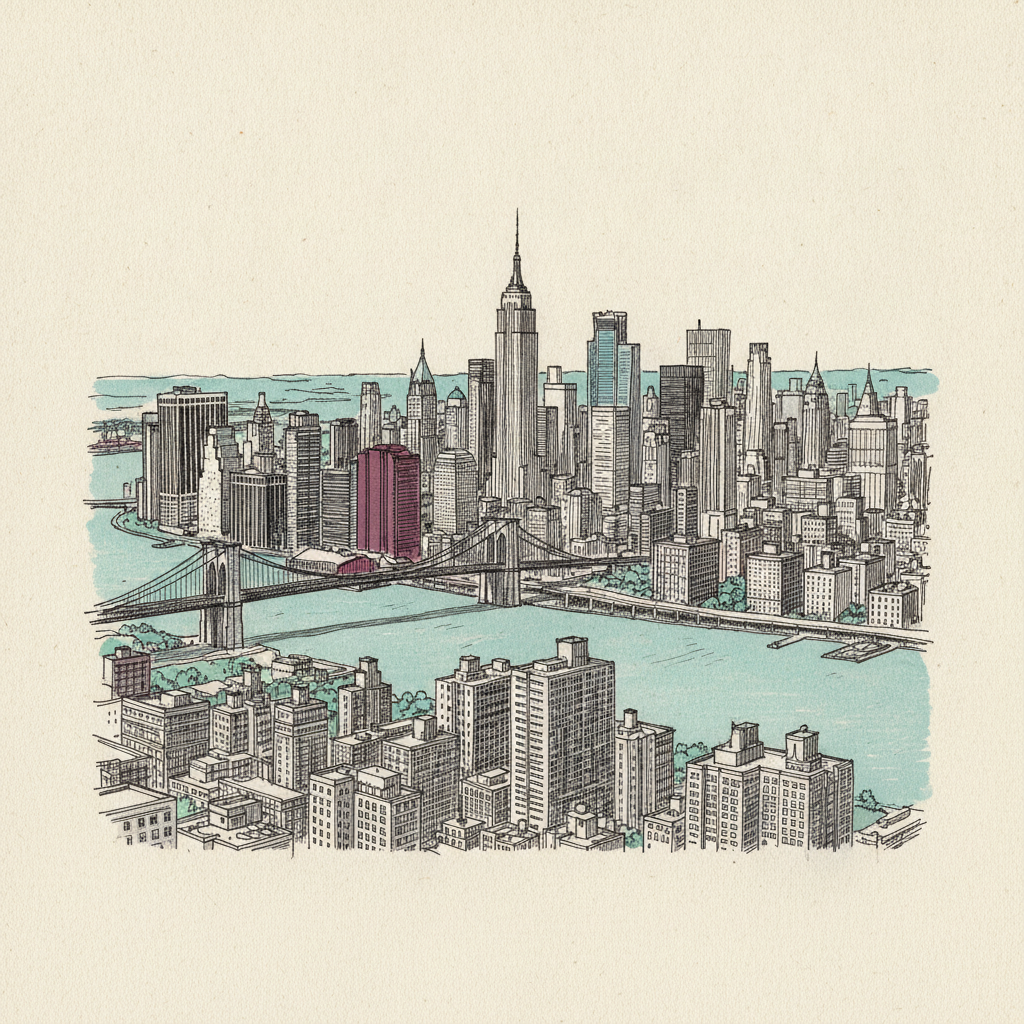
New York
The largest city in the United States and a global centre of finance, media and culture.
New York hosted the first structured US contact with Iran of the war on 22 September, when Abbas Araghchi met American envoys during the UN General Assembly, a fortnight after the IAEA sent Iran's nuclear file to the Security Council there.
Last refreshed: 3 October 2026 · Appears in 4 active topics
Timeline for New York
Mentioned in: Iran hangs two men over Mashhad unrest
Iran Conflict 2026Mentioned in: Qatar brings the US answer to Araghchi
Iran Conflict 2026Mentioned in: Caribbean PMs ask EU for CBI transition
Nomads & CommunitiesHosted the G20 foreign ministers' Ebola meeting
Pandemics and Biosecurity: G20 talks take Ebola pledges to US$3bnMentioned in: No Going Back PAC spends $29.2m in week
US Midterms 2026Background
New York is the largest city in the United States, spread across five boroughs: Manhattan, Brooklyn, Queens, the Bronx and Staten Island. It concentrates finance, media, culture and diplomacy to a degree no other US city matches.
It is home to the United Nations headquarters, which makes it the venue for Security Council business and for the General Assembly's September week, when leaders and envoys meet outside formal channels. Wall Street, the New York Stock Exchange and the Federal Reserve Bank of New York anchor its financial role. The New York Fed's research also makes the city a source of national Labour data: a survey published on 5 August 2026 found AI use among US service firms up from 25 to 40 per cent in a year, with layoffs still rare.
Its exchanges draw foreign companies too. On 18 September 2026 Nscale, a European AI computing firm, filed to list on the New York Stock Exchange at a $14.6bn valuation rather than on a home market.
New York became the war's meeting room
Iran's nuclear file came to Manhattan on 9 September, when the IAEA's Board of Governors voted 23 to 3 to send it to the UN Security Council, a step last taken two decades earlier.
General Assembly week then turned the city into the war's main venue. On 22 September Iran's Foreign Minister Abbas Araghchi met Steve Witkoff and Jared Kushner there, carrying a seven-day plan to reopen Hormuz that Washington rejected four days later. The same week, on 24 September, the prime ministers of Antigua and Barbuda and Saint Lucia used the city to lobby the European Commission over their passport schemes.
New York froze new data-centre permits
On 14 July Governor Kathy Hochul used an executive order to halt, for one year, any new discretionary environmental permit for a hyperscale data centre anywhere in the state. It made New York the first state to impose a binding statewide freeze by decree; a bill doing the same sits unsigned.
The order gave Empire State Development 60 days to set out what developers owe host communities. Its Community Investment Framework, published on 15 September, proposes $1m per megawatt of voluntary community spending, with no penalty for declining. The benchmark is New York's opening position for negotiations once the freeze lifts.
Its attorney general chased ticket records
New York Attorney General Letitia James and her New Jersey counterpart Jennifer Davenport subpoenaed FIFA on 28 May for ticket-pricing records covering the eight matches at MetLife Stadium, including the 19 July final. The two attorneys general alleged that FIFA added premium seat tiers after sales closed.
No US authority had served compulsory legal process on football's governing body before those subpoenas. The city itself carried the tournament's transport load: Penn Station closed to regular commuters for four hours before each MetLife match, and Times Square saw the first reported fan clash in a US host city on 15 June.
Reference
Is New York a global financial centre?
Was New York a host city for the 2026 World Cup?
How did New York's transit system cope with the World Cup?
Did New York publish a human rights plan for the 2026 World Cup?





