Australia
Federal Indo-Pacific democracy; 2026 World Cup nation and AUKUS partner.
Australia's AUKUS undersea-drone programme drew a European challenge on 8 June 2026, when Kongsberg and DRASS bid for work from 2027, a week after the pact named only two American-built robots for its first advanced-technology project.
Last refreshed: 3 October 2026 · Appears in 8 active topics
Why did Australia sign the Hormuz coalition when it barely imports Gulf oil?
Timeline for Australia
Mentioned in: Ten agencies name Beijing firm in hacks
Cybersecurity: Threats and DefencesMentioned in: Hanwha buys two Milrem THeMIS robots
Autonomous Systems: Land & SeaCapped second- and third-year working holiday visas
Nomads & Communities: Canberra puts backpacker visas to ballotMentioned in: Brazil moves nomad visas to e-visa only
Nomads & CommunitiesNEXTDC books 565.1 MW, options excluded
Data Centres: Boom and BacklashBackground
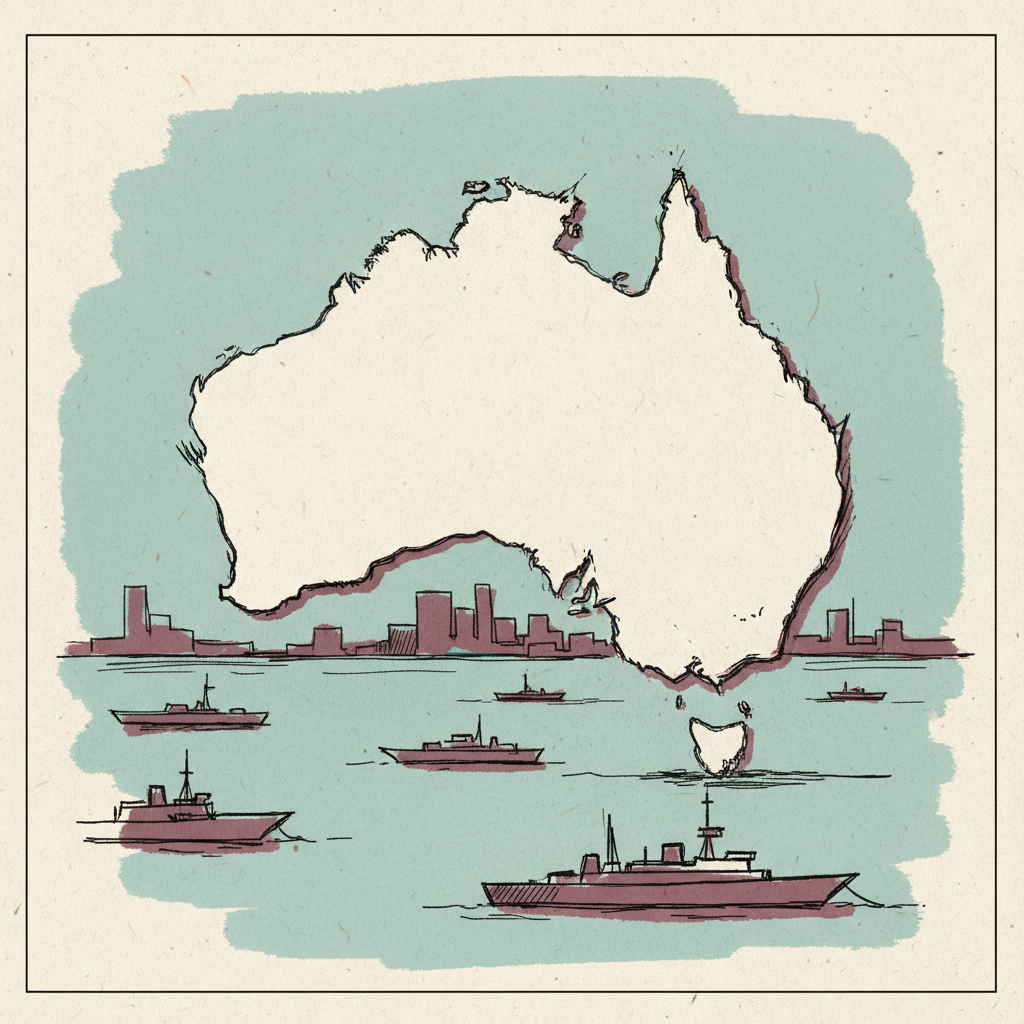
Australia is a federal parliamentary democracy in the Indo-Pacific with about 27 million people, six states and several territories, and Canberra as its capital. Its economy combines domestic services with trade into Asia and large resource exports. Its security weight exceeds its population because it works through ANZUS, Five Eyes, AUKUS and maritime coalitions linking the Indian and Pacific Oceans.
Canberra has started rationing temporary migration. Tony Burke, the Home Affairs minister, said on 17 September 2026 that extensions of the working holiday visa will be drawn by ballot, cutting the third year from 31,000 qualifiers to 5,000 places.
Australian regulators have also started writing rules for the power demand of data centres. On 5 August the Australian Energy Market Commission advised energy ministers that large centres should buy certificates from new wind and solar farms, and New South Wales introduced a bill giving its energy minister a veto over grid connections of 5 MW or more.
Australia's seabed pact favours American robots
Australia's first AUKUS Pillar II project, signed in Singapore on 30 May 2026, named two US-built underwater robots for a shared mission-equipment programme: the Mission Specialist Defender Mk IV and the L3Harris Iver4 900. Hardware deliveries start in 2027, and no British-built platform appears in the fact sheet.
European industry moved quickly to contest the next round. On 8 June Norway's Kongsberg and the Italian builder DRASS announced a joint bid pairing a Kongsberg underwater drone with a compact submarine that carries three of them. A month later, on 6 July, Thales agreed to buy Exail for €3.9bn, folding France's uncrewed submarines and navigation systems into one company. For Canberra, the choice is whether its seabed fleet stays an American monopoly or becomes a contested market.
Australia flies surveillance for the coalition
Australia sent a single high-value asset to the strait of Hormuz Coalition. On 18 May 2026 it committed an advanced surveillance aircraft, alongside a French aircraft carrier, a German minehunter and supply ship, and a Belgian minehunter rerouted from the Baltic.
The deployment gives Canberra a role in Gulf maritime security FAR from its own region, through the same alliance ties that bind it to Washington and London. Eight days into the deployment no rules of engagement had been published for the Coalition. Australia's Iran policy has also run through diplomacy: on 13 August it was among 32 states, with the EU's High Representative, that condemned Iran's use of the death penalty after at least 56 national-security executions since 19 March.
Australia exits on penalties
Australia's 2026 World Cup began with a record. In Vancouver on 14 June it beat Türkiye 2-0, and Nestory Irankunda, at 20 years and four months, became the country's youngest World Cup scorer, displacing Brett Holman's mark from 2010. Connor Metcalfe added the second.
The group stage then turned harder. The United States won 2-0 on 19 June through a Cameron Burgess own goal and an Alex Freeman header, and a goalless draw with Paraguay followed in a dead rubber. In the Round of 32 on 3 July, Australia drew 1-1 with Egypt and lost 4-2 on penalties, handing Egypt the first World Cup knockout win in its history.
Reference
What is AUKUS and what does it mean for Australia?
Does Australia import oil from Iran or the Persian Gulf?
What result did Australia get in their first World Cup 2026 game?
Who is Nestory Irankunda and what record did he break?
What is Australia's role in the Iran conflict?
Why did Australia join the Strait of Hormuz military coalition?
Did Australia qualify for the 2026 World Cup?



