Korean Peninsula
Divided peninsula where US missile shields face redeployment to the Middle East, exposing a strategic gap.
Last refreshed: 30 March 2026 · Appears in 1 active topic
Does stripping South Korea of its THAAD shields to fight Iran open a gap Pyongyang cannot resist?
Timeline for Korean Peninsula
Mentioned in: Trump's three pledges, China's silent readout
Iran Conflict 2026Mentioned in: South Korea pulls Iron Dome forward to 2029
Drones: Industry & DefenceMentioned in: Munir extracts Iran's first nuclear monitoring concession
Iran Conflict 2026Mentioned in: Trump ties Xi summit to Hormuz passage
Iran Conflict 2026Lost 2,200 Marines and F-35 assets redeployed from Pacific to Middle East
Iran Conflict 2026: 2,200 Marines pulled from PacificBackground
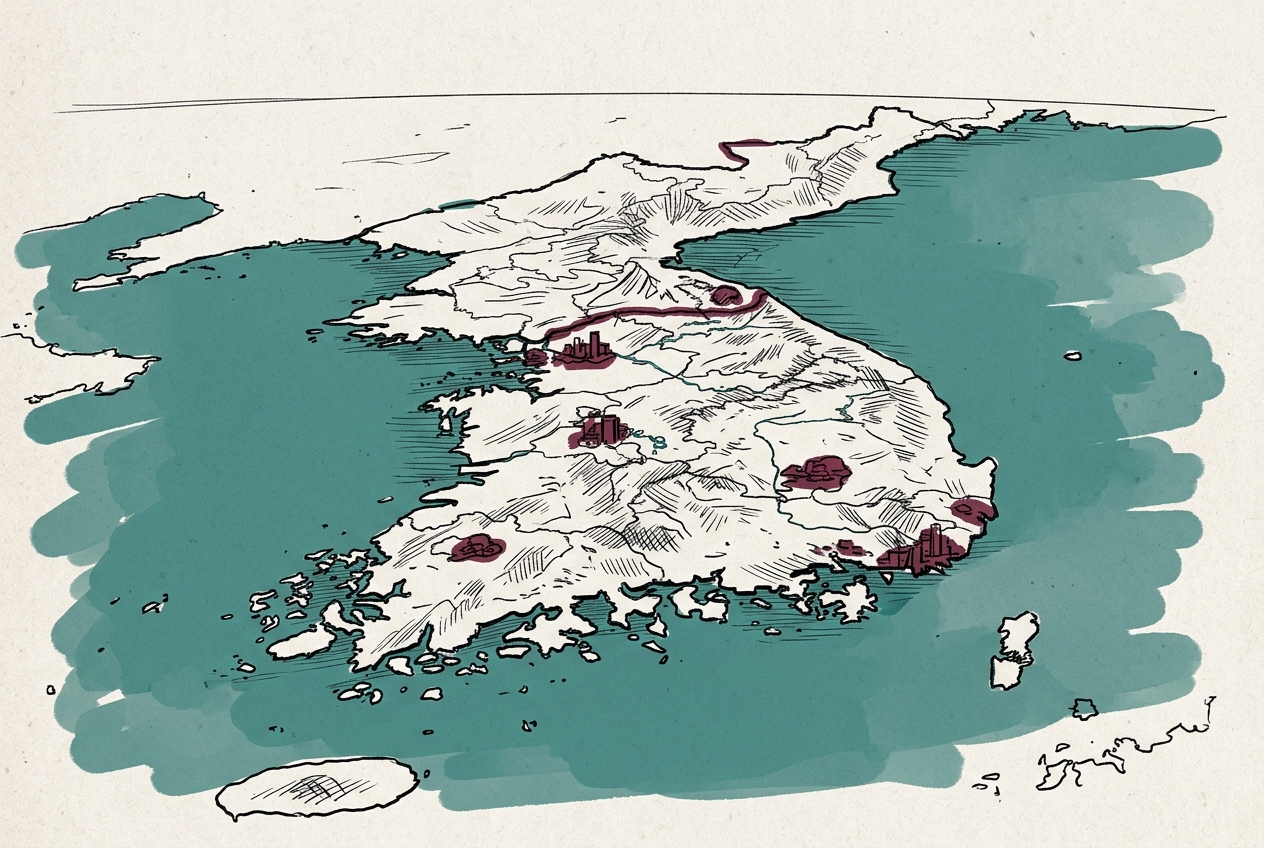
The Korean Peninsula stretches 1,100 kilometres from the Yalu River to the Korea Strait, divided since 1945 between South Korea (Republic of Korea) and North Korea (Democratic People's Republic of Korea). The 1953 armistice ended active fighting but not the war, leaving a 4-kilometre-wide Demilitarized Zone between two of the most heavily armed borders on Earth. The United States has maintained roughly 28,500 troops and a THAAD battery in South Korea ever since.
The peninsula became a direct casualty of the Iran conflict. The Pentagon weighed repositioning THAAD and Patriot batteries from South Korea to The Gulf after US forces expended 100-150 THAAD interceptors in eight days of fighting. Lockheed Martin produces roughly 48 THAAD interceptors per year; full replenishment would take two to three years. The 31st Marine Expeditionary Unit was simultaneously redeployed from Japan to the Middle East, drawing down INDOPACOM's forward assets.
The peninsula illustrates the live arithmetic of a military stretched between two flash points. Stripping South Korea of THAAD while North Korea retains its Ballistic missile arsenal creates a measurable defensive gap, one that adversaries in Pyongyang or Beijing could be tempted to exploit.
What is the Korean Peninsula?
Is the US moving THAAD from South Korea to the Middle East?
How long would it take to replace THAAD interceptors used in the Iran war?
What is the difference between THAAD in South Korea and Patriot in the Gulf?
Why did 2,200 US Marines leave Japan during the Iran conflict?


