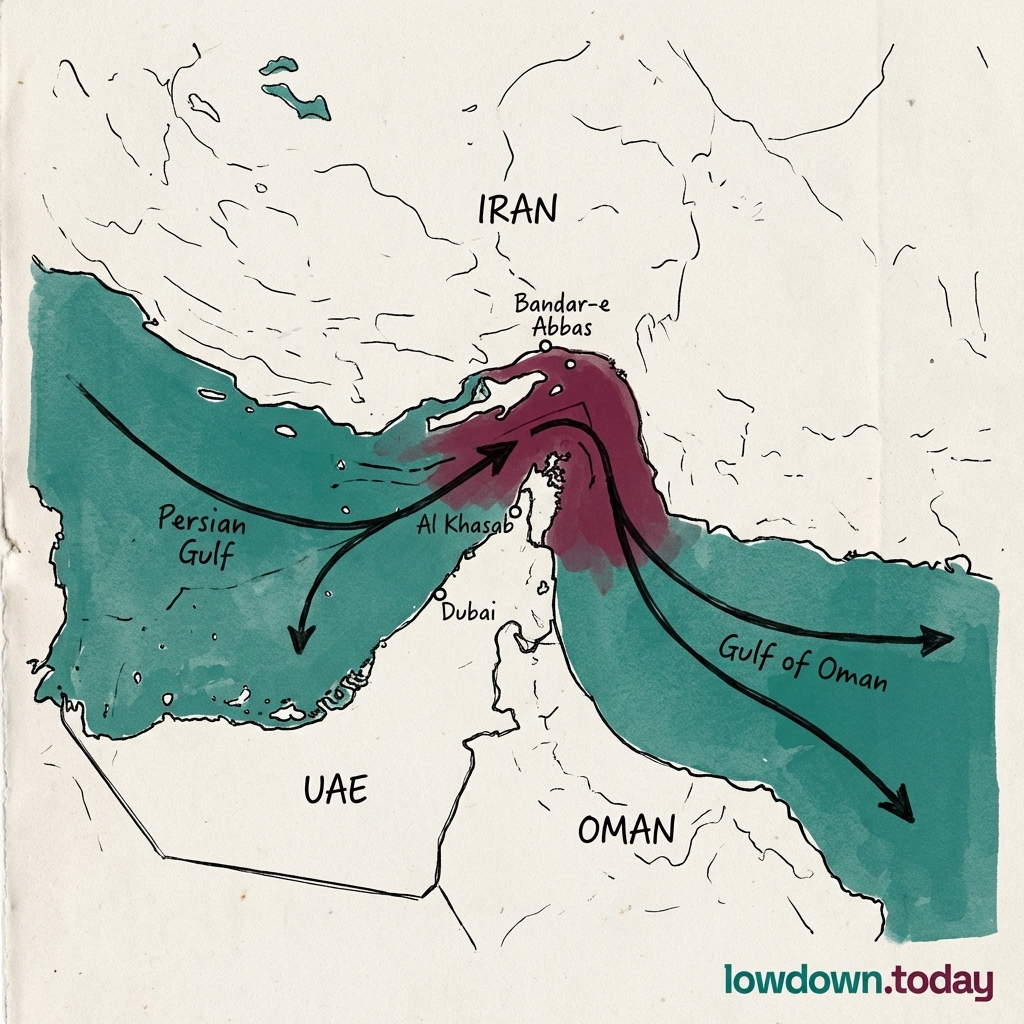
Strait of Hormuz
33km chokepoint for a fifth of global oil and LNG; contested amid Iran conflict.
On 11 September, the strait of Hormuz carried about 20 US-facilitated transits a day, but only six appeared on transponders, leaving passage through the 33km waterway difficult to assess.
Last refreshed: 22 September 2026 · Appears in 7 active topics
Three trackers can't agree on Hormuz traffic: is anyone counting real ships anymore?
Timeline for Strait of Hormuz
Held some 23 million barrels of Iranian crude behind it
Iran Conflict 2026: Iran loads no crude for a whole monthQatar brings the US answer to Araghchi
Iran Conflict 2026Carried four struck tankers over 28 and 29 September
Iran Conflict 2026: Al Funtas is struck and files no reportCarried at least four loaded Qatar-linked carriers in late September
Iran Conflict 2026: QatarEnergy suspends gas as ships movePentagon adds a 19th name to its toll
Iran Conflict 2026Background
the strait of Hormuz is a 33km maritime channel between Iran and Oman. It is the sole SEA exit for Gulf hydrocarbon exporters including Saudi Arabia, Kuwait, Iraq, the United Arab Emirates, Qatar and Iran. Its geography makes it a transport chokepoint, not a political authority or shipping service.
Iran signed but did not ratify the treaty provision guaranteeing transit passage through international straits. On 12 July, the Revolutionary Guard struck the GFS Galaxy and declared the strait closed; the reported legal basis relied on that unresolved position.
Control of access also has a financial dimension. On 30 July, the US Treasury named the HormuzSafe scheme and Persian Gulf Marine Insurance Company as sanctions-evasion vehicles. The episode shows why navigation in the strait depends on insurance and official claims as well as geography.
Traffic remains hard to verify
On 11 September, UK Maritime Trade Operations counted about 20 US-facilitated transits a day through southern Hormuz, yet only six appeared on ship transponders. Traffic was roughly 90% below the pre-war level of 138 daily crossings, leaving the strait of Hormuz's operational picture incomplete for shipowners and insurers.
The measurement problem extends to cargo volumes. On 2 September, US Energy Secretary Chris Wright said more than 17 million barrels had crossed by ship on 31 August, while tracker Samir Madani put Arabian Sea outflow at about 9.14 million barrels. The higher figure included pipeline volumes that bypass the strait, so the two counts do not measure the same passage.
Routing remains politically contested
On 5 August, Iran and Oman announced new coordinates for ships using the strait of Hormuz, but neither government published a chart or legal text. Masters therefore had no single route they could treat as authoritative, while insurers lacked a document from which to price passage.
The same day, Iranian state media said eight negotiating rounds had produced preliminary approval for a maritime-corridor draft. Approval by The Supreme Leader and Supreme National Security Council was still required, leaving the arrangement unfinished. For the strait, routing remains tied to wider political authority rather than a settled navigation rule.
Reference
How much of Europe's gas supply depends on the Strait of Hormuz staying open?
What is the BIMCO CONWARTIME clause and why does it matter for Hormuz?
How much of the world's oil goes through the Strait of Hormuz?
Has the Strait of Hormuz been closed before?
Why is the Strait of Hormuz so strategically important?
Where exactly is the Strait of Hormuz?
What is the Hormuz toll system?
Why did P&I clubs cancel and then rebuy Hormuz war-risk cover in August 2026?
Why do Kpler and S&P Global give different Hormuz transit counts?
Was anyone killed in the Strait of Hormuz in August 2026?
How did the July 2026 US-Iran strike halt affect European gas prices?
How much oil does Iran export through the Strait of Hormuz in 2026?
What are war-risk insurance premiums for ships in the Strait of Hormuz?
How long would it take to reopen the Strait of Hormuz after a ceasefire?
What is Britain doing at the Strait of Hormuz?
How does the Persian Gulf Strait Authority work?
What is the Northwood Hormuz coalition and when can it deploy?
Why are thousands of seafarers trapped at the Strait of Hormuz?
Why did the US bomb Qeshm Island in June 2026?
Why did Iran fire on Indian tankers that had clearance to transit?
How long will it take to clear mines from the Strait of Hormuz?



