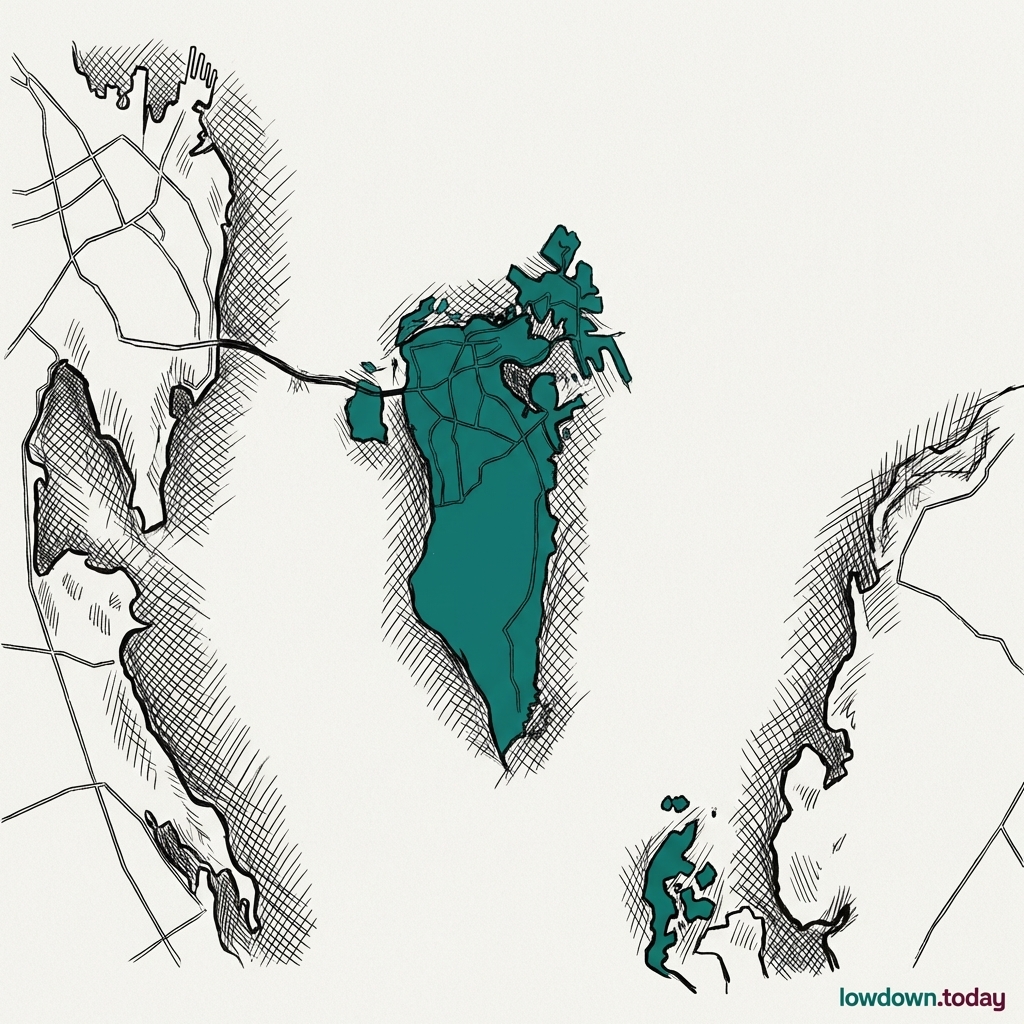
Bahrain
Gulf archipelago hosting the US Fifth Fleet; air-defence stocks near-exhausted as Iran's 2026 campaign intensifies.
Bahrain's Patriot interceptor stock stood at roughly 87% depleted by June, excluded from the US emergency resupply given to other Gulf states, even as Iran's regular Army widened Operation Saeqeh to strike Bahrain's Sheikh Isa airbase alongside Kuwait and Jordan by 18 July.
Last refreshed: 19 July 2026 · Appears in 1 active topic
Can CENTCOM defend Bahrain's Fifth Fleet base as local Patriot stocks run dry?
Timeline for Bahrain
Reported destruction of incoming munitions, not of its own installations
Iran Conflict 2026: Iran says destroyed, Kuwait says notMentioned in: Qatar files a UN claim against Iran
Iran Conflict 2026Mentioned in: Kuwait's water plants burn a fourth day
Iran Conflict 2026Mentioned in: IRGC thanks Jordanians for helping it aim
Iran Conflict 2026Thirteen airlines book out to October
Iran Conflict 2026Background
Bahrain is an archipelago of 33 islands in the Persian Gulf with a population of roughly 1.5 million, over half of them foreign nationals. It hosts the US Navy's Fifth Fleet at Naval Support Activity Bahrain, the most forward-deployed American naval presence in the Gulf, and Britain's HMS Juffair sits alongside it. A Shia-majority population governed by a Sunni monarchy gives Iran a sectarian fault line it has historically exploited, and the kingdom is a signatory to the Abraham Accords and a Gulf Cooperation Council member. With almost no natural fresh water, Bahrain depends entirely on desalination plants for drinking water.
Bahrain has absorbed more Iranian fire per square kilometre than any other Gulf state in the war: Iran has struck the Fifth Fleet headquarters, the BAPCO oil refinery and the Israeli Embassy compound, prompting Britain to withdraw diplomats. In March 2026 Bahraini authorities arrested 41 alleged IRGC-recruited nationals, the largest single IRGC-linked detention in the kingdom's history, exposing a threat that runs both external and internal at once.
The deeper problem is Bahrain's near-empty interceptor magazine: by 3 June its Patriot PAC-3 stock was estimated at 87% depleted after intercepting 198 projectiles, and it was excluded from a US emergency resupply authorisation covering Qatar, Kuwait, the UAE and Israel. A 50-round replacement order sits behind an 18-month production queue at the Camden, Arkansas factory, itself already behind Qatar's 300 rounds and Saudi Arabia's 730. On 12 May Bahrain signed the Multinational Military Mission for the Strait of Hormuz alongside Qatar, its first appearance on Western coalition paper, a calculus unchanged since: it absorbs Iranian fire and joins every Coalition because of the Fifth Fleet, and increasingly relies on CENTCOM to absorb The Intercept burden its own stocks can no longer carry.
Was the US Fifth Fleet base in Bahrain attacked again in late June 2026?
Is the US Fifth Fleet headquarters in Bahrain safe?
What did the IRGC hit in Bahrain on 5 June 2026?
Why is Bahrain running out of Patriot missiles?
What did Bahrain sign on 12 May 2026?
Has Bahrain joined the US naval blockade of Iran?
Why does Bahrain host the US Fifth Fleet?
How many Iranian attacks has Bahrain intercepted?
Does Bahrain have enough fresh water to survive the conflict?
Why is Iran targeting Bahrain in the 2026 conflict?
Is Bahrain Sunni or Shia?
Where is the US Fifth Fleet based?


