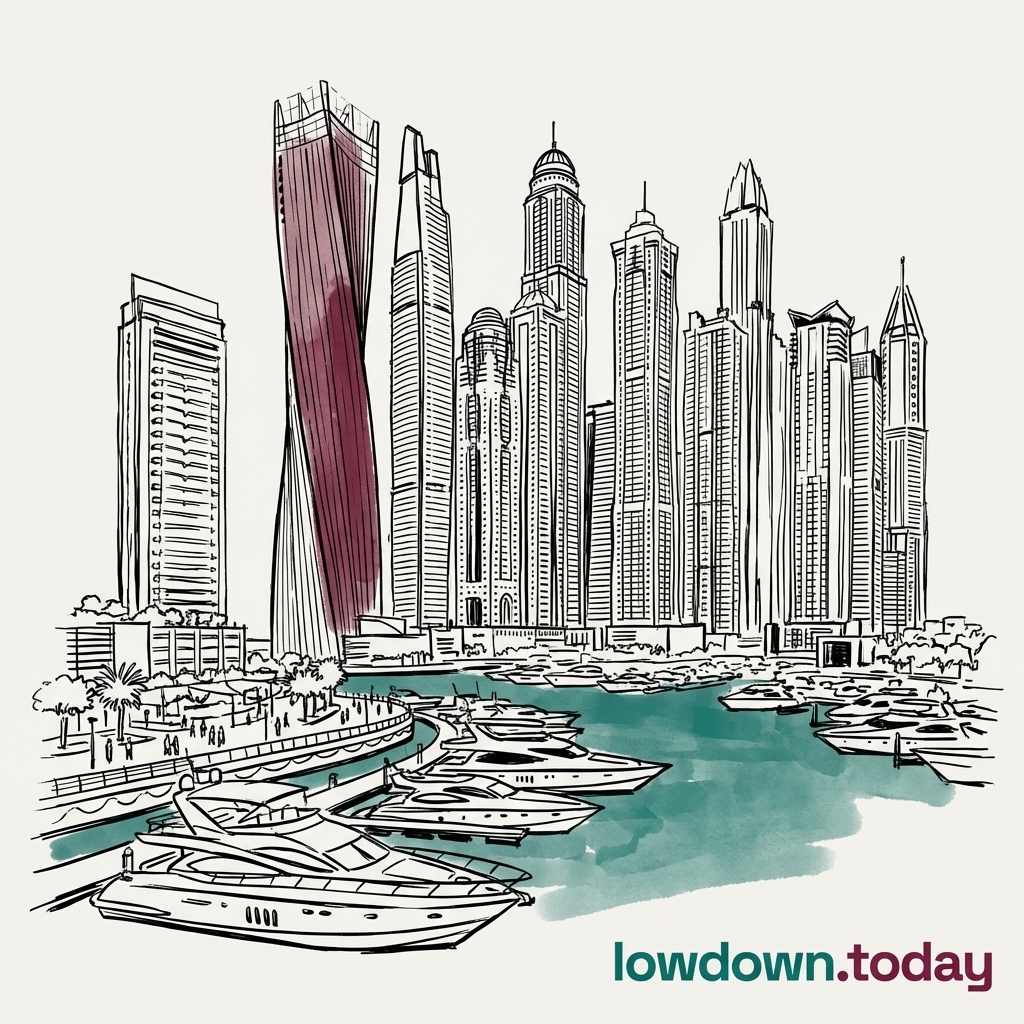
Dubai
UAE's commercial capital, Gulf trade hub, and a global oil-price benchmark.
Dubai is the UAE's commercial capital and a global oil-price benchmark whose Gulf neutrality shattered on 28 February 2026, when Iran fired 137 missiles and 209 drones at the emirate, striking Dubai International Airport and the Burj Al Arab twice.
Last refreshed: 19 July 2026 · Appears in 2 active topics
Why is a city that started no war bearing the cost of one?
Timeline for Dubai
Mentioned in: Kuwait's airport shuts as Gulf carriers retreat
Iran Conflict 2026Mentioned in: Wind-down licence lapses for blocked ships
Iran Conflict 2026Mentioned in: Brent-WTI gaps to $5.13 on Hormuz
European Oil MarketsMentioned in: Russians named in IRGC arms network
Iran Conflict 2026Mentioned in: Freight has not confirmed the spike
European Oil MarketsBackground
Dubai is the UAE's most populous emirate and its commercial engine: a 3.5-million-person city built on trade, logistics and finance rather than oil. It is home to an estimated 400,000 Iranian nationals, hosts the world's busiest international airport by passenger volume, and anchors the Jebel Ali free zone, the largest deep-water port in the Middle East. Its currency, the UAE dirham, is pegged to the US dollar; the Dubai Financial Market and the DIFC financial district position it as the region's pre-eminent banking and arbitration centre.
Beyond its role as a city, Dubai names a crude-oil benchmark traded on exchanges thousands of miles from its ports. Dubai crude, also traded as Platts Dubai, is the primary pricing marker for Middle East sour crude sold into Asia, used to settle Brent/Dubai EFS spreads and to price roughly a third of global oil exports. Any disruption to UAE exports or Gulf shipping lanes moves this benchmark independently of Brent or WTI.
Dubai built its post-1970s identity on Gulf neutrality: trade, finance and logistics for a region defined by conflict elsewhere. Iran's first missile-and-drone wave against the UAE on 28 February 2026, which struck the Burj Al Arab and Dubai International Airport, ended that assumption; the city has since operated as a combatant-adjacent hub rather than a neutral one, its financial infrastructure repeatedly used as a sanctions-enforcement lever against Iran-linked front companies.
What is the Dubai oil benchmark and how does it affect global prices?
Why did Iran attack Dubai in 2026?
How is Dubai used as a route to evade Iran sanctions?
What happened to Dubai's airport and port during the Iran conflict?
Where does Dubai fit in the Gulf trade and finance landscape?

