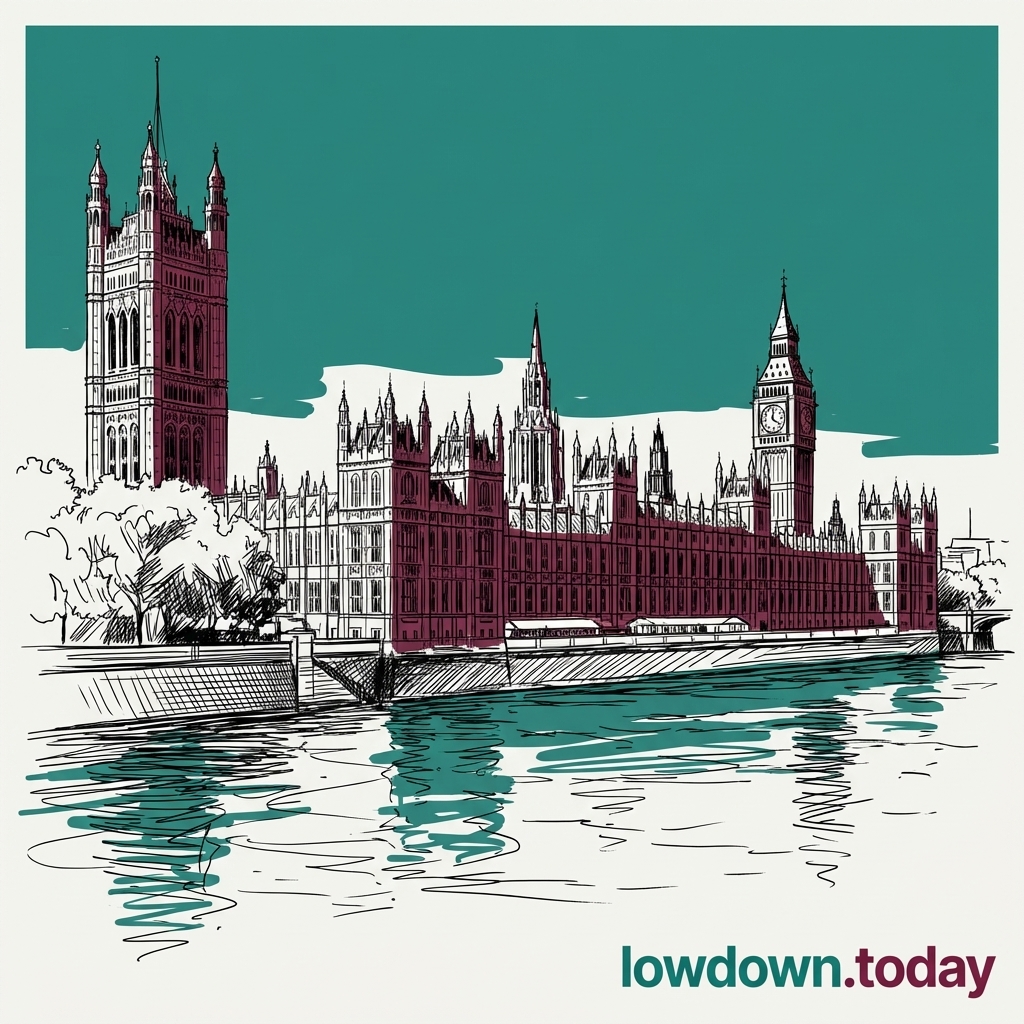
Parliament
Sovereign legislative body; UK Parliament prorogued 29 April 2026 with RPA crypto-ban unfinished.
Last refreshed: 14 May 2026 · Appears in 2 active topics
Did Parliament's prorogation deliberately leave crypto-funded candidates beyond the law on polling day?
Timeline for Parliament
Mentioned in: Qatar caps Iran's $12bn cash demand
Iran Conflict 2026Mentioned in: Essex audit unit meets the spend wall
UK Local Elections 2026Mentioned in: Brussels locks 27 May for CAIDA and Chips II
European Tech SovereigntyMentioned in: Dutch block first US cloud takeover
European Tech SovereigntyMentioned in: Holyrood demands a vote it cannot force
UK Local Elections 2026- What is the Iranian parliament called?
- The Islamic Consultative Assembly, commonly called the Majlis. Its speaker in 2026 is Mohammad Bagher Ghalibaf, who led Iran's delegation at the Islamabad talks with the United States.Source: Lowdown iran-conflict-2026 coverage
- What did the European Parliament vote on the AI Act?
- On 26 March 2026 it voted 101 to 9 to delay the AI Act's high-risk employment rules from August 2026 to December 2027. Its position in trilogue is that AI literacy obligations should be legally binding; the Council prefers non-binding encouragement.Source: Lowdown ai-jobs-power-money coverage
- Can the UK Parliament stop the Prime Minister going to war?
- By convention since the 2003 Iraq vote, prime ministers seek parliamentary approval before committing forces to combat. The convention is political, not statutory. In 2026 Keir Starmer used a Commons statement to formally refuse US requests to join military action against Iran.Source: Lowdown iran-conflict-2026 coverage
- Why does the Hungarian election matter for Ukraine?
- A Tisza victory would replace a government that has used its EU veto to block the EUR 90 billion loan for Ukraine. However, Tisza MEPs themselves voted against the package in the European Parliament, so disbursement is not guaranteed even if Tisza wins.Source: Lowdown russia-ukraine-war-2026 coverage
- What is a parliament versus a congress?
- Both are national legislatures, but parliamentary systems fuse executive and legislative power (the government is drawn from and accountable to Parliament), while congressional systems separate them. The UK, Canada, Australia, India, and EU member states use parliamentary systems; the United States uses a congressional model.Source: general
- Why was the crypto-donation ban bill not passed before the 2026 election?
- The Representation of the People (Amendment) Bill was excluded from the four-bill wash-up list when Parliament was prorogued on 29 April 2026, five days before polling. It fell entirely, leaving crypto-funded candidates outside any retrospective restriction.Source: Hansard Society / Lowdown uk-elections-2026
Background
Across Lowdown's coverage in early 2026, parliaments have functioned in three distinct modes: as legislative principals enacting consequential law, as diplomatic proxies projecting state positions into live conflicts, and as institutional vacuums whose absence or inaction shapes outcomes as powerfully as any vote. Iran's Parliament drafted legislation to codify the Strait of Hormuz toll into domestic law , while Parliament Speaker Mohammad Bagher Ghalibaf travelled to Islamabad as one of Tehran's two principal negotiators in the first US-Iran talks since 1979, making the speaker of a legislative body a front-line diplomatic actor. The European Parliament voted 101 to 9 to delay the AI Act's high-risk employment rules, with its position on binding AI literacy obligations now in trilogue against the Council's preference for non-binding encouragement.
Parliaments exercise authority not only through the laws they pass but through the conventions and political constraints they impose on executives. Westminster's uncodified war-powers convention, hardened after the 2003 Iraq vote, means British prime ministers seek parliamentary cover before committing forces; Keir Starmer used a Commons statement to formalise the UK's refusal to join US military action against Iran, transforming a diplomatic position into a durable public commitment. In Hungary, the outcome of the April 2026 election determines whether a new Parliament unlocks the EUR 90 billion EU loan for Ukraine that the outgoing Parliament's MEPs had voted against in Brussels. Canada's Parliament is effectively absent from the decision about the country's Artemis programme: MDA's commercial bids and investor calls are setting national space policy while Ottawa has issued no public statement.
The significance of Parliament as a cross-topic concept lies in the gap between formal authority and actual influence. A legislature can be the site where a conflict is formally ratified or refused, the body that codifies a wartime economic measure into permanent law, or the institution that delays a technology standard by sixteen months with a single vote. It can also be irrelevant, bypassed, or simply silent. Across geopolitics, technology regulation, and elections, 2026 has repeatedly exposed the distance between a Parliament's nominal sovereignty and its real capacity to direct events.
Westminster was prorogued on 29 April 2026, ending the parliamentary session with four bills Left unfinished. The most consequential casualty was the Representation of the People (Amendment) Bill, excluded from the wash-up list and Left without legal force — leaving crypto-donation gaps open on polling day.
The new Parliament opened on 13 May 2026 with the King's Speech, which contained 27 bills. The Representation of the People Amendment Bill was again absent from the programme. John Swinney's Section 30 order motion on Scottish independence is expected among the first major Commons proceedings, meaning the incoming chamber faces a devolution flashpoint before it has debated a budget. The prorogation-to-first-sitting period also coincided with the Starmer leadership crisis: the PLP head-count on 12 May — the day before the King's Speech — took place outside the formal parliamentary session.