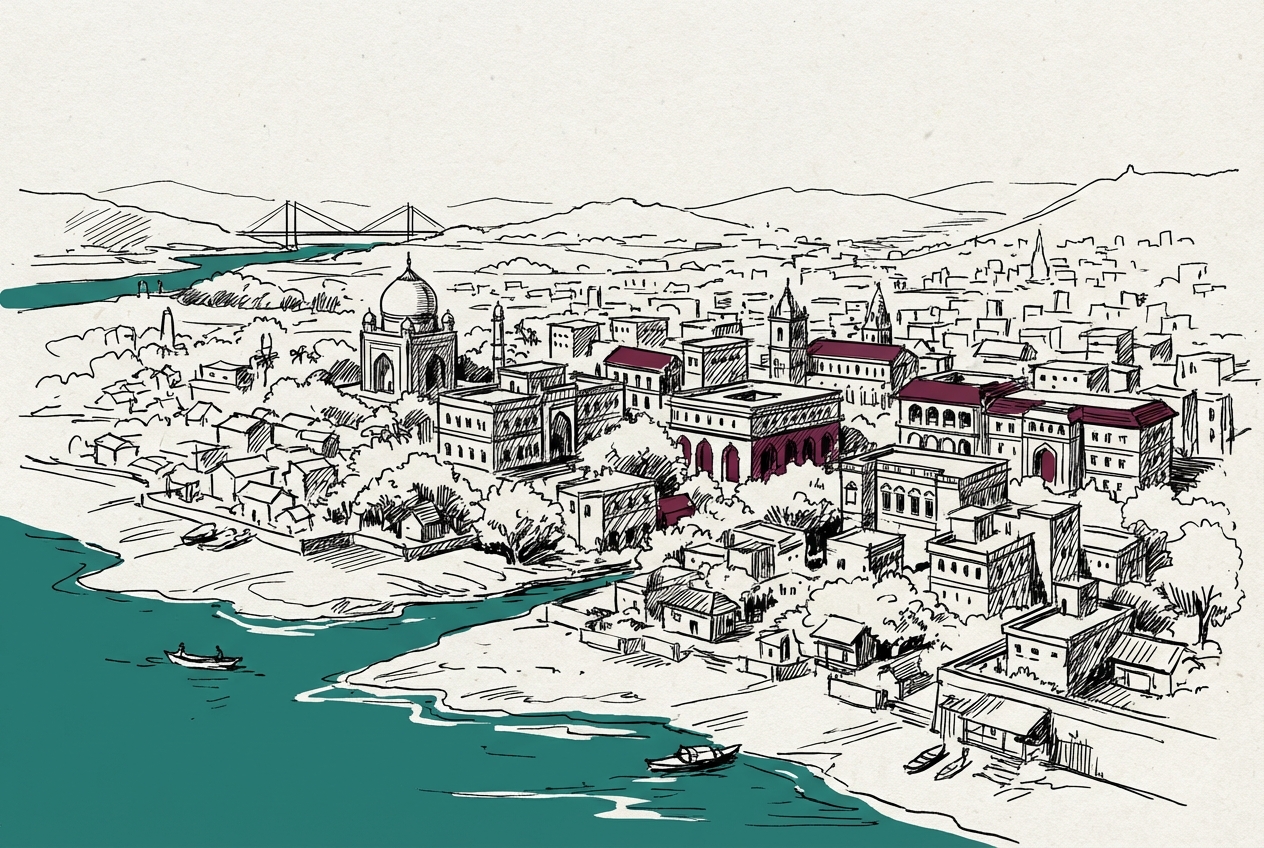
India
South Asia's largest democracy; Gulf-oil dependent, IT-sector job cuts, and major non-aligned diplomatic power.
India's refiners have absorbed a run of shocks to their discounted crude supply through 2026; by 29 July the delivered discount on Russian barrels had narrowed to just $1-2 a barrel, down from more than $10 in early July.
Last refreshed: 4 August 2026 · Appears in 9 active topics
Is India being pulled into the Gulf war as the first aggrieved non-belligerent power?
Timeline for India
Mentioned in: Bessent's oil threat meets a halved flow
Iran Conflict 2026Mentioned in: China flies inward as it walls exports
Drones: Industry & DefenceMentioned in: Gujarat pays for 7.5 GW of capacity
Data Centres: Boom and BacklashMentioned in: The quiet cuts nobody has to announce
AI: Jobs, Power & MoneyBackground
India is the world's most populous democracy and its fifth-largest economy by nominal GDP, with 5.8 million barrels a day of refining capacity that draws more than 80% of its crude imports from the Persian Gulf. That dependence is the fixed point around which India's Foreign Policy manoeuvres: New Delhi maintains parallel trade and diplomatic relationships with the United States, Russia, China and Iran simultaneously, a posture it describes as strategic autonomy rather than Non-alignment.
India also supplies the largest national cohort of merchant seafarers in the world, roughly 240,000 serving on commercial vessels at any time, giving New Delhi a direct human stake in Gulf and Red Sea shipping risk beyond its own cargo interests. Before 2019 India was Iran's second-largest oil customer after China, a relationship US sanctions cut off; that history still shapes how readily Indian refiners return to discounted but higher-risk crude when the price gap is wide enough.
Its Russian oil discount narrows
India's refiners built years of import economics on a wide discount for Russian crude delivered to their own ports; on 7 July that discount stood above $10 a barrel below Brent, worth pursuing despite the compliance risk of buying sanctioned-adjacent cargoes .
By 29 July a single unnamed-sources wire, the only support for that week's read, put the delivered-India discount at just $1-2, crediting the shift to Indian buyers themselves growing more willing to take on Hormuz-related risk rather than to any change in the crude's loading-point price . No comparable loading-point figure accompanied that report, so how much of India's saving has actually narrowed remains unconfirmed.
Waiver lapses threaten its crude access
India's refiners have depended on successive US Treasury general licences to keep buying discounted crude without falling foul of sanctions; each lapse without a named successor forces Indian buyers to weigh legal exposure against price. A US Treasury action on 28 May named Indian commercial counterparties in Chennai for the first time in its Iran-crude enforcement series, mapping the end-buyer chain rather than only transit intermediaries and putting Indian firms directly inside the sanctions net .
Secretary of State Marco Rubio said on 5 June that Washington wants to end Russian oil waivers 'as soon as we possibly can', with no confirmed replacement ahead of the 17 June expiry of GL 134C.
IT layoffs land unevenly across its giants
Oracle terminated 12,000 of its 30,000 India-based staff via a 6am email on 31 March 2026, a 40% contraction, the largest single-country AI-attributed tech layoff outside the US; none of the cuts appeared in Oracle's US WARN Act filings .
India's own IT majors complicated that picture. TCS shed 19,271 staff year-on-year by 9 July even as profit and revenue grew, HCLTech posted its sharpest quarterly headcount fall in five quarters by 13 July, and Wipro's zero-fresher pledge for FY27 coincided with a net headcount rise of 888, evidence the sector's AI-era contraction is uneven rather than uniform .
IT layoffs land unevenly across its giants
How many jobs did Oracle cut in India in 2026?
Reference
How much oil does India import from the Gulf?
Did India attend Ali Khamenei's funeral?
Is India being pulled into the 2026 Iran war?
How many Indian seafarers are at risk from the Gulf conflict?
What happened to India's Chabahar port deal and Iran oil access?
What happened to General License U when it expired?