United Nations Security Council (UNSC)
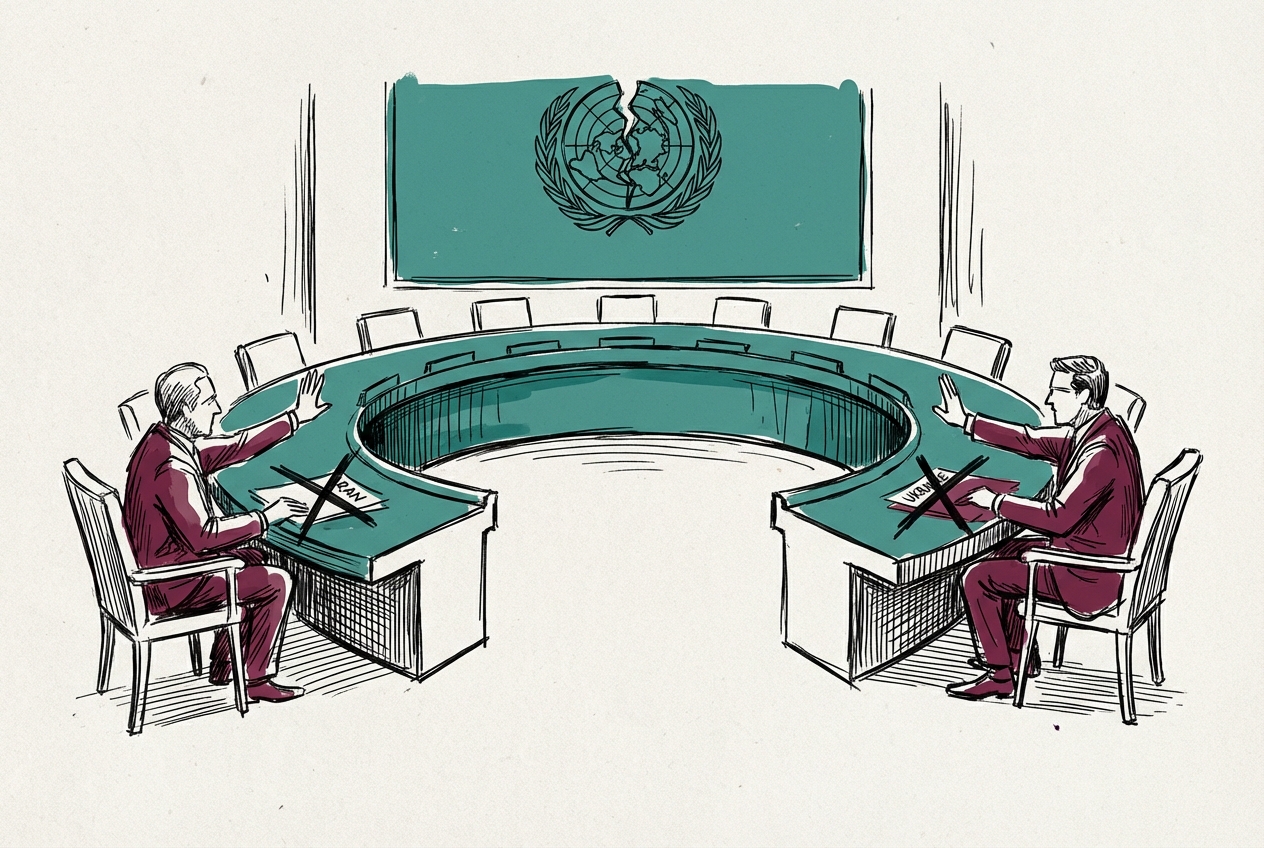
UN's principal peace and security body; structurally paralysed when P5 members are parties to a conflict.
On 10 April, the United Nations Security Council (UNSC) lost its route to compel a Strait of Hormuz reopening when Russia and China vetoed a resolution supported by 11 members.
Last refreshed: 22 September 2026 · Appears in 3 active topics
What use is the world's peace body when its veto-holders are the ones at war?
Timeline for United Nations Security Council (UNSC)
Passed Ebola Resolution 2177 in 2014
Pandemics and Biosecurity: Mentioned in: G20 talks take Ebola pledges to US$3bnRussia and China kill Iran's UN monitor
Iran Conflict 2026Mentioned in: Iraqi forces seize the launch platform itself
Iran Conflict 2026Received Iran's nuclear compliance file via referral
Iran Conflict 2026: IAEA Board sends Iran's file to New YorkReceived hundreds of Qatari letters documenting direct Iranian hits on Qatari facilities
Iran Conflict 2026: Qatar mediates in Beijing, files at UNBackground
The United Nations Security Council (UNSC) is the UN's principal body for international peace and security. Created under the UN Charter in 1945, it can impose binding measures, including sanctions and authorisations for force. Its 15 seats combine five permanent members with ten members elected for two-year terms.
China, France, Russia, the United Kingdom and the United States can each veto a substantive resolution. The arrangement was designed to keep the great powers inside the institution, but it prevents collective enforcement when a permanent member is party to a dispute or shields one.
The Council still supplies a formal forum, a public record and diplomatic legitimacy. In March 2026, it adopted Resolution 2817 with 13 votes while Russia and China abstained; in April, those same states vetoed the Hormuz measure.
The Council lost its route
On 10 April, 11 Council members backed a resolution calling for the strait of Hormuz to reopen, but Russia and China vetoed it. The vote ended the Council's collective route to require an opening.
By 14 June, a Council resolution or government certification was still needed before Lloyd's could remove Hormuz from its war-risk register. For the Council, the April veto showed that its legal authority cannot compel action when two permanent members oppose it.
Reference
What is P5 veto power at the UN?
What emergency UN session was called after the Oreshnik attack on Kyiv?
What happened at the UNSC Barakah session in May 2026?
Did Russia veto the Iran ceasefire resolution?
What did the UN Security Council do about the Iran war?
Did the UN condemn the US strikes on Iran?
How many Ukrainian civilians were killed according to UN figures in 2026?
Why can the UN Security Council not stop the Russia-Ukraine war?
Can the UN stop the Iran war?
What is UN Security Council Resolution 2817?



