
Skip to content
Iran Conflict 2026
20APR

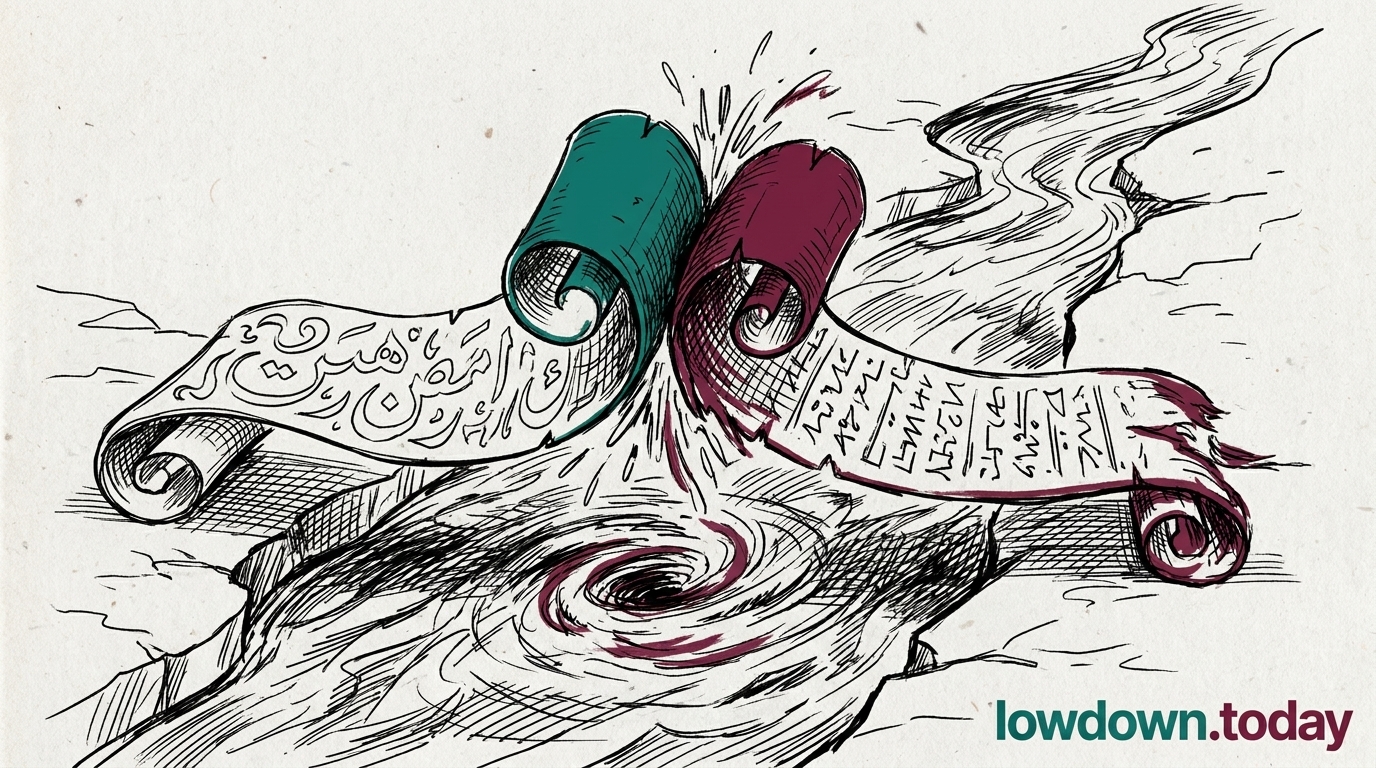
Day 52: Two unsigned rulebooks collide at Hormuz

19 min read
10:10UTC

On Day 52 of the Iran war two written-but-unsigned command frameworks now govern the same stretch of water. Iran's Revolutionary Guard Navy has published a four-condition transit order in Farsi; the US Navy has taken its first Iranian ship under a blockade whose only presidential authority remains a Truth Social post. The 22 April ceasefire expires in 48 hours against a mediation venue that has quietly shifted from Islamabad to Tehran.

Key takeaway

Both sides enforce without signed authority as the ceasefire clock expires.

In summary

US Marines seized the Iranian cargo ship Touska in the Gulf of Oman on 19 April after USS Spruance fired 5-inch rounds into its engine room, the first kinetic vessel-taking since the 1988 Tanker War and the first under nothing more than a Truth Social post. Two days earlier the IRGC Navy published its own four-condition Hormuz transit order in the Guard Corps outlet Tabnak, then fired on Indian-flagged tankers the Iranian Foreign Ministry had cleared by radio, splitting Iranian maritime authority in public. The 22 April ceasefire expires in 48 hours with no published text behind it, Treasury's Iran crude waiver GL-U has lapsed, and a Pakistani delegation is expected in Tehran, not Islamabad.

This briefing mapped
Loading map…
Military
Regulatory
Legal
Economic
Diplomatic
Humanitarian
Domestic

The USS Spruance fired into the Touska's engine room in the Gulf of Oman, the first kinetic seizure of an Iranian vessel since 1988.

Sources profile:This story draws on mixed-leaning sources from Qatar and France
QatarFrance
LeftRight

On 19 April the USS Spruance, an Arleigh Burke-class guided missile destroyer, intercepted the Iranian-flagged cargo ship Touska in the Gulf of Oman after a six-hour standoff. The warship fired several rounds from its 5-inch MK 45 naval gun into the Touska's engine room, put Marines aboard, and took the vessel into US custody. CENTCOM (US Central Command) confirmed 25 commercial vessels have been turned back since the blockade began 1.

The action crossed a threshold the previous 24 turn-backs had not. A US warship took an Iranian vessel into custody for the first time since the 1988 Tanker War, still operating under verbal authority alone. The direct antecedent was a Trump Truth Social post on 12 April , , narrowed by a CENTCOM operational order that pointed the blockade at Iranian ports . The Touska seizure also followed the IRGC firing on the Indian-flagged Sanmar Herald and Jag Arnav despite radio clearances , which is the Iranian escalation the Spruance was answering.

For shipping underwriters the risk picture changed in one afternoon. A turn-back is an insurable inconvenience; a hull taken into a foreign navy's custody is a constructive total loss claim. War-risk premiums on Hormuz hulls were already elevated; the Spruance action is the first underwritten data point on kinetic US interdiction. Khatam al-Anbiya (the IRGC's construction and engineering conglomerate) issued a written retaliation warning calling the seizure a ceasefire breach, which means the next Iranian response to a tanker stop is on a clock Tehran has now publicly started.

A counter-view from Trump's legal advisers holds that a commander-in-chief can act without signed instruments to defend US-flagged commerce. The Touska was Iranian-flagged, bound for a foreign port, still in international waters. That is a separable legal question no court has yet tested, and the signed-paper record an admiralty court would review remains empty of Iran instruments .

Explore the full analysis →

Iran's Revolutionary Guard wrote its own transit rulebook for the Strait of Hormuz in the IRGC-aligned Farsi outlet Tabnak. The foreign ministry had no seat at the drafting.

Sources profile:This story draws on neutral-leaning sources

On 17 April the IRGC Navy (Islamic Revolutionary Guard Corps Navy, Iran's parallel naval force) published a formal four-condition order for the Strait of Hormuz in the IRGC-aligned Farsi outlet Tabnak 1. Non-military vessels may transit only by Iran-designated routes; military vessels are barred; every passage requires prior Guard Corps authorisation; the framework is tied to the Lebanon ceasefire holding.

The Tabnak publication lets Iran's military write over its diplomats in public. Two days later Foreign Minister Abbas Araghchi announced a civilian corridor opening, and the announcement lasted less than 24 hours. Despite the radio clearances Iran's own foreign ministry issued, the Guard Corps fired on the Indian-flagged Sanmar Herald and Jag Arnav on Saturday 18 April . A Sanmar Herald crew member was recorded on open channel saying Iran had cleared the vessel and was now firing on it anyway, which is the evidence the Tabnak order is load-bearing and the foreign ministry's clearances are not.

For shipowners routing hulls through the strait, the practical question is whose paper to obey. The rulebook the IRGC has now published is domestic Iranian doctrine with no signatory outside the Guard Corps. The 1968 Traffic Separation Scheme agreed between Iran, Oman and the IMO has governed Hormuz movement for 58 years, and Iran's own civilian foreign ministry is still a party to it. A counter-view from sympathetic commentators in Tehran is that the Tabnak order is a wartime clarification rather than a substitute for civilian law, and that a single ceasefire can fold it back. That reading is hard to sustain while the Guard Corps is firing on vessels the foreign ministry has cleared.

Explore the full analysis →
Sources:Tabnak

OFAC let Iran's crude-export waiver expire at one minute past midnight, then on the same day signed the Russia equivalent through to 16 May.

Sources profile:This story draws on mixed-leaning sources from Qatar and France
QatarFrance
LeftRight

On 19 April Treasury Secretary Scott Bessent's Office of Foreign Assets Control (OFAC) allowed General License U, OFAC's Iran-crude waiver, to lapse at 00:01 EDT with no Federal Register notice and no replacement instrument , . The same Treasury Department, on the same day, signed General License 134B, the Russia seaborne-oil equivalent, extending Moscow's waiver to 16 May . OFAC does not sign General Licenses by accident, and the Federal Register carries both instruments from the same 19 April working day.

The White House presidential-actions index on 19 April recorded 51 days of Iran war with zero signed Iran executive instruments , . Two non-Iran orders were signed the same week, a college-sports executive order and a mental-illness treatment order, so the signing pen was available. Iran simply did not get it. Put differently, Treasury signed Russia's waiver the same day it let Iran's lapse. One country's oil flows with written permission; the other's is being stopped at gunpoint without any.

For European refiners the practical question is whose US-sanctions paper their bankers can now present to a letter-of-credit counterparty. GL-U had been the cover for residual Iran-linked crude in Chinese and Turkish flows; GL-134B continues to cover Russian barrels the G7 price cap was designed to constrain. Shipping underwriters will read the same asymmetry into war-risk premiums: a hull carrying Russian crude operates under extant US paper, a hull carrying Iranian crude operates against US paper that expired at one minute past midnight and was not renewed.

A counter-view from Treasury's defenders is that GL-U's expiry is a technical consequence of the blockade, not a signed policy, and that allowing it to lapse is itself a policy decision Congress has not contested. That reading still leaves the asymmetry on the page. The Trump administration's Russia posture has been argued on diplomatic grounds for months; the Iran posture is now operating without the paper a foreign court would expect to see.

Explore the full analysis →

The IAEA's April monitoring update, relayed by the American Nuclear Society, finds Fordow has not been reactivated since twelve GBU-57 bunker-busters disabled it in June 2025; the February 2026 strikes did not retarget the mountain site.

Sources profile:This story draws on neutral-leaning sources

The American Nuclear Society's 6 April 2026 relay of the IAEA Director-General's monitoring report confirms Fordow has not been reactivated since Operation Midnight Hammer on 22 June 2025 4. Twelve GBU-57 Massive Ordnance Penetrators, six per ventilation shaft across two shafts, were delivered by seven B-2 stealth bombers; Gen. Caine, Chairman of the Joint Chiefs, stated at the time that "all six weapons at each vent went exactly where they were intended to go." Satellite imagery shows tunnel portals remain backfilled, no heavy machinery has entered for reconstruction since late July 2025, and ventilation infrastructure is destroyed. Enrichment at Fordow is physically impossible while the shafts remain sealed.

Whether the MOP warheads actually penetrated the centrifuge cascade hall itself is contested. David Albright at the Institute for Science and International Security (ISIS) assesses the weapons "likely entered directly into the buried enrichment hall" based on satellite crater analysis; the IAEA, using "expected" rather than "confirmed" in its September 2025 monitoring report, declines to match that claim because no inspector has physically accessed Fordow since June 2025. The Arms Control Association notes the strategic effect, an inoperable facility, is not disputed by any credible source; the physical question is.

Natanz and Esfahan were destroyed in the same Twelve-Day War: Israel's Operation Rising Lion on 13 June 2025 struck Natanz's surface Pilot Fuel Enrichment Plant and cratered the underground cascade halls, while Esfahan's uranium metal conversion plant was destroyed in waves across 14 and 20-21 June. Midnight Hammer added two GBU-57s at Natanz (ISIS: "likely destroyed and knocked out of operation") and collapsed all four Esfahan tunnel entrances with Tomahawks. Esfahan's deeply buried storage, holding roughly 200 kg of 60%-enriched uranium, survived because even the MOP could not reach it; US strategy was access-denial, not destruction of the material itself .

Operation Roaring Lion / Epic Fury, the February 2026 campaign, did not retarget Fordow. Natanz took access-denial strikes on already-ruined entrances on 2-3 March and again on 21 March; the IAEA reported "no additional impact detected at FEP itself" because the underground halls had been out of service since June 2025. Iran's own foreign minister Abbas Araghchi conceded the point on 13 April, telling CBS that Iran cannot currently enrich uranium at any facility . The Majlis 221-0 suspension of IAEA cooperation on 11 April locks inspectors out of the residual questions (centrifuge hall breach, surface rebuild intent), but the first-order question, whether Fordow produces enriched uranium, was answered in June 2025.

Explore the full analysis →

IMO Secretary-General Arsenio Dominguez rejected tolls and discriminatory transit measures on international straits, and surfaced a 58-year-old tripartite scheme the Northwood planners now have to work around.

Sources profile:This story draws on neutral-leaning sources

IMO Secretary-General Arsenio Dominguez published a formal statement on 17 April invoking the UN Convention on the Law of the Sea (UNCLOS) and explicitly rejecting "tolls, fees or discriminatory transit measures" on international straits 1. The statement disclosed 20,000 seafarers and 2,000 vessels trapped in the Persian Gulf; each idle hull is accruing hire-day costs that compound whether or not it moves. Crews run out of food and fuel before governments run out of patience.

Dominguez also surfaced the 1968 Traffic Separation Scheme, a tripartite framework agreed between Iran, Oman and the IMO that has governed movement through the strait for 58 years. A new framework drafted today writes on a page that already has signatures. The officers convening at Northwood, the UK's Permanent Joint Headquarters, inherit a legal architecture older than most of the rules-of-engagement planners in the room .

The planners are drafting operating rules for a 51-nation coalition behind the Hormuz freedom-of-navigation mission , and they must either incorporate the 1968 scheme or supersede it. In international maritime law the first credible framework usually holds while later ones negotiate against it. The Paris posture bound deployment to "strictly defensive, when conditions are met", language that ties the mission to whatever ceasefire architecture emerges and inherits the Paris political ceiling before the operational ceiling is written.

The Grossi counter-point, that verification without inspectors is an illusion , applies equally here: maritime rules without a littoral signature are rules a warship cannot cite at sea. Saudi Arabia and the Gulf Cooperation Council have not signed on, and the United States is not at the table. A counter-view from European naval jurists is that UNCLOS Article 38 on transit passage gives Northwood enough standing to operate without Gulf signatures; that reading still does not solve the enforcement question when a Gulf coastguard refuses to coordinate.

Explore the full analysis →
Briefing analysis
What does it mean?

Fifty-two days into the conflict, enforcement on both sides has outrun the paper that would authorise it. The Touska seizure crossed a threshold no prior blockade turn-back had crossed, yet it rests on the same Truth Social post as the 24 preceding vessel refusals. The IRGC's Tabnak order crossed a different threshold: an Iranian military organ writing its own maritime law in public, pre-dating and then overriding the civilian foreign minister's corridor. Two written rule frameworks, neither signed at the top, now govern the same water. A wire service is the only institution still confirming the ceasefire the market has priced; Iran's own spokesperson has denied it.

The nuclear track negotiates over a capability whose current status nobody outside Fordow can measure.

Watch for
  • whether the 22 April ceasefire receives a signed text before expiry, or collapses into a verbal non-extension that neither side acknowledges identically. Whether Khatam al-Anbiya's retaliation warning produces a kinetic IRGC response before the ceasefire clock runs out. Whether Northwood's rules of engagement name the 1968 Traffic Separation Scheme or write around it. Whether Hawley's AUMF push forces the first signed Iran instrument of the war under the most adversarial conditions available.

Oil fell nine per cent on Friday after Araghchi's corridor announcement, then rebounded seven per cent on Monday once the IRGC seizures proved the corridor was void.

Sources profile:This story draws on centre-leaning sources from France
France
LeftRight

Brent Crude closed up roughly 7% to $96.88 on Monday 20 April after a 9% drop on Friday 18 April, the sharpest single-day round-trip of the war, per Euronews trading data. Between Friday close and Monday open the underlying supply picture had not changed; the market's read on whose paper bound the strait had.

The Friday drop followed Foreign Minister Abbas Araghchi's civilian corridor announcement and a brief window of reopening optimism. The Monday rebound followed two weekend developments that voided that corridor: the IRGC tanker strikes and the subsequent US seizure of the Iranian-flagged Touska. Traders had priced Friday on an Iranian clearance system they could take at face value; by Monday morning Guard Corps enforcement had falsified that assumption and Brent marked down the recovery as void.

For European drivers that round-trip translates to roughly 4 to 5 pence per litre of flex at the pump on a lag of two to three weeks, once wholesale contracts reprice and retail margin adjusts. For Protection and Indemnity (P&I) insurance clubs, the Friday-to-Monday whipsaw adds war-risk premium on every hull that has transited or will transit Hormuz while the divergence holds, because the clubs price on the most recent kinetic data point, not the most recent diplomatic announcement. A counter-view from energy strategists at Goldman Sachs is that the supply floor under Brent remains the physical volume still moving despite the blockade; that reading is compatible with this round-trip, because the volatility is on the clearance system rather than on confirmed outages.

Explore the full analysis →
Sources:Euronews

Turkey, Saudi Arabia, Egypt and Pakistan met at Antalya on 18 April to expand the quadrilateral's scope to sanctions relief, maritime security and ceasefire guarantees. The United States had no seat at the table.

Sources profile:This story draws on mixed-leaning sources from Türkiye
Türkiye

The Antalya Diplomacy Forum on 18 April hosted the third meeting of Hakan Fidan (Turkish Foreign Minister), Prince Faisal bin Farhan (Saudi Arabia), Badr Abdelatty (Egypt) and Ishaq Dar (Pakistan) 1. Stated scope expanded beyond any prior round to sanctions relief, maritime security and multi-state ceasefire guarantees, without a US seat at the table.

Regional officials told Bloomberg and the Associated Press a two-week ceasefire extension had been agreed in principle. White House Press Secretary Karoline Leavitt said the United States had not formally requested one, and Iran's Ismail Baqaei then denied the extension entirely on 20 April. The extension now rests on wire-service reporting citing regional officials; the market priced that reporting as authoritative on Friday, and the market was wrong when Brent round-tripped on Monday.

Turkey, Saudi Arabia, Egypt and Pakistan are the four states whose ports, pipelines or airspace integration bear the direct weight of a Hormuz closure. Pakistan Army Chief Field Marshal Asim Munir is now the person carrying diplomatic paper Iran will read , and Pakistan Air Force F-16s are reinforcing Saudi Arabia's airspace integration in parallel. For European governments watching from Brussels, the Antalya format is where a practicable ceasefire text will plausibly be drafted, which is a shift in where the centre of gravity of the process sits.

A counter-view from Washington is that quiet Mediation works best when the United States does not claim public ownership, and that an absent US seat is tactical rather than structural. That reading sits against a 22 April ceasefire expiry with no published text behind it and no signed Iran instrument on the US side .

Explore the full analysis →

Iran's foreign ministry spokesperson told Shafaqna the ceasefire extension is not confirmed and a Pakistani delegation is expected in Tehran, not Islamabad.

Sources profile:This story draws on neutral-leaning sources

Iran foreign ministry spokesperson Ismail Baqaei told Shafaqna on 20 April that Iran "does not confirm" ceasefire-extension speculation and that "message exchanges continue" 1. He also said a Pakistani delegation was expected in Tehran rather than in Islamabad, a venue shift that moves the Mediation's centre of gravity.

The channel has moved from a US-facing triangular format, which ran through the Islamabad talks under Vice President JD Vance, to a direct Iran-Pakistan bilateral carried by Pakistan Army Chief Field Marshal Asim Munir . Diplomacy now runs through a serving soldier, in Tehran, without Washington in the room. Baqaei's denial directly contradicted the wire-service reporting that had cited regional officials on an in-principle two-week extension , the same reporting the oil market priced as authoritative on Friday.

For European foreign ministries tracking the process, the Tehran venue alters the process operationally. Text drafted in Tehran and carried by Munir does not pass through a US interagency. White House Press Secretary Karoline Leavitt's statement that the US had not formally requested the extension is consistent with that absence; the United States is being briefed on the process rather than running it. A counter-view from Pakistani diplomats is that Islamabad's dual-track, mediating in Tehran while Pakistani F-16s reinforce Saudi airspace, is the pragmatic posture of a state with hard stakes on both sides of The Gulf. That is plausible. It is also a posture Washington used to occupy by default.

Explore the full analysis →
Sources:Shafaqna

Iran's foreign ministry spokesperson called the country's enriched uranium 'as sacred as Iranian soil' and rejected Donald Trump's claim that a handover had been agreed.

Sources profile:This story draws on neutral-leaning sources

On 19 April Iran foreign ministry spokesperson Ismail Baqaei called the country's enriched uranium "as sacred as Iranian soil" and rejected Donald Trump's uranium-handover claim . The gap between the US position and Iran's offer is now being negotiated against a stockpile Iran frames in territorial register rather than technical.

The soil metaphor carries specific domestic weight. Iranian political rhetoric reserves "as sacred as Iranian soil" for claims to disputed territory in the Shatt al-Arab and Abu Musa, not for commodity stockpiles. Applying the same language to enriched material pulls uranium into the constitutional category Tehran does not trade. Supreme Leader Mojtaba Khamenei's position that nuclear weapons are non-negotiable (recorded in writing the previous week) is what makes Baqaei's framing consistent rather than a freelance.

For the diplomatic track Baqaei's framing closes a procedural door on handover. Trump had claimed on 17 April that Iran had agreed to a uranium transfer; that claim cannot now survive without the foreign ministry walking back the soil language, which binds the 221-0 Majlis vote against IAEA cooperation . A foreign minister who signs a handover on a stockpile described this way in public is signing his own dismissal.

A counter-view from non-proliferation analysts at the Washington Institute is that Iranian rhetoric routinely rejects transfers before negotiating them, and the soil language is a bargaining floor rather than a bright line. That reading is defensible; it also underestimates how tightly Khamenei's written position constrains Iran's negotiating team once it is deployed in public.

Explore the full analysis →
Causes and effects
Why is this happening?

The IRGC overrode the civilian foreign ministry because Araghchi's Friday corridor conceded operational control over strait transit the Guard Corps has treated as its institutional property since 2019. The Tabnak order pre-dated the corridor by two days, making the split a codified command-authority dispute rather than an inter-ministry rift.

On the American side, the absence of signed instruments is topic-specific: the signing pen was available for college-sports and mental-illness orders the same week, yet Iran received nothing. That pattern holds across 52 days and points to a deliberate preference for verbal authority over legal durability.

Foreign Secretary Vikram Misri personally warned Iran's ambassador in New Delhi of 'consequences' after the IRGC fired on two Indian-flagged vessels that had been given radio clearance.

Sources profile:This story draws on centre-left-leaning sources from India
India

Vikram Misri, India's Foreign Secretary, personally warned Iran's ambassador in New Delhi, Mohammad Fathali, of "consequences" after the Revolutionary Guard struck two Indian-flagged tankers that Iran's own foreign ministry had cleared by radio, per the Indian Ministry of External Affairs read-out relayed by The Wire 1. The underlying 18 April strikes on the Sanmar Herald and Jag Arnav have been the proximate trigger for every non-Western diplomatic reaction the war has produced.

Misri's personal delivery of the warning carries weight Delhi does not usually spend on Tehran. India has held a studied non-alignment across the Iran war and the parallel Russia track, and has declined to characterise the US blockade in public. A personal warning from India's Foreign Secretary is not routine consular language; it is the diplomatic register Delhi reserves for situations in which an Indian-flagged hull or Indian citizens have been put under fire.

For Tehran the cost is the distance between Foreign Minister Araghchi's clearance system and the IRGC's enforcement. The same pattern that produced the Spruance seizure also produced Misri's summoning: a foreign ministry clearance that did not hold once a Guard Corps vessel opened fire. A counter-view from Iranian officials is that the Sanmar Herald and Jag Arnav were operating on a corridor already voided by the 17 April Tabnak order, and that the crew tape reflects a miscommunication rather than a policy. That reading does not explain why the foreign ministry had cleared the hulls at all.

Explore the full analysis →
Sources:The Wire
1 The Wire (Indian MEA read-out)

Pakistan Air Force F-16s deepened their airspace integration with Saudi Arabia in mid-April, even as Islamabad mediated the US-Iran channel through its army chief.

Sources profile:This story draws on centre-left-leaning sources from Türkiye
Türkiye

Pakistan Air Force F-16s reinforced Saudi Arabia's airspace integration in mid-April, per reporting in Hurriyet Daily News. The deployment is defensive in posture, supporting Saudi air defence while the Arabian Peninsula remains within the arc of Iranian missile and drone reach, and it lands while Pakistan simultaneously runs the US-Iran Mediation channel through Army Chief Field Marshal Asim Munir .

Islamabad has chosen a dual-track posture. Pakistan is a treaty-bound defender of Saudi airspace and simultaneously the only capital with a working diplomatic pipe into Tehran. The F-16 reinforcement signals to Riyadh that the defensive commitment holds regardless of the Mediation outcome; the Munir channel signals to Tehran that the Mediation commitment holds regardless of the Saudi posture. The two signals would contradict each other inside most foreign ministries. In Rawalpindi's operational command they do not.

For Gulf governments weighing how to read the Pakistani posture, the practical question is whether the F-16s integrate with the Saudi air defence chain or sit on standby as a political symbol. Hurriyet's reporting describes active integration, which carries harder commitments than a communiqué alone would suggest. A counter-view from Indian defence analysts is that Pakistani forward-basing on the Arabian Peninsula complicates Delhi's own Gulf posture and raises the diplomatic cost of Pakistan's Mediation claim. That reading is fair; it also underestimates how much Riyadh values the integration while Iran's enforcement rulebook is unstable.

Explore the full analysis →

Day four of the Lebanon truce saw a dispute over a 10km buffer the IDF is holding inside Lebanese territory. Benjamin Netanyahu told his cabinet Israeli troops would not withdraw.

Sources profile:This story draws on centre-left-leaning sources from Qatar
Qatar

Day four of the Lebanon truce saw a "yellow line" dispute over a 10km buffer the Israel Defense Forces (IDF) is maintaining inside Lebanese territory, per Al Jazeera 1. Benjamin Netanyahu told his cabinet Israeli troops would not withdraw from the buffer.

The Lebanon truce was announced on Truth Social without prior cabinet consultation, and the Yellow Line dispute is the first operational stress test of a ceasefire that has no agreed line of demarcation. The 10km depth is meaningful: it puts IDF positions inside villages on the Lebanese side of the Blue Line, the UN-demarcated border, with the force posture of an occupying buffer rather than a withdrawing one. Hezbollah has fired on Tel Aviv as recently as 10 April under truce cover; the buffer is operating as the tripwire between restraint and resumption.

For Lebanese civilians inside the buffer the immediate consequence is displacement under a truce notionally in force. The UN Interim Force in Lebanon (UNIFIL) has no mandate to remove IDF positions, and the Lebanese Armed Forces cannot move into the buffer without escalating the dispute. A counter-view from Israeli officials is that the buffer is a temporary operational necessity until Hezbollah disarms under the Lebanon ceasefire's Annex B; Lebanese officials argue the annex requires reciprocal withdrawal that the 10km posture pre-empts. Both readings can be true simultaneously, which is why the dispute is load-bearing rather than cosmetic.

Explore the full analysis →
Sources:Al Jazeera

Iran's nationwide shutdown reached 51 days on 20 April. MP Ranjbar told state media that reconnection was 'not advisable'.

Sources profile:This story draws on neutral-leaning sources

Iran's nationwide internet blackout passed 51 days on 20 April, extending the longest sustained shutdown ever recorded against any country . Ranjbar, a member of Iran's parliament, told Iranian state media that reconnection was "not advisable", per state-media reporting 1.

The blackout started as a wartime OPSEC measure, intended to limit coordination space for domestic dissent and foreign intelligence tasking during the opening phase of Operation Roaring Lion / Epic Fury. Fifty-one days in, that framing no longer fits. Ranjbar's comment to state media is the first on-record instance of a sitting MP defending the shutdown as continuing policy rather than temporary necessity. Once parliamentarians are arguing the shutdown should not be lifted, the off-switch is no longer a technical decision.

For Iranian civilians the economic cost is measured in shuttered small businesses that operate on messaging apps, remittance flows that cannot clear, and medical consultations that no longer happen. Internet-facing Iranian exports, already constrained by sanctions, run through VPN infrastructure that the state actively disrupts. Human-rights monitors including NetBlocks have catalogued the outage day by day; the comparative data is the record itself. A counter-view from Iranian security officials is that reconnection would expose domestic networks to coordinated foreign operations while the war remains hot. That argument held on Day 5; on Day 51, with hostilities in a tentative ceasefire posture, it is harder to sustain.

Explore the full analysis →
Sources:UN News
1 Iranian state media

The Norway-based Kurdish rights monitor Hengaw confirmed two executions at Ghezel Hesar prison and the custodial death of Abbas Yavari in a Shiraz detention centre.

Sources profile:This story draws on neutral-leaning sources

Hengaw, the Norway-based Kurdish human-rights organisation, confirmed two executions at Ghezel Hesar prison and the custodial death of Abbas Yavari in a Shiraz detention centre . Hengaw's casework on Iranian prison conditions relies on named sources inside the families of detainees and on communication with released prisoners; its figures are typically lower than Iran Human Rights' aggregated totals because the monitor verifies individually.

Ghezel Hesar, north-west of Tehran, has been Iran's busiest execution site during the war. The custodial death in Shiraz is categorically separate: Yavari was not sentenced to death but died in detention, a pattern that covers interrogation fatalities, medical neglect and unexplained prison violence. The legal remedies available to his family under Iranian wartime procedure are close to nil; the parliamentary commissions that would normally investigate have been stood down for the duration of hostilities.

For the EU's Iran human-rights dossier, the April Hengaw figures matter procedurally. The Foreign Affairs Council reviews the Iran sanctions list every six months, and the executions recorded during the war will sit on the next review under the listed criteria for targeted measures against Iranian prison officials. A counter-view from Iranian state media frames execution figures from diaspora monitors as politically motivated; Hengaw's practice of naming individual detainees, rather than publishing aggregated totals, is the part of its methodology that makes that counter-framing hardest to sustain.

Explore the full analysis →
Sources:UN News

Reuters reporting relayed on 11 April puts Iran's Supreme Leader alive but recovering from facial disfigurement and leg injuries, governing by audio call from an undisclosed location.

Sources profile:This story draws on mixed-leaning sources from United Kingdom
United Kingdom
LeftRight

Mojtaba Khamenei, Iran's Supreme Leader, is alive and recovering from facial disfigurement and leg injuries sustained during the opening phase of the war, and is governing by audio conference, according to Reuters reporting relayed by EAdaily 1. No authentic public footage has appeared since 28 February.

The operational question inside the Iranian system is how much a Supreme Leader's written statement weighs against a Revolutionary Guard commander's operational decision when the leader cannot appear in public. Khamenei's 14 April written position that nuclear weapons are non-negotiable carries the formal authority of the office; the IRGC's 17 April Tabnak transit order carries the enforcement capacity of the hulls doing the firing . A system in which the public-authority leader is audio-only and the enforcement authority is publishing its own doctrine is a system drifting towards the enforcer.

For Iran-watchers inside the US intelligence community the absence of visual confirmation is a genuine analytic problem, because the distinction between a leader governing from recovery and a leader whose office is being run by staff around him is not one audio can settle. Rival centres of authority, including the IRGC leadership and the Expediency Discernment Council, benefit from ambiguity at the top. A counter-view from within the leader's office is that audio conferencing through serious injury is a demonstration of continuity rather than incapacity, and that public footage can wait until recovery is complete. That framing held through March; it gets harder to sustain as the blackout on visuals approaches two months.

Explore the full analysis →
1 Reuters (relayed by EAdaily)

UK-hosted planners at Permanent Joint Headquarters opened the summit to draft rules of engagement for the 51-nation Hormuz initiative on 20 April. The United States is not at the table, and no Gulf state has signed on.

Sources profile:This story draws on neutral-leaning sources

Planners convened at Northwood, the UK Permanent Joint Headquarters, on 20 April to draft rules of engagement for the 51-nation Hormuz freedom-of-navigation coalition , . Washington declined a seat at the table, and Saudi Arabia and the wider Gulf Cooperation Council (GCC) have not signed on.

Both constraints have already been set elsewhere. The Paris posture tied operational activation to whatever ceasefire architecture eventually emerges, with deployment conditional on ceasefire conditions being met. IMO Secretary-General Dominguez's 17 April statement anchored the legal position by surfacing the 1968 tripartite framework the new rules would have to either inherit or override. The Grossi principle from the nuclear track applies equally at sea : enforcement without coastal signatures is rules a boarded vessel's flag-state lawyer can challenge on the Dominguez statement alone.

The practical question Northwood faces is whether a British or French warship can stop a vessel under the new rules without a Gulf coastguard coordinating the stop. Without Gulf signatures the coordination is missing, which means every boarding becomes a bilateral diplomatic event between the flag state and the stopping state. Underwriters will price that friction into hull risk; commercial operators will route around it.

A dissenting read inside European defence ministries is that the absence of US participation is a feature rather than a flaw, because a mission without American framing preserves the European diplomatic space to negotiate with Tehran in parallel. That argument has merit; it also leaves a draft rulebook whose citable authority is currently thinner than the political ambition behind it.

Explore the full analysis →

In Brief

  • Iran's internet blackout passed 51 days on 20 April, extending the longest nationwide shutdown on record; MP Ranjbar told state media reconnection was "not advisable", per Iranian state media .
  • Hengaw confirmed two executions at Ghezel Hesar and the custodial death of Abbas Yavari in a Shiraz detention centre, per Hengaw.
  • Per Reuters (11 April), Mojtaba Khamenei is alive, recovering from facial disfigurement and leg injuries, and governing by audio conference; no authentic public footage has appeared since 28 February.
  • India's Foreign Secretary Vikram Misri personally warned Iran's ambassador in New Delhi, Mohammad Fathali of "consequences" after the Sanmar Herald and Jag Arnav firings, per Indian Ministry of External Affairs via The Wire; a rupture the US blockade has not produced.
  • Lebanon truce Day 4 saw a "yellow line" dispute over a 10km Israel Defense Forces (IDF) buffer inside Lebanon, per Al Jazeera; Benjamin Netanyahu told his cabinet Israeli troops would not withdraw.
  • Pakistan Air Force F-16s reinforced Saudi Arabia's airspace integration in mid-April, a defensive posture reported per Hurriyet Daily News while Pakistan simultaneously mediated the US-Iran channel.

Watch For

  • Whether the 22 April Iran ceasefire receives a signed text before expiry or slides into a verbal extension neither side acknowledges identically.
  • Whether Khatam al-Anbiya's retaliation warning after the Touska seizure produces a kinetic Iranian response before the ceasefire clock runs out.
  • Whether the Northwood readout published this week names the 1968 Traffic Separation Scheme or writes around it, and whether any Gulf state signs on.
  • Whether the Lebanon truce holds to 26 April with the IDF's Yellow Line unresolved.
  • Whether Senator Josh Hawley forces the War Powers Resolution (WPR) / Authorization for the Use of Military Force (AUMF) vote he has promised by the 60-day mark, now reckoned closer to 1 May after Trump's 2 March hostilities notification, producing the first signed Iran instrument of the war under the most adversarial conditions.
Closing comments

The Touska seizure moved the blockade from vessel refusal to vessel-taking, a threshold not crossed since 1988. Khatam al-Anbiya's written retaliation warning makes a symmetric IRGC kinetic response more probable than at any point since the ceasefire began. The converging deadlines, GL-U already lapsed, ceasefire expiry in 48 hours, Lebanon truce uncertain, WPR 60-day clock approaching 1 May, produce maximum institutional pressure on a method that has deliberately avoided signing paper.

Different Perspectives
Israel / Netanyahu
Israel / Netanyahu
Netanyahu told his cabinet on Day 4 of the Lebanon truce that Israeli troops would not withdraw from the 10km Yellow Line buffer inside Lebanese territory, using the Gaza model as the explicit precedent. The dispute complicates the Lebanon ceasefire architecture that underpins Iran's own four-condition Tabnak order.
Iran: IRGC Navy, Foreign Ministry and Supreme Leader
The IRGC published its four-condition Hormuz transit order on 17 April, fired on Indian tankers the Foreign Ministry had cleared, then issued a retaliation warning after the Touska seizure. Baqaei denied ceasefire extension on 20 April; Khamenei's position that nuclear weapons are non-negotiable has not moved.
US: White House, Treasury and CENTCOM
The White House recorded 51 days of war with zero signed Iran executive instruments, while Treasury let GL-U lapse and signed Russia's GL-134B extension on the same day. CENTCOM executed the Touska seizure under the same Truth Social post authorising every prior turn-back; the DOES column on Iran remains blank on paper.
IAEA / Grossi
IAEA / Grossi
The April IAEA update confirmed Fordow sustained no damage from Operation Midnight Hammer, contradicting the premise of Washington's 20-year pause demand. Grossi warned publicly that any agreement without inspector access would be an illusion; Iran's Majlis voted 221-0 to suspend all IAEA cooperation on 11 April.
Pakistan / Munir
Pakistan / Munir
Army Chief Field Marshal Asim Munir secured Iran's in-principle nuclear monitoring concession in Tehran on 16 April, a concession Washington could not extract in 48 days of talks. The venue shift to Tehran for the follow-on meeting confirms Munir is now the principal diplomatic conduit between Tehran and any ceasefire architecture.
Antalya quartet: Turkey, Saudi Arabia, Egypt
Foreign ministers Fidan, Prince Faisal, Abdelatty and Dar met for the third time at Antalya on 18 April and expanded scope to sanctions relief, maritime security and multi-state ceasefire guarantees. They are writing the only diplomatic framework the four most Hormuz-exposed states have accepted, without a US seat at the table.
