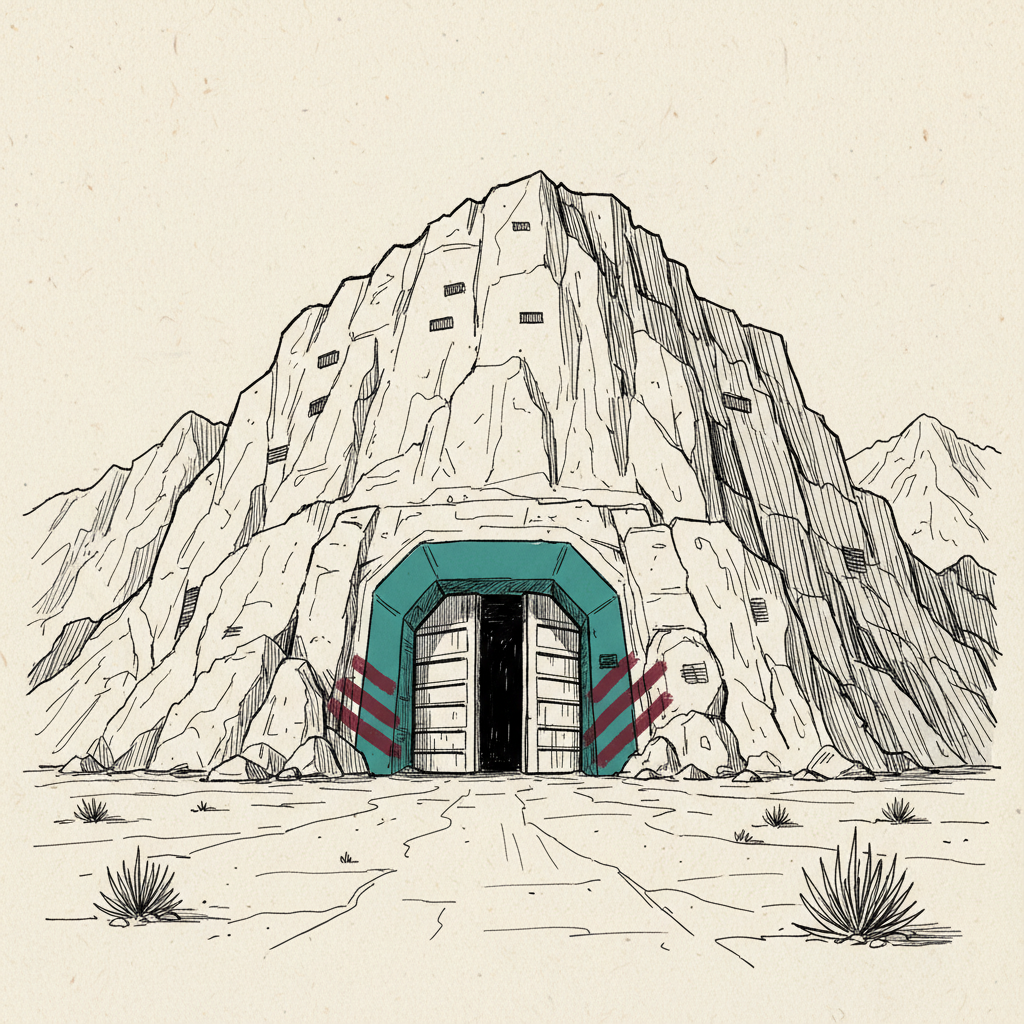
Fordow
Iran's deepest underground enrichment facility, built inside a mountain near Qom.
A senior Tehran source denied on 22 July that Fordow's centrifuges and enriched uranium had been moved to Pickaxe Mountain, hours after Trump said the US would soon be 'hitting that area very heavily'.
Last refreshed: 24 July 2026 · Appears in 1 active topic
Has Fordow been destroyed, or is Iran's nuclear capacity still intact?
Timeline for Fordow
Iran denies moving uranium to Pickaxe
Iran Conflict 2026461 kg of uranium no one can verify
Iran Conflict 2026Bombed nuclear site still closed to inspectors
Iran Conflict 2026: Mentioned in: Trump claims inspections; Iran denies itMentioned in: Grossi warns Iran on hidden transfers
Iran Conflict 2026Mentioned in: Iran's red line: dilute uranium at home
Iran Conflict 2026Background
Fordow is Iran's most hardened nuclear facility, built roughly 100 metres inside a mountain near Qom to survive conventional air strikes. Twelve GBU-57 Massive Ordnance Penetrators delivered by B-2 stealth bombers during Operation Midnight Hammer sealed the facility's ventilation shafts, and no enrichment activity has resumed since; its tunnel portals remain backfilled.
Before the strikes, Fordow housed around 2,700 centrifuges and was Iran's primary site for enrichment to 60% U-235. Iran's own foreign minister has since confirmed that no facility in the country can currently enrich uranium, leaving the programme's residual leverage resting entirely on its existing stockpile rather than any production capacity.
Fordow's significance now lies less in what it can do than in what nobody can verify about it: with inspectors locked out, its buried centrifuge halls and any remaining material sit beyond outside confirmation, a physical fact that shapes every subsequent dispute over Iran's nuclear intentions.
Its stockpile may have moved elsewhere
A senior Tehran security source told CNN on 22 July that Fordow's centrifuges and enriched uranium remained where they were, rejecting a Wall Street Journal report attributing to Israeli intelligence the claim that the material had been moved to Pickaxe Mountain after the June 2025 strikes. Iranian state media said any US strike on nuclear facilities would now be treated as an expansion of the war.
Trump followed with a threat to hit 'that area... very heavily' the same day, though CENTCOM has named no target and issued no deployment order. For Fordow, the threat is almost beside the point: its tunnels were already sealed by the June 2025 strikes, and with no inspector able to check what remains inside them, whether any material moved before or after Trump's remark is exactly as unverifiable as everything else about the site.
Inspectors still cannot enter
Trump posted on 23 June that Iran had fully agreed to IAEA nuclear inspections. Iran's Foreign Ministry spokesman Esmail Baghaei denied within hours that any such meeting or agreement had taken place, and IAEA Director General Rafael Grossi said inspections 'will happen' but named no date.
Fordow sits at the centre of that stand-off, one of the bombed sites still closed to inspectors months after the June 2025 strikes. Its own tunnel collapse means no outside verifier can confirm whether its centrifuge halls, or the enriched uranium once stored there, remain in any usable state at all.
Reference
How deep underground is Fordow?
When did the US strike Fordow?
What is the Fordow nuclear facility and why is it so hard to bomb?
How does Fordow compare to Natanz?
Did Iran move enriched uranium out of Fordow?
Why can't inspectors check Fordow?
Is Fordow operational after the 2026 strikes?
Was Fordow destroyed in the 2026 Iran strikes?
Can the GBU-57 destroy Fordow?
How many nuclear weapons could Iran build with its enriched uranium?
Was Fordow actually destroyed in the 2026 strikes?

