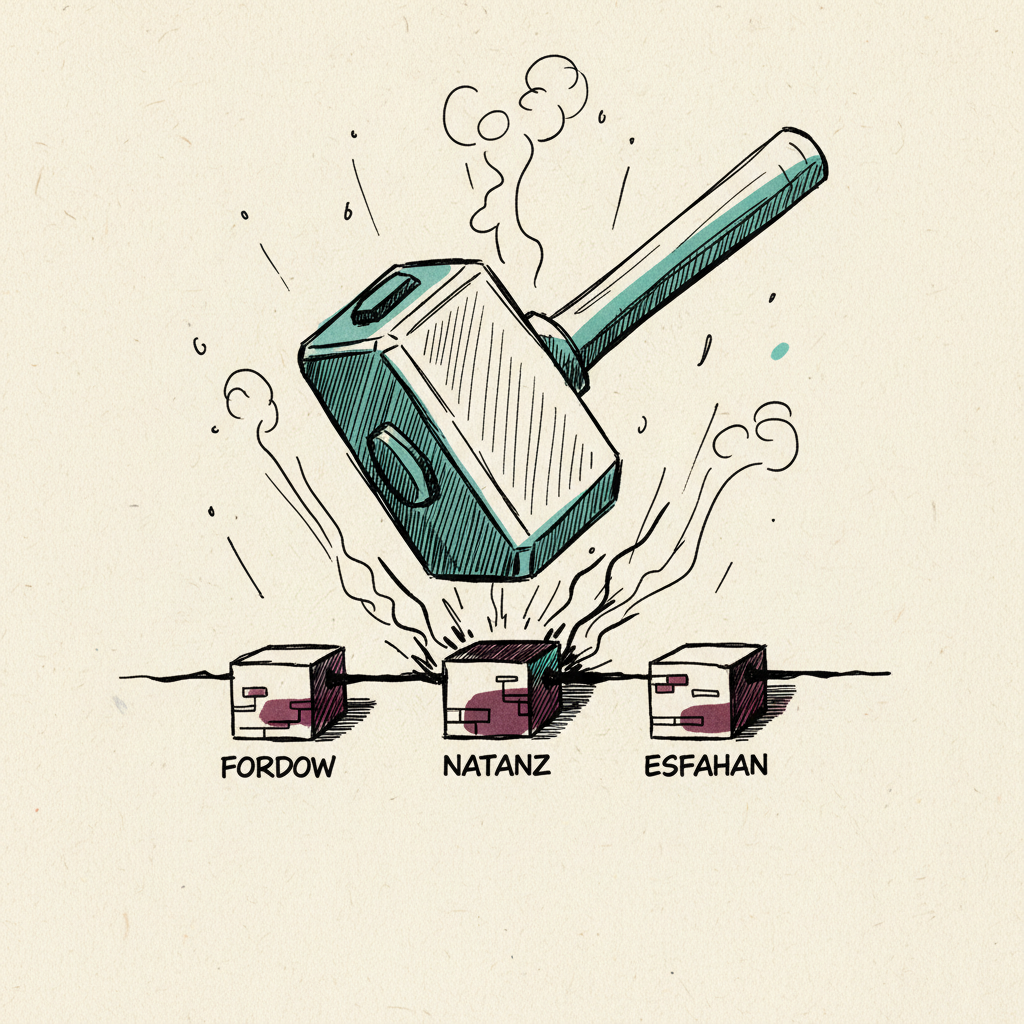
Did the GBU-57 actually breach Fordow's centrifuge hall, or only destroy the ventilation shafts?
Timeline for Operation Midnight Hammer
Mentioned in: Khamenei orders the uranium to stay
Iran Conflict 2026Fordow inoperable since June 2025 bunker-busters
Iran Conflict 2026Background
Operation Midnight Hammer was a US-only strike conducted on 22 June 2025, nine days after Israel opened the Twelve-Day War. Seven B-2 stealth bombers delivered 12 GBU-57 Massive Ordnance Penetrator bunker-buster bombs against Fordow and Natanz, while more than two dozen Tomahawk land-attack Cruise Missiles struck Esfahan. At Fordow, six MOPs targeted each of the two main ventilation shafts; Chairman of the Joint Chiefs General Caine stated "all six weapons at each vent went exactly where they were intended to go." At Natanz, two MOPs struck the already-damaged underground Cascade halls in a double-tap sequence; ISIS assessed this rendered the halls "likely destroyed and knocked out of operation." At Esfahan, the Tomahawks collapsed all four tunnel entrances to the underground complex, denying access to a storage area holding approximately 200 kg of 60%-enriched uranium.
The intelligence assessment of Fordow's fate remains contested. ISIS (five-month report) concluded the GBU-57s "likely caused significant damage to the buried enrichment hall" and "likely entered directly into" it. The IAEA used more cautious language, assessing Fordow "expected to have suffered very significant damage" based on satellite imagery, because inspectors were denied access. A Defence Intelligence Agency assessment, leaked after the strikes, described the sites as "damaged but not destroyed," estimating a delay of "a few months" rather than years. The White House called the facilities "obliterated."
Midnight Hammer represented the first combat use of the GBU-57 MOP against a deeply buried nuclear site and set a precedent for US willingness to strike hardened underground infrastructure directly. Five months after the strikes, satellite imagery showed no enrichment activity resuming at any of the three targeted sites: Fordow tunnel portals remained backfilled, Natanz electrical infrastructure inoperable, and Esfahan surface facilities destroyed.
What was Operation Midnight Hammer?
Did the US bunker-buster bombs destroy Fordow?
How many GBU-57 bombs were dropped on Iran?
What is the GBU-57 Massive Ordnance Penetrator?



Written with AI from Lowdown's published reporting. Not individually reviewed by an editor. Updated 20 April 2026. Editorial standards.