Skip to content
Welcome, thoughtbot's Giant Robots listeners!Start here
Benjamin Netanyahu
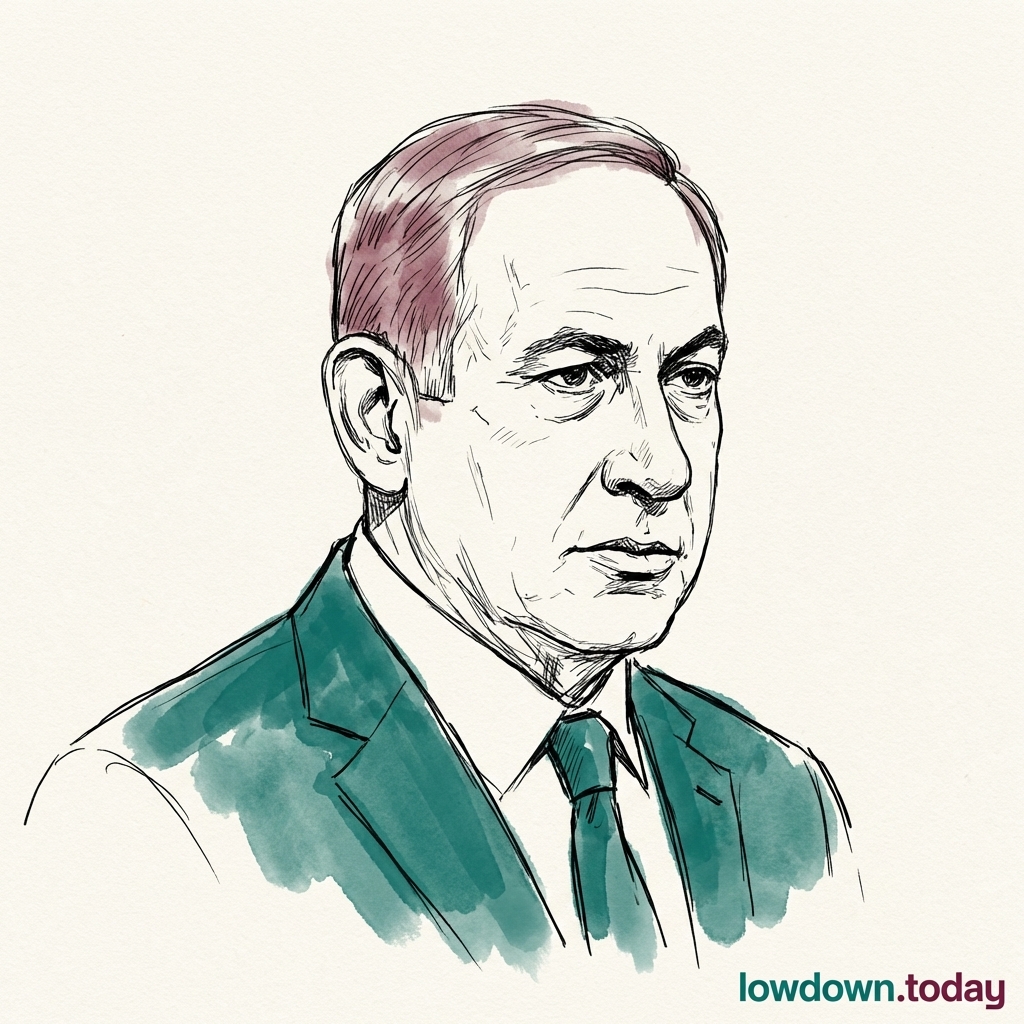
AI-generated illustration
PersonIL

Benjamin Netanyahu

Israel's longest-serving prime minister; prosecuting a multi-front war while fracturing his alliance with Washington.

Benjamin Netanyahu returned to Israel's premiership in December 2022 and remains the country's longest-serving prime minister.

Last refreshed: 22 October 2026 · Appears in 1 active topic

Key Question

Is Netanyahu's refusal to withdraw from Lebanon wrecking the Iran nuclear talks?

Timeline for Benjamin Netanyahu

#182 20 Oct

Directed agencies to topple Iran's government

Iran Conflict 2026: Katz: Israel holds 700 sq km of Lebanon
#181 12 Oct
#162 26 Jul

Convened Israel's security cabinet ahead of a Monday Washington trip

Iran Conflict 2026: Netanyahu takes his case to Washington
#137 23 Jun
View full timeline →

Background

Benjamin Netanyahu is Israel's prime minister and the country's longest-serving holder of that office. He leads Likud and has built his political identity around national security, opposition to Iran's nuclear programme and a willingness to use military force against Iranian and Hezbollah targets.

The prime minister heads Israel's government but acts through a Cabinet, security agencies and the Israel Defense Forces. Netanyahu's choices can shape military planning and the terms Israel seeks in diplomacy, while allies and adversaries retain their own decision-making power. His importance to the Iran and Lebanon files rests on that combination of executive authority and a long-established security doctrine. That combination of executive authority and security doctrine keeps his office central to Israeli decisions on Iran and Lebanon.

Common Questions

Reference

How long has Netanyahu been prime minister of Israel?
Netanyahu has held the premiership across three stints (1996-1999, 2009-2021, December 2022-present), making him Israel's longest-serving prime minister.Source: entity background
Why won't Israel withdraw from south Lebanon?
Netanyahu has carved Lebanon out of every Ceasefire since the conflict began, stating IDF troops will stay 'as long as necessary'. On 22 June he repeated the hold-position order after a localised redeployment from Debbine, with the wider security zone unchanged.Source: Lowdown events 4427/4452
Why is Netanyahu not part of the Iran ceasefire deal?
Netanyahu was excluded from the diplomacy that produced the Islamabad MoU. Mediation ran through Qatar, Pakistan, Saudi Arabia, and Turkey; he admitted on 15 June he had not yet seen the text. National Security Minister Ben-Gvir said the deal 'does not bind us in any way'.Source: Lowdown events 4233/4276
Why does the Israel-Iran ceasefire exclude Lebanon?
Netanyahu has insisted from the war's outset that any Iran Ceasefire does not bind Israeli operations in Lebanon, where the IDF is conducting its deepest incursion in 25 years north of the Litani River. The 9 June mutual halt was confirmed to cover Iran only.Source: event
What did Trump threaten Netanyahu with?
On 9 June 2026, Trump told Netanyahu publicly: 'Bibi, you better be careful, or you will be on your own very soon': the sharpest US rebuke of Israel in the conflict, following Israel's strike on the Karun Petrochemical Complex against Trump's wishes.Source: Lowdown event 4059
What is the Karun Petrochemical complex and why did Israel strike it?
The Karun Petrochemical Company at Mahshahr, Khuzestan, produces toluene diisocyanate, methylene diphenyl diisocyanate, and nitric acid, solid-fuel missile precursor chemistry. The IDF struck it on 8 June 2026 to degrade Iran's missile production pipeline.Source: event
Why did Trump threaten to abandon Israel in June 2026?
Trump publicly told Netanyahu "you will be on your own very soon" on 9 June after the IDF struck the Karun Petrochemical plant at Mahshahr, defying Trump's explicit request not to retaliate for an IRGC missile salvo on Ramat David Airbase.Source: Axios
Are the US and Israel disagreeing over the Iran war?
Yes. Netanyahu's unilateral Regime change declaration, South Pars fuel depot strikes that went 'far beyond' US expectations, and Vice President Vance's direct rebuke mark the first substantive US-Israeli divergence since the conflict began.Source: event
What is Netanyahu's position on Iran?
Netanyahu has argued since the 1990s that Iran poses an existential threat to Israel. In March 2026 he declared Regime change in Tehran an explicit Israeli war aim, going further than the US position which denies pursuing Regime change.Source: event
Did Netanyahu claim Iran's nuclear programme was destroyed?
Yes. On 18 March 2026 Netanyahu claimed Iran 'no longer has capacity to enrich uranium or make ballistic missiles.' The IAEA contradicted this, confirming 440 kg of 60%-enriched uranium remains. The Wall Street Journal subsequently reported that Iran preserved roughly half its Ballistic missile stockpile.Source: event
Did Israel destroy Iran's nuclear programme in the 2026 war?
No. Netanyahu claimed Iran had lost its enrichment capacity, but the IAEA confirmed 440 kg of 60%-enriched uranium remains. Iran's wider nuclear infrastructure was damaged but not eliminated.Source: IAEA
What did Netanyahu say about regime change in Iran?
Netanyahu declared Regime change in Tehran an explicit Israeli war aim on 8 March 2026, telling Trump he had 'yearned to do this for 40 years'; the statement put him at odds with Washington, which called destabilising Iran's security apparatus 'not Regime change'.Source: Lowdown Iran Conflict 2026 U51
Source Material

Written with AI from Lowdown's published reporting. Not individually reviewed by an editor. Updated 22 October 2026. Editorial standards.
