Skip to content
Iran Conflict 2026
21APR

Day 53: Ceasefire ends in the water, a day early

15 min read
10:51UTC

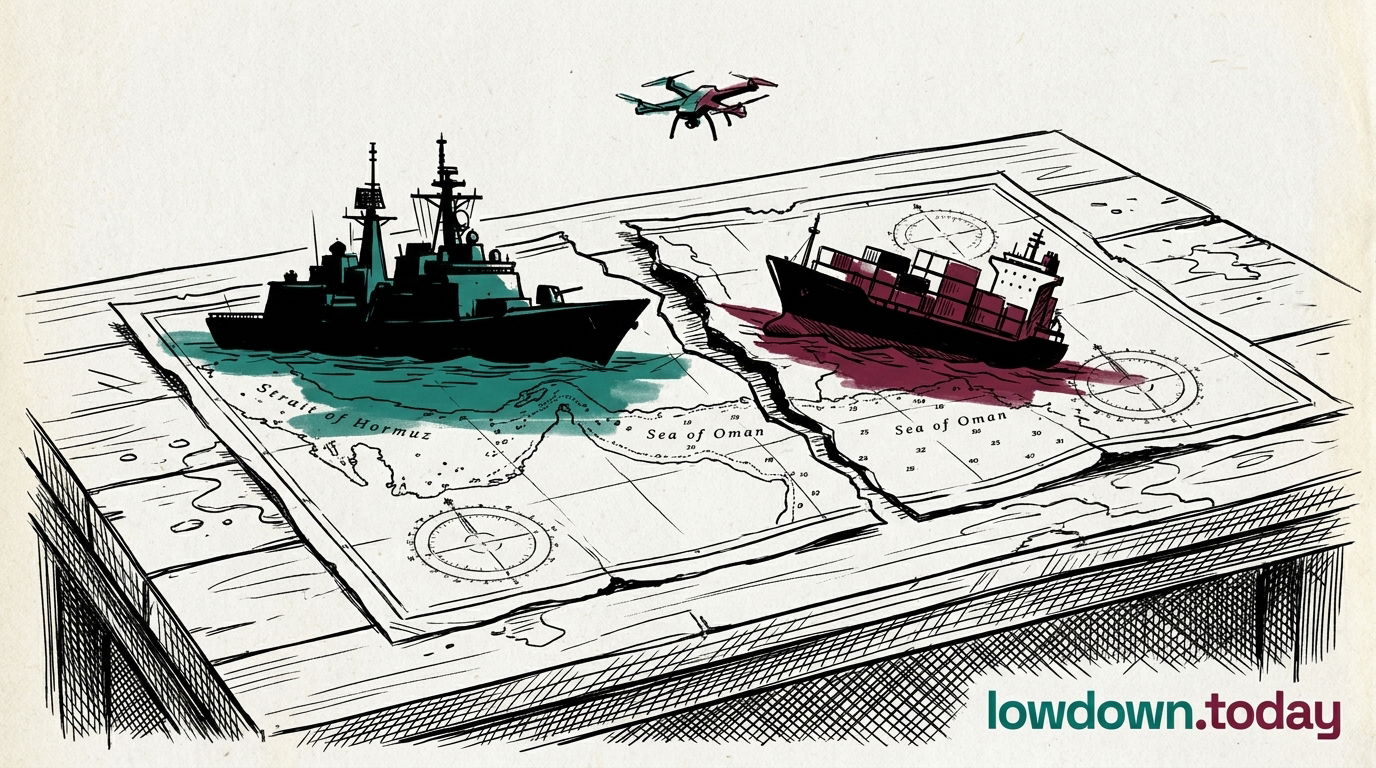
On Day 52 of the Iran war, the 8 April ceasefire has been effectively voided 24 hours before its formal Wednesday expiry. On 19 April the USS Spruance fired into the Iranian cargo vessel Touska's engine room and US Marines boarded it; the following day Tasnim reported IRGC drone strikes on US vessels in the Sea of Oman. The only Iran-specific instrument **Donald Trump** has signed all week is an OFAC designation that named Indian nationals, three days before IRGC gunners fired on Indian-flagged tankers and dragged Delhi inside the same enforcement action.

Key takeaway

A ceasefire voided in the water, a signed record that named India instead of Iran, and a Russian custody offer whose technicians are no longer in the country.

In summary

The Iran ceasefire ended in the water on Day 52, a day early. The USS Spruance fired into the Touska's engine room on 19 April; Iranian state media claimed drone strikes on US vessels the next day; Donald Trump told Bloomberg an extension was 'highly unlikely' without a deal. The signed American record for the week, the one physical instrument tied to Iran, was a 15 April OFAC action that named Indian nationals three days before the IRGC fired on Indian tankers.

This briefing mapped
Loading map…
Military
Legal
Diplomatic
Infrastructure
Regulatory
Humanitarian

Lowdown Bureau / Military. Tehran's state wire announced the strike; Washington has neither confirmed nor denied it. The ambiguity is the point.

Sources profile:This story draws on centre-right-leaning sources from United Arab Emirates
United Arab Emirates

Tasnim News Agency, the state-linked wire close to the Islamic Revolutionary Guard Corps (IRGC), reported on Monday that IRGC drones had attacked US military vessels in the Sea of Oman in retaliation for the USS Spruance's boarding of the Iranian cargo ship Touska the night before . The Tasnim dispatch gave no target name, no damage claim, and no casualty figure. US Central Command (CENTCOM), the Pentagon's Middle East combatant command, issued neither confirmation nor denial.

Both sides benefit from the ambiguity. If the IRGC launch happened, it becomes the first Iranian kinetic action against the US Navy since the 8 April ceasefire took effect, and the War Powers Resolution clock would arguably reset. If it did not happen, Tehran has for the first time under this ceasefire claimed an action it may not have carried out, which preserves Donald Trump's discretion on whether to respond. Tasnim has form as the IRGC's preferred outlet for announcements that front-run official confirmation; it carried the IRGC Navy's four-condition transit order before Iranian state media generalised it .

The absence of any published rules of engagement around the blockade makes every kinetic incident a separate judgement call by two commands that have not agreed a text. A blockade written on Truth Social with no presidential instrument in the Federal Register, a ceasefire announced the same way, and a Touska boarding conducted under orders nobody has published. Both navies are firing on the other's flagged vessels inside an agreement both governments still cite in public.

Explore the full analysis →
Sources:The National
Briefing analysis

The Reagan administration fought a reflagging and escort war in the Gulf across 1987-88 under Operation Earnest Will without a congressional authorisation and largely through executive and CENTCOM-level orders. It ended with USS Vincennes downing Iran Air 655 in July 1988, killing 290 civilians. The parallel is neither exact nor reassuring. Earnest Will at least rested on a reflagging executive decision signed and published; the 2026 blockade rests on Truth Social posts with no presidential instrument on the Federal Register. The Touska boarding, like Earnest Will's mine clearance operations, is the kind of action that produces the first mass casualty when the rules governing it are not written down.

Lowdown Bureau / Legal. The one Iran instrument Treasury signed all week dragged Delhi inside the same enforcement action Tehran provoked.

Sources profile:This story draws on neutral-leaning sources

The Office of Foreign Assets Control (OFAC), the US Treasury bureau that administers sanctions, issued on 15 April a designation which Treasury titled "Economic Fury Targets Illicit Oil Smuggling Network Run by Iranian regime Elite". The action, listed under the Treasury programmes Iran-EO13902 and SDGT, named two Indian nationals, Chetan Prakash Balhotra and Tanjore Sunilkumar Srinivas, both based in the UAE. It named three companies, including Fleet Tanqo Private Limited of Navi Mumbai and House of Shipping Private Limited of Chennai. It added nine tankers (ANAYA, ANIKA, AURA, BELLARIS, CAUVERI, DAPHNE V, HORAE, SILVAR, VERSA) to the Specially Designated Nationals (SDN) list. It is the only Iran-specific instrument Donald Trump's Treasury has signed all week.

The anchor is Ali Shamkhani, former Secretary of Iran's Supreme National Security Council, whose smuggling network depends on Indian facilitators based in the Gulf to clear Iranian crude through sanctioned shipping. Three days after the designation, the IRGC fired on the Indian-flagged Sanmar Herald and Jag Arnav after granting them radio clearance . Foreign Secretary Vikram Misri summoned Iran's ambassador Iraj Elahi Fathali that evening and warned of consequences . Delhi has issued no statement on the OFAC designations naming its own nationals and India-registered companies.

OFAC's SDN architecture does the structural work here. Designation blocks the named parties from the US financial system, and it exposes any counterparty, including Indian state-owned refiners and clearing banks, to secondary sanctions that can cut off dollar access. Indian Oil Corporation, Bharat Petroleum and Hindustan Petroleum have historically carried Shamkhani-adjacent exposure on Iranian crude. Registering enforcement at Navi Mumbai and Chennai puts OFAC inside Indian municipal jurisdiction for the first time in this war. The nearest precedent is the Chabahar SDN exposure on Iranian port-linked Indian firms seven years ago, which Delhi resolved through silent compliance adjustments rather than public protest.

The two diplomatic tracks now operate on timelines that cannot stay separate much longer. Misri has a live demarche protesting IRGC fire on Indian ships; Delhi simultaneously sits inside an American enforcement action naming two Indian citizens and two India-registered entities. Neither side of the US-India-Iran triangle has yet acknowledged the other in public.

Explore the full analysis →

Lowdown Bureau / Diplomatic. The president set a verbal deadline to Bloomberg while his own press secretary denied a written US extension request.

Sources profile:This story draws on left-leaning sources from United States
United States
LeftRight

Donald Trump told Bloomberg that extending the Iran ceasefire was 'highly unlikely' without a deal, and that expiry fell 'Wednesday evening Washington time'. The remark is the clearest presidential commitment to the Wednesday deadline since the ceasefire was announced on a Truth Social post, and the first time the White House has assigned the deadline a precise hour.

Two kinetic events now sit behind the verbal deadline. The USS Spruance fired into the Touska's engine room overnight, US Marines boarded the vessel, and Iranian state media claimed drone attacks on American Navy ships the following morning. Trump's 'Wednesday evening' line trails both.

The signed White House record runs the other way. Press secretary Karoline Leavitt had already denied, before the Bloomberg interview, that the United States formally requested the 60-day extension regional officials briefed to Reuters and the Associated Press last week . No formal request went on paper; no formal refusal has either. Abbas Araghchi told Pakistani FM Ishaq Dar on Sunday that Iran is 'taking all aspects into consideration' before deciding on talks. Vice President JD Vance's scheduled Islamabad trip on Tuesday is the only diplomatic event between the verbal deadline and its passing.

Through fifty-two days of war, the pattern has held. Trump's public posture on Iran runs entirely through remarks, interviews and social posts. The Federal Register has carried zero Iran-tagged executive text since the war began. The Bloomberg line is the deadline the press will quote; Washington's signed ledger for the week consists of an OFAC designation that named Indian nationals and five domestic-energy instruments. By the architecture of the presidency's own publications, the deadline exists in remarks and nowhere else.

Explore the full analysis →
Sources:CNN

Lowdown Bureau / Infrastructure. Russian technicians are out of Bushehr; Peskov is still publicly offering the custody mechanism the evacuation has gutted.

Sources profile:This story draws on centre-left-leaning sources from Netherlands
Netherlands

Rosatom CEO Alexei Likhachev confirmed on Monday through TASS that the evacuation of Russian personnel from the Bushehr Nuclear Power Plant is complete. Twenty-four volunteers remain on site 'to maintain the operability of nuclear power units'. Likhachev disclosed the fuel inventory: 72 metric tonnes of fresh nuclear fuel and 210 metric tonnes of spent fuel. The main evacuation wave of 198 staff moved toward the Armenian-Iranian border after a projectile strike near the facility killed a security guard .

Kremlin spokesman Dmitry Peskov is still publicly advancing the Rosatom uranium-custody offer, the three-option proposal Moscow sketched in March through which Russia would take transfer of Iran's stockpile. The mechanism requires Russian technicians on Iranian soil handling Iranian material under a bilateral transfer architecture. Those technicians are now in Russia. The offer and the capacity to deliver on the offer are operating on different continents.

For the nuclear track, Moscow's custody offer has been the fallback ever since the Majlis voted 221-0 to suspend all cooperation with the International Atomic Energy Agency (IAEA), the UN nuclear watchdog. Rafael Grossi warned last week that any agreement without inspector access would be 'an illusion' . ANS monitoring this month confirmed Fordow remains inoperable since the June 2025 Midnight Hammer strikes . Bushehr is now the only large pre-existing fuel stockpile inside Iran, and 282 tonnes of material sit under two dozen people, no inspectors, and no Russian specialists.

Pakistan's four-country monitoring framework is the only remaining 2026 track with movement behind it. A monitoring architecture that depends on Russian technicians Moscow has withdrawn, Iranian cooperation the Majlis has revoked, and inspectors the IAEA cannot place on the ground is not a monitoring architecture. Peskov's continued public framing of the custody offer functions as rhetorical leverage, not as an operational mechanism. Whether Moscow reverses the evacuation in exchange for concessions, or lets the gap widen, is the most consequential nuclear-track decision of the next fortnight.

Explore the full analysis →
Sources:Moscow Times
Briefing analysis
What does it mean?

Two vessel incidents within 24 hours on 19-20 April voided the 8 April ceasefire in fact while both capitals continued to reference it in rhetoric. The Touska seizure and Tasnim's unconfirmed drone claim establish that each side has fired on or claimed to fire on the other's vessels inside an agreement neither has signed. The only Iran-specific American instrument of the week was the 15 April OFAC Shamkhani designation, which named Indian nationals and India-registered entities three days before the IRGC fired on Indian-flagged tankers, quietly installing a secondary-sanctions tripwire inside India's own shipping register.

A Lebanon cessation text appeared on state.gov this week; 52 days of the Iran war have produced no equivalent. Trump signed five domestic-energy Presidential Determinations on 20 April, confirming the signing machinery works and is being pointed at American supply chains rather than at Iran. Rosatom's custody offer is now separated from the technicians needed to execute it.

Watch for
  • any signed Iran instrument before 22 April expiry; whether Vance and an Iranian delegation hold a second Islamabad round on 23 April; Indian government response to OFAC's Shamkhani designations naming Mumbai and Chennai entities; US confirmation or denial of the Tasnim drone-strike claim.

Lowdown Bureau / Regulatory. Trump signed five domestic-energy instruments the day before the ceasefire expires, proving the signing machinery was available.

Sources profile:This story draws on neutral-leaning sources

Donald Trump signed five Presidential Determinations on Monday invoking the Defense Production Act to mobilise domestic energy supply: petroleum production, liquefied natural gas (LNG), natural gas, coal supply chains, and grid infrastructure. Presidential Determinations are formal executive instruments published in the Federal Register; they commit funds, authorise contracting, and carry statutory weight. Trump's signing of five Presidential Determinations in a single day is an unusually dense output, and no Iran-specific executive instrument was produced on the same day or any other day since the 28 February start of the war.

Strait of Hormuz disruption is the Iran-driven condition these instruments respond to. Monday's traffic collapse has tightened American LNG and petroleum routing across the Pacific and Atlantic. The five PDs address that disruption by pointing the Defense Production Act inward at US supply chains rather than outward at the cause. The Defense Production Act machinery exists to address foreign-origin threats to American industrial capacity; the instruments signed this week use it for domestic mobilisation without naming Iran, the war, or the strait.

The 51-day instrument gap has, by this point in the war, acquired its own evidence. Josh Hawley is pressing an Authorization for Use of Military Force (AUMF) floor vote push by 29 April, citing the absence of any presidential instrument anchoring the campaign . Lisa Murkowski has drafted an Iran AUMF. The five energy PDs are the clearest single demonstration that the signing apparatus was available the day before the ceasefire expired, and that it was pointed somewhere else.

Explore the full analysis →

Lowdown Bureau / Diplomatic. The State Department published a formal Israel-Lebanon cessation document the same week the Iran ceasefire has reached 52 days without any equivalent text.

Sources profile:This story draws on neutral-leaning sources

The US State Department published on state.gov the formal text Ten Day Cessation of Hostilities to Enable Peace negotiations Between Israel and Lebanon this week, following 14 April talks. The document names the parties as the 'Government of Israel and Government of Lebanon' and declares the cessation 'brokered by the United States'. The two governments are scheduled for a second round of direct talks in Washington on Thursday, the first direct bilateral engagement in decades.

No equivalent Iran document exists. The Iran ceasefire, announced by Donald Trump through a Truth Social post at the start of this month, has produced no text on state.gov, whitehouse.gov, or the Federal Register after fifty-two days. The Federal Register's Iran-tagged documents feed has been empty since the start of last week. The Ten Day Cessation text and its handling of party identification, duration, and US brokerage role are exactly the template an Iran cessation would require.

The absence has now acquired structural consequences. Four unsigned deadlines now converge inside a fortnight . A UK-France-led coalition has been writing rules of engagement for the strait without US signatures at the table, leaving American vessels to operate under a document they did not draft. European Protection and Indemnity (P&I) underwriters are now pricing the Lebanon track on paper and the Iran track on Trump's remarks, widening the premium spread between the two theatres.

The counter-argument that unsigned pressure preserves flexibility carried weight through weeks two and three. With a Lebanon cessation text drafted the same week and five domestic-energy PDs signed the day before Iran's expiry, that flexibility argument is now what the absence is being used to produce, not what the absence reveals. The State Department's publication architecture is the neutral witness: it can produce Iran cessation paper, and it has not.

Explore the full analysis →

Lowdown Bureau / Diplomatic. The Vice President flies toward Pakistan on Tuesday with talks scheduled for the ceasefire-expiry day; Tehran has not confirmed attendance.

Sources profile:This story draws on mixed-leaning sources from United States and Qatar
United StatesQatar
LeftRight

Vice President JD Vance leaves Washington for Islamabad on Tuesday, with the possibility of a second round of US-Iran indirect talks scheduled for the day the April ceasefire formally expires. Iran's foreign ministry stated that the country has 'no plans to reengage' negotiations 'for now', citing Washington's 'provocative actions'.

The first round collapsed at the Serena Hotel on 12 April, with Vance walking out after overnight negotiations and no next meeting scheduled . The channel Pakistan's Chief of Army Staff Asim Munir reopened during his Tehran visit, which secured Iran's in-principle concession on nuclear monitoring, is the only live mediation track. Islamabad has since offered to host multi-day talks aimed at a ceasefire extension via memorandum of understanding, rather than a signed agreement, which lowers the commitment cost on both capitals.

The mechanics of the Pakistan track are doing work the US-Iran bilateral cannot. Pakistani F-16s reinforced Saudi airspace while Islamabad mediated the US-Iran channel , embedding the mediator inside the regional air picture. Munir carried an agreed four-country monitoring framework out of Tehran last Wednesday; Pezeshkian and Khamenei have both signalled tolerance of Pakistani good offices even while hardening public rhetoric. Whether Tehran sends negotiators or lets the Tuesday departure pass unanswered will be the first readable signal of whether the rhetorical floor Iran set this week is negotiable.

Explore the full analysis →
Sources:CNN·Al Jazeera

Lowdown Bureau / Diplomatic. Pezeshkian, Ghalibaf and Baqaei anchored the English-facing posture on refusal while a parallel channel stayed open in Farsi.

Sources profile:This story draws on mixed-leaning sources from United States and Qatar
United StatesQatar
LeftRight

President Masoud Pezeshkian told state media on Monday that Iran has 'deep historical mistrust' of the United States and that 'Iranians do not submit to force'. Speaker of Parliament Mohammad Bagher Ghalibaf accused Donald Trump of trying to turn negotiations into a 'table of surrender' . Foreign ministry spokesman Esmaeil Baqaei demanded the 'immediate release of the Iranian vessel, its sailors, crew and their families' after the American boarding of the Touska, and framed the US blockade as 'a criminal act and a violation of the ceasefire'.

The three voices cover the three institutional pillars of the Iranian state. Pezeshkian is the civilian reformist president elected on a platform of re-engagement. Ghalibaf is the principlist speaker, close to the Revolutionary Guard and a former IRGC commander. Baqaei is the foreign ministry's public face, speaking for Abbas Araghchi's diplomatic track. Convergence from all three on maximalist framing on the same day is unusual; the three institutions have spent this war feuding in public, most visibly when Ghalibaf, Baqaei and Tasnim issued contradictory positions on negotiations last weekend.

Touska produced the alignment. A US Navy destroyer firing into an Iranian-flagged cargo vessel's engine room, then Marines boarding, is the kind of action the three institutional blocs react to identically regardless of their internal position on talks. The demand for ship-and-crew release is now a precondition Tehran has planted in the public record; any Iranian negotiator walking into Islamabad without it in the opening text loses domestic standing. The hardening locks in a new entry condition for talks without closing the channel.

Explore the full analysis →
Sources:CNN·Al Jazeera

Lowdown Bureau / Military. The Macron-Starmer statement on GOV.UK confirmed the 51-nation Hormuz mission as active, with mine clearance on the mandate.

Emmanuel Macron and Keir Starmer, co-chairs of the International Summit on the Strait of Hormuz, published a joint statement on GOV.UK on Monday reclassifying the fifty-one-nation mission from 'planning' to 'established' . The three-part mandate confirmed in the statement covers protection of merchant vessels, reassurance of commercial operators, and mine clearance. The coalition's operational headquarters is Northwood HQ in north-west London, the UK's standing joint command site and the seat of the NATO Maritime Command.

The move from 'planning' to 'established' changes the legal character of the forces involved. A planning construct rotates staff officers; an established mission assigns units, standing orders, and deconfliction protocols with other navies. The Northwood rules-of-engagement summit opened the same week without US or Gulf state signatures . Bahrain, headquarters of the US Fifth Fleet, is among the 23 post-summit confirmations sitting inside a mission with an RoE the Pentagon has not signed.

Macron and Starmer wrote mine clearance into the mandate deliberately, and that single line is the operational tell. Mine clearance was the specific capability gap that historically dragged non-US navies into Gulf operations during the 1987-88 Reagan-era Operation Earnest Will. It is high-risk, low-prestige work that requires dedicated platforms: Royal Navy Hunt-class vessels, French Tripartite-class, and European ammunition clearance divers. A coalition that has formalised a mandate including mine clearance has been briefed that the strait will require it, which is itself a signal about what CENTCOM and European planners expect from the Iranian blockade through the summer.

The Northwood coalition is now drafting the live legal framework for the strait under which US and European vessels will have to operate, whether or not Washington ever publishes its own text. Institutional gaps fill in when somebody else writes the document, and the unsigned actor inherits whatever the document says. The Pentagon is not in the planning room because there is no US text for its rules to attach to.

Explore the full analysis →
Sources:GOV.UK

Lowdown Bureau / Diplomatic. The foreign ministry's domestic-language readout held the channel open even as its English-facing statements called the US action unlawful.

Sources profile:This story draws on neutral-leaning sources

Foreign ministry spokesman Esmaeil Baqaei told Fararu, the Tehran-based reformist-leaning news site, in Farsi that 'message exchanges with America continue' and that Iran 'will host a delegation from Pakistan'. Entekhab.ir, a moderate-conservative domestic outlet, carried his characterisation of the US Hormuz blockade as unlawful, the preferred legal framing heading into any next round. Neither statement appeared on IRNA, Mehr or Press TV in English or Farsi .

Baqaei has split his English-facing and Farsi-facing readouts on purpose, and the split is doing the operational work. The English-language statements issued the same day through the foreign ministry press office ran the public hardening: no plans to reengage, demand for Touska release, condemnation of the US action. The Farsi readout, aimed at the domestic reformist-centrist readership that supported Pezeshkian, confirmed the back-channel was still live. Fararu and Entekhab are the preferred conduits for signals Tehran wants Iranian elites to register without raising English-language wire traffic.

The pattern maps to the institutional split the war has run along since February. Pezeshkian's civilian government negotiates through Araghchi and Baqaei; the IRGC runs the kinetic track through Khatam al-Anbiya and Tasnim; the Majlis under Ghalibaf writes the laws that ratify what the IRGC does on the water. Baqaei's Farsi readout is the civilian channel signalling to Tehran's own elite that talks are still live; Ghalibaf's English-friendly 'table of surrender' line is the principlist channel signalling to its own base that nothing has been conceded. Both statements are official; both were released the same day; both are true within their own audience frame. Neither has produced a single signed Iranian document binding the government to either position.

Explore the full analysis →
Sources:Fararu

Lowdown Bureau / Humanitarian. The execution tally reached at least 404 since the war began, with one protest-related case now producing four hangings.

Sources profile:This story draws on neutral-leaning sources from Iran
Iran

Hengaw, the Norway-based Iranian human rights monitor, confirmed on Monday the execution of Ali Fahim at Ghezel Hesar Prison in Karaj. Fahim's family was not notified in advance, Hengaw reported. His hanging is the fourth execution in a single protest-related case prosecuted through the same branch of the Karaj Revolutionary Court. The war-era execution tally reached at least 404 by Hengaw's tracking.

Ghezel Hesar, the largest prison complex in Alborz Province, has been the primary node for the protest-case docket since the February war began. A single case producing four executions inside roughly a month compresses the standard appeal window at Iran's Supreme Court, which normally runs six to twelve months on capital cases. Hengaw has documented the pattern in three previous protest-related cases this year: charges filed, revolutionary court verdict, Supreme Court summary affirmation, execution inside weeks. The 404 war-era total runs against a pre-war annual figure of 975 recorded by Iran Human Rights; the war is producing executions at roughly twice the pre-war monthly rate.

Hengaw confirmed two executions at Ghezel Hesar and the custodial death of Yavari in Shiraz last weekend , and the Fahim case now extends that pattern. Iran's nationwide information blackout hands the state the operational enabler it needs: families learn of executions from Hengaw's Telegram channel rather than from judicial notifications, and legal representation in protest cases has collapsed as lawyers lose contact with clients in the absence of video-conferencing court access. The execution pace is visible outside Iran only because Hengaw and Iran Human Rights Documentation Center still have informants inside the prison system; that pace is not transmissible to the Iranian public in real time.

Explore the full analysis →

Lowdown Bureau / Humanitarian. Strait traffic is far below baseline while Iran's internet shutdown sets a world record for duration.

Sources profile:This story draws on mixed-leaning sources from United States and Qatar
United StatesQatar
LeftRight

NetBlocks, the UK-based internet observatory, recorded Iran's nationwide internet blackout at one thousand two hundred and twenty-four hours on Day 52, the longest national shutdown on file. Al Jazeera reported partial restoration to 'favoured groups' on Monday, while most Iranians remained disconnected. Kpler data relayed by CNN showed sixteen vessel transits of the Strait of Hormuz the same day, against a pre-war baseline of one hundred and thirty-five per day, an eighty-eight per cent shortfall. Brent sat at roughly 94-96 dollars through the week, up from 73 before the strikes .

The Hormuz figure carries a carve-out worth naming. Two US-sanctioned Chinese tankers continued transiting unchallenged under what CNN described as CENTCOM's standing carve-out. A blockade that lets sanctioned Chinese crude through while denying clearance to Indian-flagged tankers is a blockade whose selection rules are not written down and whose enforcement pattern favours the counterparty Washington has most friction with. Saturday briefly touched twenty-plus transits before the Touska seizure reversed the recovery.

Iran's internet shutdown is running as a protest-era governance tool, not a wartime communications restriction. Al Jazeera's readout names 'favoured groups' as the recipients of partial restoration, pointing at state-linked institutions, financial clearing infrastructure, and security apparatus users rather than the general public. The Aban protest shutdown in Esfand 1398 ran for roughly one week at its peak; the current shutdown has now run more than seven times that length. The infrastructure to maintain a selective internet, with whitelisted IP ranges, domestic-only mesh, and state-controlled filtering, is mature in Iran in a way it was not then, and the war has given Tehran both the justification to deploy it and the excuse to let it harden past the ceasefire.

Explore the full analysis →
Sources:CNN·Al Jazeera

In Brief

  • Sixteen vessels transited Hormuz on Monday 20 April, 88 per cent below the pre-war baseline of 135 per day, yet two US-sanctioned Chinese tankers continued transiting unchallenged under CENTCOM's standing carve-out, according to Kpler data relayed by CNN ; Saturday 19 April briefly touched 20-plus transits before the Touska seizure reversed the recovery.
  • NetBlocks recorded Iran's internet blackout at 1,224 hours on Day 52, the longest national internet shutdown on record; Al Jazeera reported partial restoration to 'favoured groups' on 20 April .
  • Hengaw confirmed the execution of Ali Fahim at Ghezel Hesar Prison in Karaj, the fourth in a single protest-related case; the war-era execution tally reached at least 404 .
  • The War Powers Resolution 60-day clock, triggered by the 28 February start of hostilities, expires on 29 April; no new Senate floor vote is scheduled, and Josh Hawley is pressing for an Authorization for Use of Military Force (AUMF) vote once the deadline hits.
  • The Macron-Starmer joint statement published on GOV.UK on 20 April reclassified the 51-nation mission from 'planning' to 'established', with a three-part mandate: protect merchant vessels, reassure commercial operators, and conduct mine clearance .
  • Israel and Lebanon scheduled a second round of direct talks in Washington for Thursday 23 April, the first direct bilateral engagement in decades.
  • Pakistan's delegation to Tehran, confirmed by Baqaei in Farsi, had no published arrival date as of 21 April.

Watch For

  • Whether any signed Iran instrument (executive order, presidential determination, Federal Register notice, or State Department agreed text) appears on or before the 22 April ceasefire expiry; default expectation is none.
  • Whether Vance and an Iranian delegation hold a second Islamabad round on Wednesday 23 April, or whether Iran's 'for now' refusal holds through the deadline.
  • Whether the Indian government issues any public response to the 15 April OFAC designations naming Indian nationals and Mumbai- and Chennai-based entities; silence to date is a diplomatic choice and tests how long Delhi can carry it.
  • Whether IRGC or CENTCOM confirms or denies the 20 April Tasnim drone-strike claim; ambiguity benefits Iran domestically but complicates Pakistan's mediation ask.
Closing comments

Lateral, not vertical. The Touska seizure and IRGC drone claim are kinetic incidents within the existing blockade architecture, not a structural expansion of it. The highest-probability non-kinetic escalation vector remains the radiological-safeguards gap at Bushehr: 282 tonnes of nuclear material, a 24-person skeleton crew, no IAEA access, and a custody offer from a country whose technicians departed.

Different Perspectives
Donald Trump / CENTCOM
Trump told Bloomberg on 20 April that extension was 'highly unlikely'; press secretary Leavitt denied the US had requested a 60-day extension. CENTCOM released video of the Touska boarding as lawful interdiction, then issued no confirmation or denial of the Tasnim drone claim, preserving executive discretion ahead of the 29 April War Powers clock.
Tehran: Pezeshkian, Ghalibaf and Baqaei
Pezeshkian said Iranians 'do not submit to force'; Ghalibaf accused Trump of seeking a 'table of surrender'; Baqaei told domestic outlet Fararu in Farsi that 'message exchanges with America continue' and Iran would host a Pakistani delegation. The split is structural: maximalist rhetoric is for the domestic base; the live back-channel runs underneath it.
Dmitry Peskov / Rosatom
Peskov continues advancing the uranium custody offer as live diplomatic leverage while Rosatom CEO Likhachev confirmed the Bushehr evacuation is complete. Moscow's offer and Moscow's capacity to execute it are now on different continents, which suits the Kremlin's preference for preserved optionality over delivered commitments.
Vikram Misri / Indian MEA
Foreign Secretary Misri summoned Iranian Ambassador Iraj Elahi Fathali on 18 April after the IRGC fired on the Sanmar Herald and Jag Arnav. New Delhi has issued no statement on the 15 April OFAC designations naming Indian nationals and Mumbai- and Chennai-registered entities, running both tracks through the same ministry without publicly connecting them.
Macron and Starmer / Northwood coalition
The joint statement published on GOV.UK on 20 April reclassified the 51-nation Hormuz mission from 'planning' to 'established', with a three-part mandate: protect merchant vessels, reassure commercial operators, and conduct mine clearance. The UK-France command at Northwood is drafting rules of engagement without a US signature at the table.
Rafael Grossi / IAEA
Grossi warned on 18 April that any agreement without inspector access 'would be an illusion'; the IAEA has been locked out since the Majlis 221-0 vote on 11 April. With the Rosatom evacuation complete, Grossi's agency is now the only institutional body with a legal mandate to verify Bushehr and no physical access to execute it.
