
Skip to content
Briefings are running a touch slower this week while we rebuild the foundations.See roadmap
Iran Conflict 2026
8APR

Day 40: Two victories, two different lists

4 min read
09:27UTC

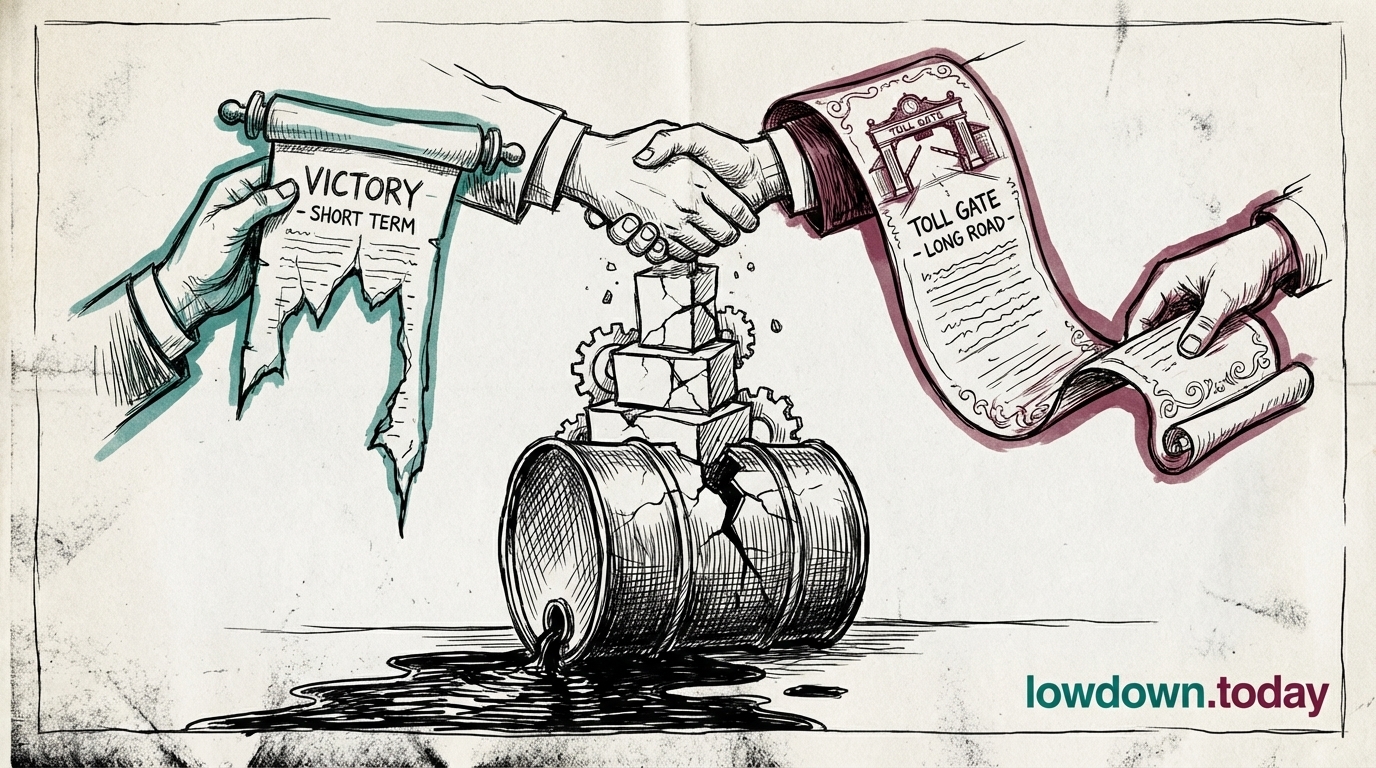
Donald Trump and Iran's Supreme National Security Council each declared victory on Day 40 against goal lists they had set themselves: Trump against a four-item White House page that quietly dropped Hormuz reopening on 1 April, Iran against a 10-point plan that codifies its existing toll system as 'coordinated passage'. The two-week ceasefire begins Friday 10 April with Lebanon ambiguity baked in at inception, and Brent crude posted its biggest one-day fall since the 1991 Gulf War.

Key takeaway

Both principals declared victory by measuring against goal lists they had positioned to make signing possible.

This briefing mapped
Loading map…
Diplomatic
Domestic
Regulatory
Economic
Humanitarian

Two hours before his fifth Hormuz ultimatum was due to lapse, the president converted the deadline into a two-week diplomatic window.

Sources profile:This story draws on centre-left-leaning sources from Israel, United States and 1 more
IsraelUnited StatesQatar

Donald Trump posted on Truth Social less than two hours before his fifth Hormuz ultimatum was due to expire that he had agreed to a two-week pause on US bombing of Iran, citing Iran's 10-point plan as a 'workable basis on which to negotiate' and claiming the United States had 'already met and exceeded all Military objectives'.

The ceasefire ends six weeks of escalating deadline rhetoric without crossing any of the civilian-infrastructure thresholds the rhetoric had threatened. 

Briefing analysis

Primary parallel: The 1953 Korean armistice ratified the front line where the fighting had stopped, not the political objectives either side entered the war pursuing. Both Beijing and Washington claimed victory against differently-positioned goals; the document survived because nobody had to admit which list was the real one.

Counter-parallel: The 1991 Gulf War coalition ended hostilities with a UN-supervised inspection regime that constrained Iraq for over a decade. That settlement contained enforcement; today's ceasefire contains a Friday meeting and no published text. The structural difference is the verification mechanism, and the verification mechanism is what oil traders look for when deciding whether to retire the structural premium.

Tehran's official acceptance describes the deal as forced capitulation and binds Khamenei's name to it.

Sources profile:This story draws on centre-left-leaning sources from United Kingdom and United States
United KingdomUnited States

Iran's Supreme National Security Council issued a statement accepting the two-week ceasefire that frames the agreement as a forced US capitulation, claiming Iran has 'achieved a massive victory and forced criminal America to accept its 10-point plan' and attributing the decision to Mojtaba Khamenei's 'prudence and approval'.

Iran's domestic framing is total victory, leaving no rhetorical room to climb down inside the two-week window without civilian-government collapse. 

Iran says yes, Israel says no, Pakistan says yes — three primary parties describe the same deal three ways.

Sources profile:This story draws on centre-left-leaning sources from United Kingdom and Qatar
United KingdomQatar

On the day the ceasefire was announced, three primary signatories described the deal in three contradictory ways on Lebanon. Iran's SNSC text explicitly named 'cessation of war on all fronts, including against the heroic Islamic Resistance of Lebanon'. Israeli Prime Minister Benjamin Netanyahu's office stated 'the two-weeks ceasefire does not include Lebanon'. Pakistan's Prime Minister Shehbaz Sharif said Lebanon was included.

The Friday Islamabad meeting begins with irreconcilable terms on a question that decides whether Lebanese civilians remain inside the strike envelope. 

Iran's Supreme Leader, walled off from civilian government for the entire war, surfaces by name in the ceasefire text.

Sources profile:This story draws on centre-left-leaning sources from United Kingdom
United Kingdom

Iran's Supreme National Security Council ceasefire statement attributed approval to Mojtaba Khamenei's 'prudence and approval', the first decisional engagement publicly attributed to The Supreme Leader since the war began on 28 February. Khamenei had not appeared in person for 34 days as of 2 April.

The civilian-track route to The Supreme Leader has reopened in the days after his gatekeeper was reportedly killed, with consequences for whether negotiations can survive the IRGC closing the gate again. 

The White House paper trail under six weeks of escalation contains college sports and steel tariffs, not a single Iran filing.

Sources profile:This story draws on neutral-leaning sources

A direct fetch of the White House presidential-actions index on 8 April confirms that across 40 days of war, the Trump administration has signed zero Iran-related executive orders, proclamations or memoranda. The nine most recent items on the page are an executive order on saving college sports, a memorandum on the DHS shutdown, a proclamation on pharmaceutical imports, a steel/aluminum/copper proclamation, an EO on federal election citizenship verification, a memorandum on TSA officer pay, an EO on DEI discrimination, an EO on a FEMA review council, and a Greek Independence Day proclamation. None reference Iran, Hormuz, Defense Production Act, reserve callup, or munitions production.

The actions footprint under the rhetoric is empty; the war has lived inside the rhetoric, not the executive paper trail. 

Sources:White House

Oil retired the war's escalation premium overnight; the structural Hormuz risk premium remains in the price.

Sources profile:This story draws on mixed-leaning sources from United States
United States

Brent Crude opened London trading on 8 April between 15 and 16 per cent below its previous settle, falling to $92.21 a barrel and as low as $91.70 intraday. It was the largest one-day fall in the oil market since the 1991 Gulf War. The previous close was $110.05; the pre-war baseline was $67.41.

Markets priced out the escalation tail but kept the structural Hormuz floor, telling you what oil traders actually believe about the durability of 'coordinated passage'. 

The deadline-day strikes targeted infrastructure and a Tehran residential district before the ceasefire announcement.

Sources profile:This story draws on centre-left-leaning sources from Qatar
Qatar

On the day of the ceasefire announcement, the IDF struck the Bahram, Mehrabad and Azmayesh airports in Tehran (destroying multiple aircraft and helicopters), the Yahya Abad railway bridge in Kashan (at least two killed), and the Shiraz petrochemical complex. Per Iran's Fars News Agency, four girls and two boys below the age of 10 were killed in a US-Israeli strike on the Baharestan residential area of Tehran.

The same target categories the war had been hitting for a fortnight; no new civilian-infrastructure threshold was crossed even as the rhetorical ceiling reached civilization-ending threats. 

Sources:Al Jazeera

The OFAC instrument authorising Iranian-origin crude expires 11 days into the diplomatic pause.

Sources profile:This story draws on neutral-leaning sources

OFAC General License U, the Iran-related general license issued on 20 March 2026 that authorises delivery and sale of Iranian-origin crude oil and petroleum products loaded on vessels before that date, expires at 12:01am EDT on 19 April 2026, eleven days into the two-week ceasefire window. It is the first OFAC general license ever to broadly authorise transactions involving Iranian-origin crude. No Treasury renewal signal has been issued.

The first material Treasury test of whether Trump's 'met and exceeded' framing survives contact with sanctions architecture. 

The Iranian president's post-ceasefire framing is the civilian government's domestic victory marker.

Sources profile:This story draws on mixed-leaning sources from United States
United States

After the ceasefire announcement, Iranian President Masoud Pezeshkian posted to social media that 'more than 14 million proud Iranians have so far registered to sacrifice their lives to defend Iran' and that he himself remained 'devoted to giving my life for Iran'. The 14 million figure has no independent corroboration.

The number is unverifiable but the post functions as the civilian-government's political insurance against the IRGC re-claiming the victory framing. 

Sources:PBS News

Eleven flag states had paid the toll to transit by 5 April; the ceasefire ratifies the operating model.

Sources profile:This story draws on neutral-leaning sources

Strait of Hormuz transit data from Windward and Iran's Fars News Agency showed that 20 vessels (14 outbound, 6 inbound) transited the strait in 24 hours as of 5 April, the highest count since the war began on 28 February but still 1/7 of the pre-war baseline of 138 daily transits. Eleven flag states were paying Iran's toll to transit: China, Russia, India, Iraq, Pakistan, Malaysia, Thailand, the Philippines, France, Japan and Oman.

The operating universe of 'coordinated passage' before the ceasefire formalised it. 

Closing comments

De-escalation without resolution. The ceasefire pauses the strike exchange for two weeks but ratifies Iran's Hormuz toll architecture, leaves Lebanon contested between signatories, and contains no enforcement mechanism. Probability of resumption inside the two-week window is non-trivial; probability that the structural Hormuz position is reversed is near zero.

Different Perspectives
Donald Trump / United States
Trump posted on Truth Social that the US has 'already met and exceeded all Military objectives' and accepted Iran's 10-point plan as a 'workable basis'. The framing relies on a four-item objectives page that does not list Hormuz reopening, the war's six-week public justification.
Iran SNSC / IRGC
Iran SNSC / IRGC
Iran's Supreme National Security Council framed the ceasefire as a forced US capitulation, attributed approval to Mojtaba Khamenei's prudence, and claimed to have 'forced criminal America to accept its 10-point plan'. The framing leaves no rhetorical room for climbdown.
Benjamin Netanyahu / Israel
Netanyahu's office expressed conditional support for the ceasefire after warning Trump against it on Sunday, with an explicit Lebanon carve-out: 'the two-weeks ceasefire does not include Lebanon'. The carve-out is the concession Israel was given for not blocking the deal.
Shehbaz Sharif / Pakistan
Pakistan brokered the framework via Field Marshal Munir and the 10 April Islamabad meeting, and stated that Lebanon is included in the ceasefire. Pakistan's diplomatic credibility now depends on producing a published text on Friday that all three signatories can stand behind.
China
China
China remains the toll-paying flag state with the largest stake in coordinated passage and the UNSC veto holder positioned to block any text that contradicts Iran's framing. Beijing has not commented publicly on the deal.
Russia
Russia
Moscow's Geran-2 drone supply to Iran continues through the ceasefire window and Rosatom's evacuated Bushehr staff have not returned. Russia's material support insulates Tehran from the operational cost of any future settlement breakdown.