Skip to content
Briefings are running a touch slower this week while we rebuild the foundations.See roadmap
Iran Conflict 2026
7APR

Day 39: Carriers retreat; Iran codifies Hormuz

5 min read
10:19UTC

Hours before Donald Trump's fifth Hormuz ultimatum expires, the US carriers most likely to enforce it have moved further from Iran's coast than at any point in the war. Iran's 10-point counter-proposal asks Washington to legally ratify the toll system Tehran already runs, the Islamabad Accord turns out to have been announced over a dead diplomatic channel, and Israel's strikes on the South Pars gas complex and the IRGC's intelligence chief proceed in the silence the deadline drama has provided.

Key takeaway

Trump's carriers retreated, his war aim quietly vanished, and Iran codified the leverage he went to war to remove.

This briefing mapped
Loading map…
Military
Diplomatic
Economic
Humanitarian

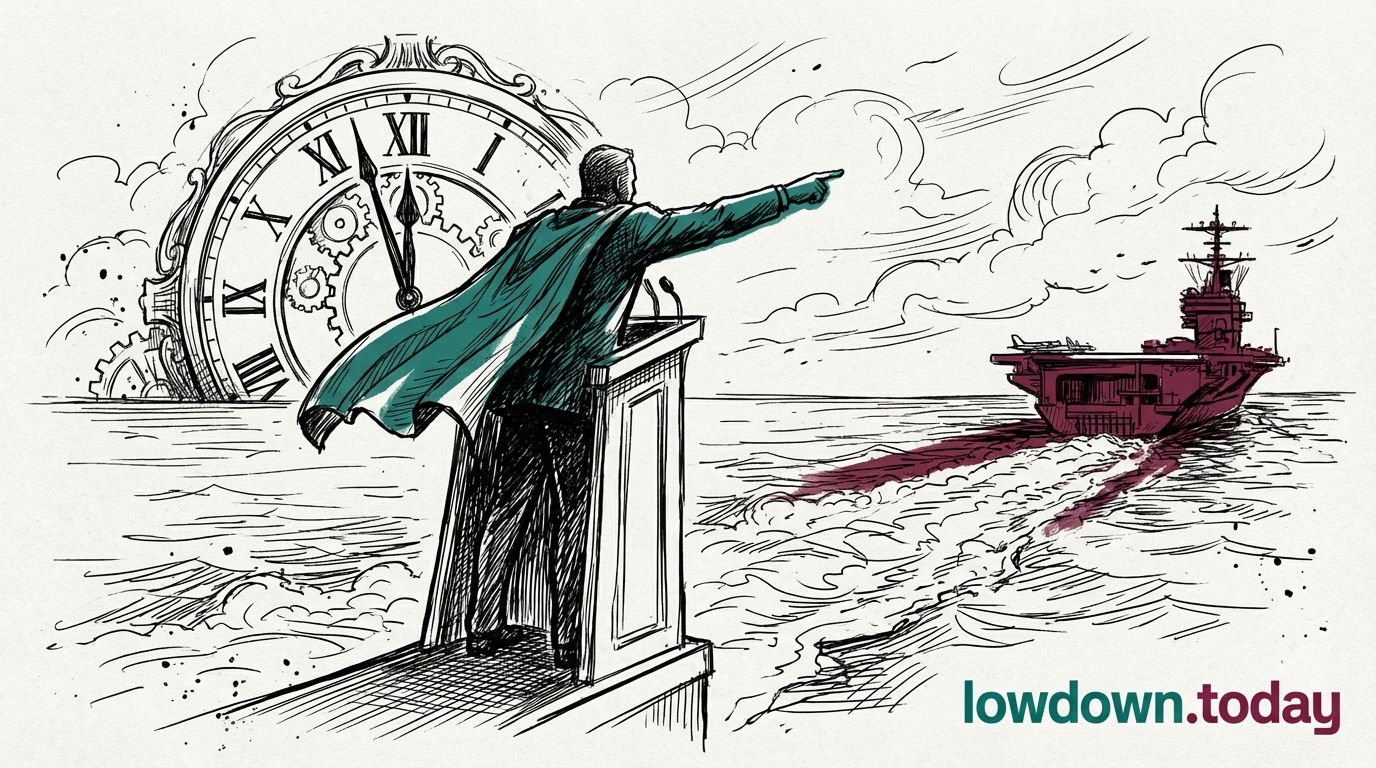
On the morning Donald Trump's fifth Hormuz ultimatum was due to expire, the two US carriers most likely to enforce it moved further from Iran than at any point in the war.

USS Gerald R Ford repositioned south to the Central Red Sea off Jeddah and USS Abraham Lincoln shifted to waters off Salalah in southern Oman, placing both carriers more than 1,100 km from Iran's coast , up from under 350 km earlier in the campaign. The Pentagon attributed the move to prudent force protection following an Iranian gunboat engagement of an Abraham Lincoln escort vessel.

The platforms required to make tonight's deadline credible have just removed themselves from the operational envelope they would need to be inside. 

Iran's overnight counter-proposal asks Washington to legally recognise the Hormuz toll system Tehran has already built, not negotiate it away.

Iran transmitted a 10-point counter-proposal to Washington via Pakistani channels overnight, in which President Masoud Pezeshkian's spokesman stated the strait of Hormuz would open only when war damage is compensated through a new legal regime using transit fee revenue. The proposal demands Washington recognise a new legal regime for Hormuz, grant full sanctions relief, fund war reconstruction, and cease Western military operations across the region.

Iran is asking the United States to sign the customs system into legal existence, an invoice for ratification of the status quo dressed as a counter-offer. 

Qatar walked away from mediation two weeks before the Pakistan framework was held up as a ceasefire route, and Iran had already refused to attend the venue.

The Islamabad Accord ceasefire framework was shown to have been announced over a dead diplomatic channel: Qatar's Ministry of Foreign Affairs publicly declined the central mediator role on 24 March, and the Wall Street Journal reported on 3 April that the Pakistan-led mediation had already hit a dead end, with Iran refusing to attend proposed Islamabad meetings and calling Washington's conditions unacceptable. The framework was publicly announced three days after the WSJ dead-end report.

Yesterday's apparent ceasefire breakthrough turns out to have been a label for the deadline-extension cycle, not a process either party agreed to attend. 

Israel struck the South Pars gas complex on 6 April; Defence Minister Israel Katz claimed the bombing has now knocked out the bulk of Iran's petrochemical exports.

The IDF struck the South Pars / Asaluyeh gas complex on 6 April, Iran's largest petrochemical facility. Israeli Defence Minister Israel Katz confirmed the strike publicly and claimed that combined with the Mahshahr complex hit on 5 April, 85% of Iran's petrochemical export capacity is now offline. Independent verification is constrained because Planet Labs imagery of Iran has been blacked out by undisclosed US government order since 9 March.

If Katz's figure holds, three weeks of Israeli air operations have done more measurable damage to Iran's hydrocarbons sector than two decades of US sanctions managed. 

The IRGC intelligence chief who kept Iran's elected president away from the Supreme Leader was reported killed in the same 6 April Israeli strike that hit South Pars.

Maj. Gen. Majid Khademi, IRGC intelligence chief since 2024 and described as effectively the No. 2 within the IRGC, was reported killed in the same 6 April Israeli strike wave. Khademi's apparatus had through six weeks of war kept President Pezeshkian physically and procedurally away from Supreme Leader Mojtaba Khamenei. Wire-service confirmation was still pending at time of filing.

Khademi's death, if confirmed, briefly unfastens the IRGC's grip on Iran's civilian decision-making at the precise moment a deadline expires. 

Regional reporting names Asghar Bakeri, commander of the Quds Force's external operations unit, among the dead in the 6 April Israeli strike wave on Asaluyeh.

Asghar Bakeri, named as the commander of Quds Force Unit 840 (the IRGC's external assassinations branch), was reported killed in the same 6 April Israeli strike wave as Khademi. Wire-service confirmation was still pending at time of filing.

If confirmed, Iran has lost the operational head of the unit Western intelligence has linked to the Riyadh embassy tandem-drone attempt and similar foreign operations. 

The fifth reformulation of the same Hormuz ultimatum in six weeks is set to lapse at 8pm Eastern, with the most probable outcome a sixth extension framed around the Islamabad track.

Donald Trump's fifth reformulation of the Hormuz ultimatum was set to expire at 8pm ET (0000 UTC Wednesday) on 7 April. It follows the 6 April power-grid deadline and the second ultimatum that replaced it. Each previous expiry produced an extension; the pattern across five cycles has been escalating rhetoric with a flat operational ceiling.

Five expiries, five extensions, no civilian-infrastructure crossings: the deadline mechanism itself has become the tool, not a precursor to action. 

Defence Secretary Pete Hegseth told reporters today's air operations would be the largest since Day 1, while calling Iran's outbound missile rate the lowest of the war.

Defence Secretary Pete Hegseth told reporters at a Pentagon press briefing that 7 April air operations would constitute the largest volume of strikes since Day 1, while in the same briefing characterising Iran's outbound missile fire over the previous day as the lowest of the war. Hegseth declined to specify target categories and did not announce any crossing of civilian-infrastructure thresholds.

Both claims may be true; neither tells the reader where the strikes are landing, and Hegseth declined to specify target categories. 

Donald Trump, through aides, called Iran's counter-proposal significant but not good enough, the closest verbal engagement he has made with any Iranian signal in six weeks.

Trump's response to Iran's 10-point counter-proposal, relayed through aides, was that the proposal is significant but not good enough , the closest verbal engagement he has made with any Iranian signal in six weeks. Egyptian officials separately briefed that Tehran is conditionally open to a 45-day truce, but only with a written guarantee of permanent end to hostilities.

After six weeks of refusing to acknowledge Iranian signals at all, Trump has now characterised one as significant in the same breath as rejecting it. 

Brent crude settled at $110.05 on 7 April, holding 64% above pre-war levels but easing marginally overnight as traders priced either deadline fatigue or quiet hope of a deal.

Brent Crude settled at $110.05 on 7 April in a $106.89 to $111.68 intraday range, still 64% above pre-war levels of around $67 a barrel despite a marginal overnight decline. Markets were assessed as pricing in either fatigue with the deadline cycle or quiet hope tied to the diplomatic accord.

After five deadlines without enforcement, oil markets are now treating Trump's ultimatums as background noise rather than a leading indicator. 

The White House Clear and Unchanging Objectives page now omits Hormuz reopening from the official US war aims, putting in writing a climbdown that was previously private.

The whitehouse.gov Clear and Unchanging Objectives page omits Hormuz reopening from the official list of US war aims, making public what had previously been a private climbdown on this objective.

Trump's stated war objective for the past six weeks has quietly disappeared from the page that lists what the US is fighting for. 

The International Committee of the Red Cross repeated its warning that threats against civilian infrastructure must not become normalised, hours after a Pentagon briefing that walked past it.

The International Committee of the Red Cross reiterated that threats against civilian infrastructure cannot become the new norm. The statement was made as Hegseth's Pentagon briefing walked past the warning without engaging it.

The custodian of the Laws of War is now publicly flagging the rhetorical threshold the Trump deadlines have repeatedly crossed. 

Ali Vaez of the International Crisis Group summarised six weeks of war in a single sentence: in trying to deny Iran a weapon of mass destruction, the US handed it a weapon of mass disruption.

Ali Vaez of the International Crisis Group summarised the six-week conflict with the observation that in the attempt to prevent Iran from developing a weapon of mass destruction, the US handed Iran a weapon of mass disruption. The quote encapsulates the structural outcome of the Hormuz toll system's codification.

Vaez's framing captures the structural inversion the deadline cycle and the toll system have produced: leverage that was supposed to disappear has been codified instead. 

Closing comments

Mixed, with asymmetric risk distribution. The carrier reposition and Iran's lowest-of-war missile rate both reduce the probability of an imminent large-scale exchange. The South Pars strikes and the reported Khademi and Bakeri kills raise the structural stakes without triggering immediate retaliation , Iran's outbound rate fell rather than spiked. The dominant risk is not short-term escalation but miscalculation on a future cycle: five extensions have conditioned Iran to treat US deadlines as non-binding, meaning the day Trump genuinely intends to enforce, no actor in the system will read the signal differently from the four that preceded it. The ICRC's public intervention on civilian infrastructure norms adds a second asymmetric risk: any US crossing of that threshold now faces an immediate international humanitarian law record. Assessed escalation direction: mixed, with the credibility gap between rhetoric and available force widening.

Different Perspectives
Donald Trump / United States
Trump described Iran's 10-point counter-proposal as 'significant but not good enough', the first verbal acknowledgement of any Iranian signal in six weeks. The Pentagon framed the carrier reposition as routine force protection while quietly removing Hormuz reopening from the official war aims page, signalling that the operational ceiling has not moved.
Iran / IRGC
Iran / IRGC
Iran's overnight counter-proposal, transmitted via Pakistan, demands legal ratification of the Hormuz toll system Tehran has already built, full sanctions relief, and war reconstruction. The IRGC's simultaneous loss of its intelligence chief and Quds Force Unit 840 commander has not produced a missile-rate spike, suggesting command disruption rather than restraint.
Israel / IDF
Israel / IDF
Defence Minister Katz publicly confirmed the South Pars strike and claimed combined Asaluyeh and Mahshahr hits have taken 85% of Iran's petrochemical export capacity offline. The same 6 April strike wave reportedly killed both IRGC intelligence chief Khademi and Quds Force Unit 840 commander Bakeri.
Pakistan / Field Marshal Asim Munir
Pakistan hosted the Islamabad Accord framework and transmitted Iran's 10-point counter-proposal to Washington. Today's events expose the framework as press conference product: Qatar had declined the mediator role and Iran had refused the venue before the accord was announced.
Qatar
Qatar
Qatar's MoFA stated on 24 March it was not engaged in any direct US-Iran mediation. The South Pars strike compounds Doha's exposure because Iran's half of the jointly-operated South Pars / North Dome field has now been hit, in the same week Qatar declined the mediator role.
Egypt
Egypt
Egyptian officials separately briefed that Tehran is conditionally open to a 45-day truce, but only with a written guarantee of a permanent end to hostilities , a condition no US administration has accepted on any prior occasion. Cairo is running a back-channel compatible with Iran's formal Pakistan submission, providing a second track that neither replaces nor contradicts the Islamabad framing.