
Skip to content
Briefings are running a touch slower this week while we rebuild the foundations.See roadmap
Iran Conflict 2026
18MAR

Day 19: Larijani dead; Israel hunts the new leader

7 min read
06:00UTC

Israel killed Ali Larijani, secretary of Iran's Supreme National Security Council and the most senior Iranian official to die since Khamenei, then authorised its military to kill senior figures without political approval. Leaked audio revealed Mojtaba Khamenei's wife and son died in the 28 February strikes. The NCTC director resigned — the first senior Trump official to break with the war.

Key takeaway

Israel is simultaneously eliminating Iran's capacity to negotiate and its own political constraints on escalation, while the first cracks in US domestic support emerge alongside an expanding two-front ground and air commitment with no articulated end-state.

This briefing mapped
Loading map…
Military
Domestic
Diplomatic
Humanitarian
Economic

The overnight Tehran strike killed Iran's most senior surviving official — the nuclear negotiator, parliament speaker, and SNSC secretary whose institutional memory spanned four decades of Iranian statecraft.

Sources profile:This story draws on centre-left-leaning sources from United States and Qatar
United StatesQatar

Israel killed Ali Larijani — secretary of Iran's Supreme National Security Council and the most senior Iranian official to die since Supreme Leader Ali Khamenei on 28 February — in an overnight strike on Tehran. The same strike killed Gholamreza Soleimani (62), commander of the Basij paramilitary for six years and an Iran-Iraq War veteran, and his deputy Seyyed Karishi. Soleimani and Karishi were found in a makeshift tent encampment rather than their headquarters, indicating senior Iranian commanders have dispersed to evade targeting. Larijani had served as Parliament speaker, judiciary chief, nuclear negotiator, and SNSC secretary across four decades; his death removes Iran's institutional memory for future negotiations.

Larijani's death removes Iran's institutional memory for diplomacy and its last figure with the cross-institutional authority required for backchannel negotiation, at the moment the new Supreme Leader cannot appear in public and FM Araghchi's diplomatic position was showing its first movement. 

Briefing analysis

In March–April 2004, Israel assassinated Hamas founder Sheikh Ahmed Yassin and his successor Abdel Aziz al-Rantisi within four weeks. Both operations required cabinet approval, and neither eliminated Hamas as a governing force — Ismail Haniyeh succeeded Rantisi within days. The pattern was consistent: decapitation reshuffled leadership without resolving the underlying conflict.

The removal of political sign-off requirements more closely parallels the post-9/11 US shift, when the 2001 Authorization for Use of Military Force devolved targeting authority from political leadership to operational commanders. That delegation accelerated the campaign tempo but also removed the institutional friction that forces strategic reassessment — a trade-off whose consequences unfolded across two decades of war without a defined end-state.

For the first time, Israel's military and intelligence services can kill senior adversary figures without waiting for cabinet approval — a change a senior Israeli official called unprecedented.

Sources profile:This story draws on centre-left-leaning sources from Israel
Israel

Netanyahu and Defence Minister Katz granted the IDF and Mossad advance authority to kill senior Iranian and Hezbollah figures without per-operation cabinet sign-off. A senior official told Ynet: "This has never happened before." Previous operations, including the 2024 killing of Hamas chief Ismail Haniyeh, each required cabinet approval.

Removing that step matches operational tempo to Iranian commanders now living in tent encampments, while stripping the pause that sometimes allowed backchannels to intervene. 

An elderly couple — one unable to reach shelter due to a disability — were killed as the IRGC fired its broadest weapon mix yet at central Israel, shutting Tel Aviv's main rail hub.

Sources profile:This story draws on centre-left-leaning sources from Israel
Israel

The IRGC launched the 61st wave of Operation True Promise 4 using Khorramshahr-4 and Qadr multiple-warhead missiles. A disabled couple in their 70s were killed in Ramat Gan; damage at Tel Aviv's Savidor Central station forced rail suspension. Israel's civilian toll reached 17.

Multiple-warhead missiles split during descent, multiplying targets for Israeli interceptors. An IRGC spokesman noted days earlier that missiles fired so far were made "a decade ago"; newer inventory remains unused. 

The first senior Trump administration official to resign over the war is a Special Forces veteran and former CIA officer whose wife was killed fighting in Syria — and he says Iran never posed an imminent threat.

Sources profile:This story draws on centre-left-leaning sources from United States
United States

Joe Kent resigned as director of the National Counterterrorism Centre on 17 March, the first senior Trump official to leave over the Iran war. A Special Forces veteran, he said Iran "posed no imminent threat" and accused the administration of following Israel's lead.

Kent's wife was killed in the 2019 Manbij bombing, making the "soft on terrorism" dismissal hard to land. NBC News reported Trump has rejected every off-ramp option in daily war briefings. 

A verified recording from inside the Supreme Leader's office reveals Mojtaba Khamenei survived the 28 February strikes by seconds. His wife and son did not.

Sources profile:This story draws on mixed-leaning sources from United States and United Kingdom
United StatesUnited Kingdom
LeftRight

A Telegraph-verified recording from Mazaher Hosseini, head of protocol for the late Supreme Leader's office, placed Mojtaba Khamenei in his garden at 09:30 on 28 February when ballistic missiles struck his home. His wife and son were killed instantly; he survived with a leg injury by "mere seconds."

18 days on, no verified image or audio of the new Supreme Leader has surfaced. Iran's constitutional apex directs a war while incapacitated, bereaved, and hidden. 

Sources:Newsweek·The Telegraph
1 The Telegraph2 Newsweek

An Israeli brigadier general names Iran's Supreme Leader as an assassination target on camera — the first time Israel's military has publicly declared a sitting head of state marked for killing.

Sources profile:This story draws on mixed-leaning sources from Israel
Israel
LeftRight

IDF spokesman Brig. Gen. Effie Defrin stated on camera: 'He is not immune. We will pursue him, find him, and neutralise him,' referring to Mojtaba Khamenei. This is the first time an Israeli military official has publicly named the sitting Supreme Leader as an assassination target.

First public Israeli military declaration naming a sitting head of state as an assassination target. Combined with the removal of cabinet-level approval for targeted killings, this transforms Israel's decapitation campaign from covert operations to declared policy and forces Iran to choose between hiding its leader and producing him. 

After every ally he named for a Strait of Hormuz escort coalition formally refused, Trump said leaving NATO is 'something to think about.' Germany's foreign minister answered for the continent: 'We will not participate in this conflict.'

Sources profile:This story draws on centre-left-leaning sources from United States
United States

Trump said leaving NATO is "something to think about" after Australia, Japan, the UK, Germany, and France all declined to send warships for a Strait of Hormuz escort. Germany's foreign minister replied: "We will not participate in this conflict."

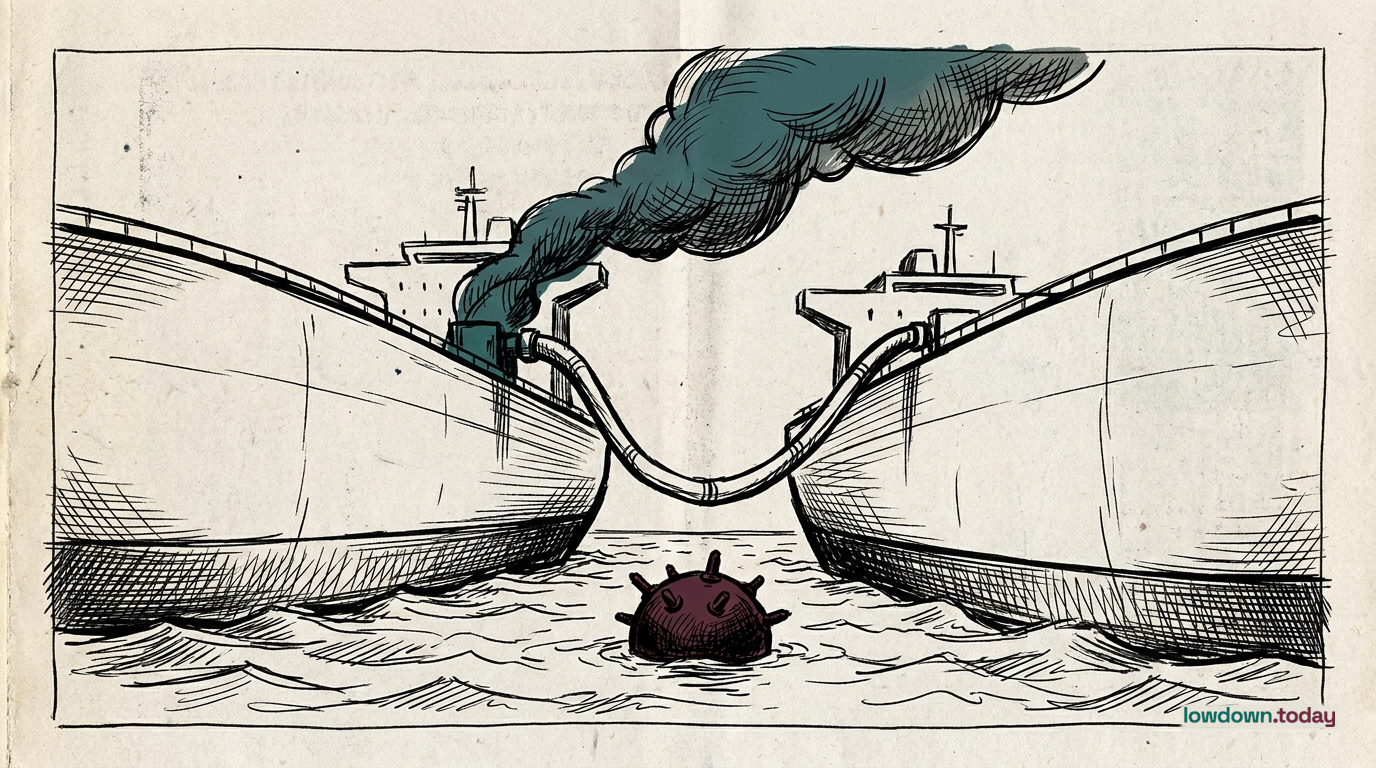
With 3 consecutive leverage attempts on Europe, China, and NATO all producing zero warship commitments, the strait stays closed. Threatening to leave NATO does not produce frigates. 

Iran's foreign minister shifted from flat refusal to his first formulation of how the war might end — but whether he speaks for the IRGC is unresolved, and the man most capable of turning words into negotiations was killed hours later.

Sources profile:This story draws on centre-right-leaning sources from United Kingdom
United Kingdom

Iranian FM Araghchi shifted language on 16 March: after flat denial the previous day, he stated "this war must end, in a way that our enemies never again think about repeating such attacks." He denied Iran had asked for a truce.

This is the first Iranian formulation describing an end-state rather than refusing one. Ali Larijani, the figure most capable of acting on it, was killed hours after Araghchi spoke. 

The Israeli Air Force struck an aircraft used by Ali Khamenei and the IRGC's transport fleet at Mehrabad Airport — degrading the command mobility of a leadership already dispersed, injured, and under systematic targeting.

Sources profile:This story draws on centre-right-leaning sources from United Kingdom
United Kingdom

The Israeli Air Force destroyed an aircraft used by Ali Khamenei and senior officials at Mehrabad Airport in Tehran two days before the Larijani strike. The IDF said the plane served military procurement and coordination functions. Iran International reported the IRGC's transport fleet was struck in the same raid.

Destroying leadership transport at a civilian airport in central Tehran eliminates command mobility and evacuation options, compounding the constraints that have kept Mojtaba Khamenei out of public view and forcing surviving leaders into static positions more vulnerable to targeting. 

The 36th Armoured Division has deployed to southern Lebanon alongside the 91st Galilee Division, committing Israel's most storied armoured brigade to the same towns it occupied from 1982 to 2000.

Sources profile:This story draws on centre-right-leaning sources from United States, United Arab Emirates and 1 more
United StatesUnited Arab EmiratesIsrael

Iran's government reports 1,444 killed after 18 days of war. An independent Kurdish human rights organisation counts at least 5,300 — a gap that mirrors the government's documented record of undercounting its own dead.

Sources profile:This story draws on neutral-leaning sources from Iran
Iran

After 18 days of war, Hengaw counted 5,300 killed in Iran (4,789 military, 511 civilian), HRANA reported 3,099, and Iran's Health Ministry claimed 1,444. Strikes hit 178 cities across 25 provinces.

The 3-fold gap follows the 2022 Mahsa Amini protests, when official counts ran at one-quarter of independent tallies. The 9:1 military-to-civilian ratio in Hengaw's figures, if accurate, would be unusually precise for an 18-day urban campaign. 

Sources:Hengaw

Three Lebanese Armed Forces soldiers were killed by Israeli strikes on 17 March, as the country's death toll reached 912–921 — including 111 children — in a fortnight of intensified operations.

Sources profile:This story draws on centre-right-leaning sources from United Arab Emirates
United Arab Emirates

Lebanon's death toll reached 912 in 15 days: 111 children, 67 women, and 38 health workers dead, with 2,221 wounded. On 17 March, Israeli strikes killed 3 Lebanese Armed Forces soldiers and wounded 5.

The LAF is Lebanon's national military, distinct from Hezbollah and funded by the US, UK, and France. Killing its soldiers risks collapsing the studied neutrality those governments depend on to stabilise the south. 

One million Lebanese — nearly one in five — have been driven from their homes in 18 days, with 300,000 children among them and shelters overflowing.

Lebanon's displacement reached 1,049,328 people (19% of the population) as of 17 March. The IOM appealed for $19 million; over 130,000 are sheltering across 600-plus collective sites, with thousands sleeping in streets.

Lebanon absorbed this crisis on a state already fiscally collapsed since 2019. The country hosts more than 1 million Syrian refugees and has no Treasury capacity to fund emergency response independently. 

Sources:MEMO 886·IOM
1 IOM2 IOM

US diesel has jumped 34% since 28 February and petrol is at its highest since October 2023, translating a distant conflict into a cost every American driver can read on the pump sign.

Sources profile:This story draws on centre-left-leaning sources from United States
United States

US diesel topped $5 per gallon on 17 March, up 34% since 28 February. Petrol averaged $3.79, up 27%, the highest since October 2023. Brent closed at $100.21, still 49% above the pre-war $67.41.

Diesel activates automatic freight surcharge tiers that pass costs to retailers within weeks. Chatham House warned sustained conflict could push Brent to $130 and probably contract the Eurozone in Q2, compounding Stagflation warnings already issued by Deutsche Bank and Oxford Economics

Sources:CNBC

The UAE intercepted 10 ballistic missiles and 45 drones in a single day, but a third fire at Fujairah's oil zone shows the limits of air defence when every interception must succeed.

Sources profile:This story draws on centre-right-leaning sources from United States
United States

The UAE intercepted 10 Iranian ballistic missiles and 45 drones on 17 March, closing its airspace for hours. A third fire struck Fujairah's oil zone; loading has been suspended since the second strike. Cumulative Gulf interceptions exceed 2,000 since 28 February.

Fujairah handles roughly 85 million barrels of bunkering fuel per month as the main tanker refuelling point bypassing Hormuz. Repeated fires raise global shipping costs independently of whether the strait itself stays open. 

Human Rights Watch documents 11 dead and 268 injured across Gulf states from Iranian strikes — the majority migrant workers with no political voice in the conflict killing them.

Sources profile:This story draws on centre-left-leaning sources from United States
United States

Human Rights Watch documented at least 11 civilian deaths and 268 injuries across Gulf States, with migrant workers comprising the majority of victims. Pezeshkian's 8 March apology pledging to stop targeting Gulf neighbours was followed by uninterrupted attacks.

The IRGC reports to The Supreme Leader, not the civilian president. Any ceasefire negotiated with Pezeshkian cannot be assumed to halt IRGC missiles. The gap reflects a structural feature of Iranian governance. 

American casualties accumulate entirely from Iranian strikes on fixed bases — no ground combat, no front line — with CENTCOM reporting 200-plus wounded and 13 killed.

Sources profile:This story draws on centre-left-leaning sources from United States
United States

US wounded in the Iran conflict surpassed 200 by 17 March, up from 140-plus three days earlier; more than 180 returned to duty. Killed in action remains at 13.

The 15:1 wounded-to-killed ratio reflects blast injuries from missiles and drone debris striking fixed bases, not ground combat. All 200-plus casualties came from strikes on logistics nodes across a 2,000-kilometre arc from Baghdad to the southern Gulf, with no US ground engagements. 

Military planners present structured exit options in every daily war briefing. Trump has not taken one in 18 days, telling NBC the terms 'aren't good enough yet.'

Sources profile:This story draws on centre-left-leaning sources from United States
United States

Military officials present off-ramp options alongside escalation choices in Trump's daily war briefings, NBC reported. He has not exercised any exit option in 18 days. Trump said Iran is ready for a deal but 'the terms aren't good enough yet.'

At $900 million per day and diesel at $5 a gallon, each declined off-ramp makes the next harder to accept. Both sides are publicly inching toward compatible end-states while neither makes the first move. 

Sources:NBC News

Greene and Carlson break publicly with Trump on Iran, but polling shows 85–90% of self-identified MAGA Republicans still support the war — the fracture may cost general-election margins without threatening the coalition's core.

Sources profile:This story draws on centre-left-leaning sources from United States
United States

Marjorie Taylor Greene told CNN that MAGA supporters feel '100% betrayed' by the Iran campaign. Tucker Carlson called the strikes 'absolutely disgusting and evil.' Both blamed neoconservative capture of Republican foreign policy rather than Trump directly.

Polling shows 85-90% of self-identified MAGA Republicans support the war. Analyst G. Elliott Morris assessed real defection is concentrated among soft partisans and swing voters, eroding general-election margins without threatening Trump's intra-party control. 

As Israeli strikes destroy fixed military installations, Hengaw documents the consequence: Iranian troops relocating into schools, dormitories, and mosques, compounding risk to the civilians inside.

Sources profile:This story draws on neutral-leaning sources from Iran
Iran

Hengaw documented Iranian military forces moving into schools, dormitories, and mosques as the air campaign entered its third week, placing non-combatants at additional risk across 178 cities in 25 provinces.

Under International humanitarian law, military use of a civilian building can make it a legitimate target. Hengaw recorded 511 civilian dead, including 120 minors, out of 5,300 total. If military assets embed in schools and mosques, that 9.6% share will rise. 

Sources:Hengaw

Three major defence institutions independently assess the war's trajectory: CSIS prices it at $900 million a day, IISS warns of an endurance contest, and Chatham House projects $130 oil and eurozone contraction.

Sources profile:This story draws on neutral-leaning sources from United Kingdom
United Kingdom
LeftRight

CSIS calculated Operation Epic Fury costs the United States nearly $900 million per day. The International Institute for Strategic Studies described the conflict as at risk of becoming a 'battle of endurance.'

Cost asymmetry is structural: Iranian drones cost tens of thousands of dollars; interceptors cost $1-4 million each. Israel entered with depleted stocks from the Twelve-Day War. Chatham House warned months of fighting could push Brent to $130 and contract the Eurozone

Closing comments

Three escalation vectors are simultaneously active. First, the declared intent to kill a sitting Supreme Leader whom Iran must protect as an existential matter regardless of Khamenei's actual condition — the IRGC's doctrinal response to existential threats includes its heaviest conventional warheads. Second, two armoured divisions in Lebanon with a timeline extending to late May create a second ground front that competes for political attention and military resources; Haaretz assessed the operation would push Hezbollah launch sites northward without stopping barrages, meaning it may require further expansion to achieve its stated purpose. Third, each IRGC retaliatory wave introduces a broader weapon mix — the 61st added multiple-warhead missiles to the cluster munitions that first penetrated Israeli defences a week ago, while an IRGC spokesman has stated that post-war production remains unused. The Kent resignation and Araghchi's language shift are both off-ramp signals, but each lacks a counterpart positioned to receive it.

Emerging patterns

  • Decapitation campaign escalating to Iran's most senior political-military officials
  • Israeli political-military command structure loosening constraints on targeted killing operations
  • Iran diversifying missile types to test multiple failure modes in Israeli air defences
  • First senior administration defection over Iran war policy
  • Progressive disclosure of 28 February strike damage to Iranian supreme leadership
  • Israel publicly declaring assassination intent against heads of state
  • US alliance friction escalating from operational refusal to existential threats
  • Incremental Iranian rhetorical movement toward conditions for war termination
  • Targeting of Iranian leadership assets and transport infrastructure
  • Progressive expansion of Israeli ground forces in Lebanon toward two-division commitment
Different Perspectives
Joe Kent, NCTC Director
Resigned as National Counterterrorism Centre director — the first senior Trump administration official to leave over the war — stating Iran 'posed no imminent threat to our nation' and accusing the administration of following Israel's lead.
Marjorie Taylor Greene and Tucker Carlson
Greene told CNN MAGA supporters feel '100% betrayed'; Carlson called the strikes 'absolutely disgusting and evil.' Greene accused neoconservative Republicans of capturing the party's foreign policy. Polling shows 85–90% of self-identified MAGA Republicans still support the war.
Iranian FM Araghchi
Iranian FM Araghchi
Shifted from categorical ceasefire refusal on 15 March to a conditional end-state formulation on 16 March — the first Iranian acknowledgement that war termination is a subject for discussion, though still explicitly rejecting the word 'ceasefire.'
IDF Brig. Gen. Effie Defrin
Publicly named Mojtaba Khamenei as an assassination target on camera — the first time an Israeli military official has declared a sitting head of state a named target.