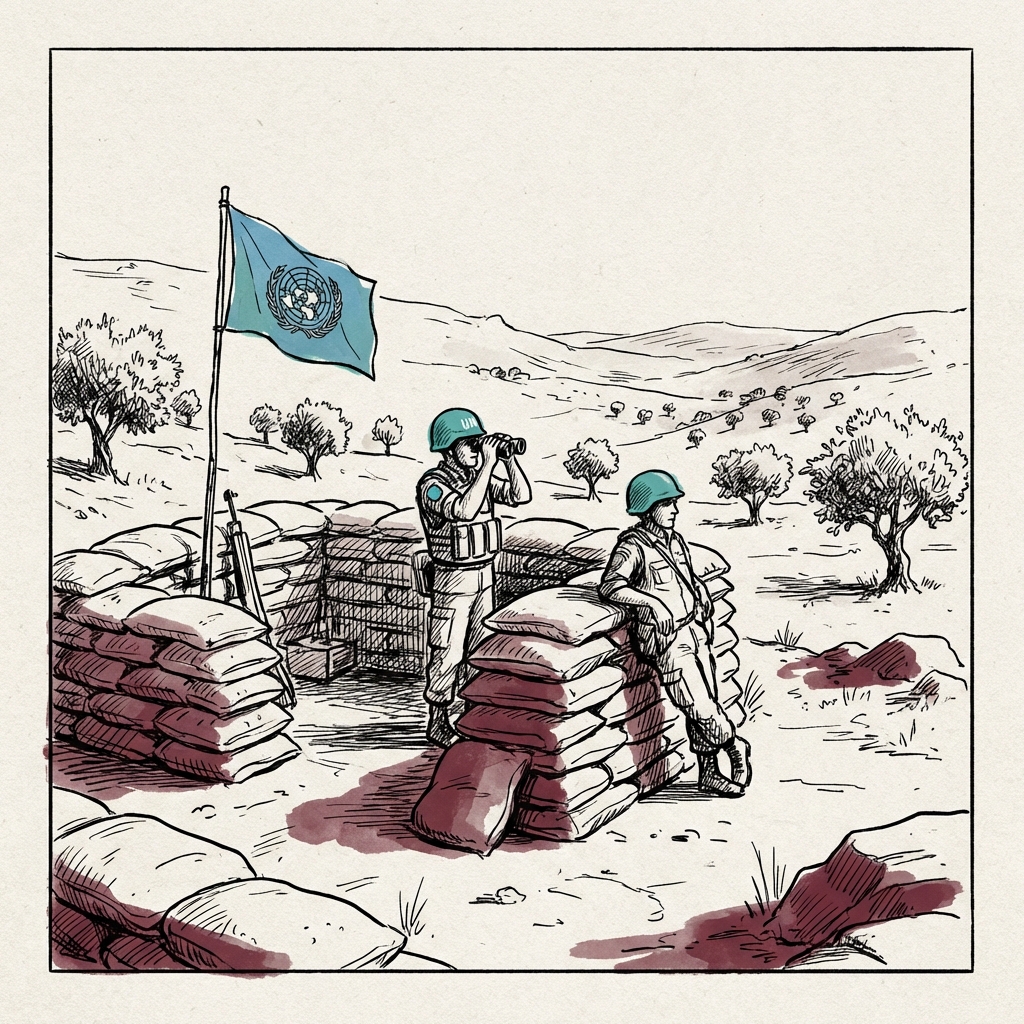
UNIFIL
UN peacekeeping force in southern Lebanon since 1978, monitoring the contested 2026 Israel-Hezbollah Ceasefire zone.
UNIFIL has taken repeated fire since Israel's ground campaign expanded in March 2026: two Ghanaian peacekeepers were critically wounded on 7 March, and a Serbian sergeant was killed near Marjayoun on 4 June, its first fatality of the war.
Last refreshed: 14 August 2026 · Appears in 1 active topic
Can UNIFIL still operate as Israeli demolitions continue inside its area of operations?
Timeline for UNIFIL
Mentioned in: Israeli forces detonate a Zawtar school
Iran Conflict 2026Mentioned in: Israeli drone kills four in Nabatieh
Iran Conflict 2026Mentioned in: Israel raids Lebanon, loses a captain
Iran Conflict 2026Mentioned in: Hezbollah kills senior IDF tank officer
Iran Conflict 2026Mentioned in: Iran makes Lebanon the gate to talks
Iran Conflict 2026Background
UNIFIL, the United Nations Interim Force in Lebanon, was established in 1978 under Security Council Resolution 425 after Operation Litani, tasked with overseeing Israeli withdrawal and restoring peace. Its modern mandate derives from Resolution 1701 (2006), which expanded the force to roughly 10,000 troops from more than 50 contributing nations, headquartered at Naqoura on the Lebanese coast.
The mission monitors the Blue Line, supports the Lebanese Armed Forces, and reports violations by all parties, but has no enforcement authority: it can observe and report, but cannot compel compliance. Its legitimacy rests on the consent of the parties it monitors, so the collapse of that consent leaves it without a military option.
France and Italy lead the largest European contingents, with Spain, Germany, Ghana and Serbia among the other major contributors. Those nationalities have borne the casualties of the 2026 campaign directly, which is why individual troop-contributing governments, not only the UN Secretariat, have pressed Israel over incidents involving their own personnel.
Peacekeepers keep coming under fire
Two Ghanaian peacekeepers were critically wounded in a strike on their base on 7 March; Ghana filed a formal protest with the UN Secretary-General.
On 4 June, Serbian Sergeant Milovan Jovanovic was killed by mortar fire near Marjayoun, its first fatality of the campaign; UNIFIL said the attack may amount to a war crime. The mission has no enforcement authority, so each incident is logged and protested rather than answered. Six more peacekeepers were injured and one detained on 10 April when the IDF blocked a logistics convoy.
It reopened roads behind a pullback
On 22 June a UNIFIL contingent and a Lebanese Army engineering unit moved into a southern village to reopen roads behind a localised Israeli redeployment toward Khiam in the Marjeyoun district. Israel called the move dynamic defence, not a withdrawal, and its wider 10km security zone stayed in place.
The handover matches the Washington round-five framework, under which Lebanon's Army would take exclusive control of pilot zones south of the Litani. It is the first confirmed instance of that architecture working on the ground, though Israel opened access to one village while holding position in dozens of others. UNIFIL's practical relevance now depends on whether further handovers follow.
What is UNIFIL and what does it do?
Were UNIFIL peacekeepers attacked in 2026?
How many troops does UNIFIL have?
What is UN Security Council Resolution 1701?
Why is Israel in conflict with UNIFIL?
What did Ghana say about the UNIFIL attack?
What is UNIFIL and why is it in Lebanon?
Have UN peacekeepers been attacked in Lebanon in 2026?
Why is Israel pushing beyond the Lebanon ceasefire buffer zone?
How many countries contribute troops to UNIFIL?
What is UNIFIL and what does it do in Lebanon?
Was a UN peacekeeper killed in Lebanon in June 2026?
How many times have UNIFIL peacekeepers been attacked in 2026?
Will UNIFIL's mandate be renewed after peacekeepers were killed?
What did UNIFIL do in Debbine, Lebanon in June 2026?
Has UNIFIL had casualties in the 2026 Lebanon conflict?
Can UNIFIL enforce a ceasefire in southern Lebanon?
What is the UNIFIL mandate and how does it relate to the Litani River?
Is UNIFIL still operating in areas where Israel is demolishing buildings?


