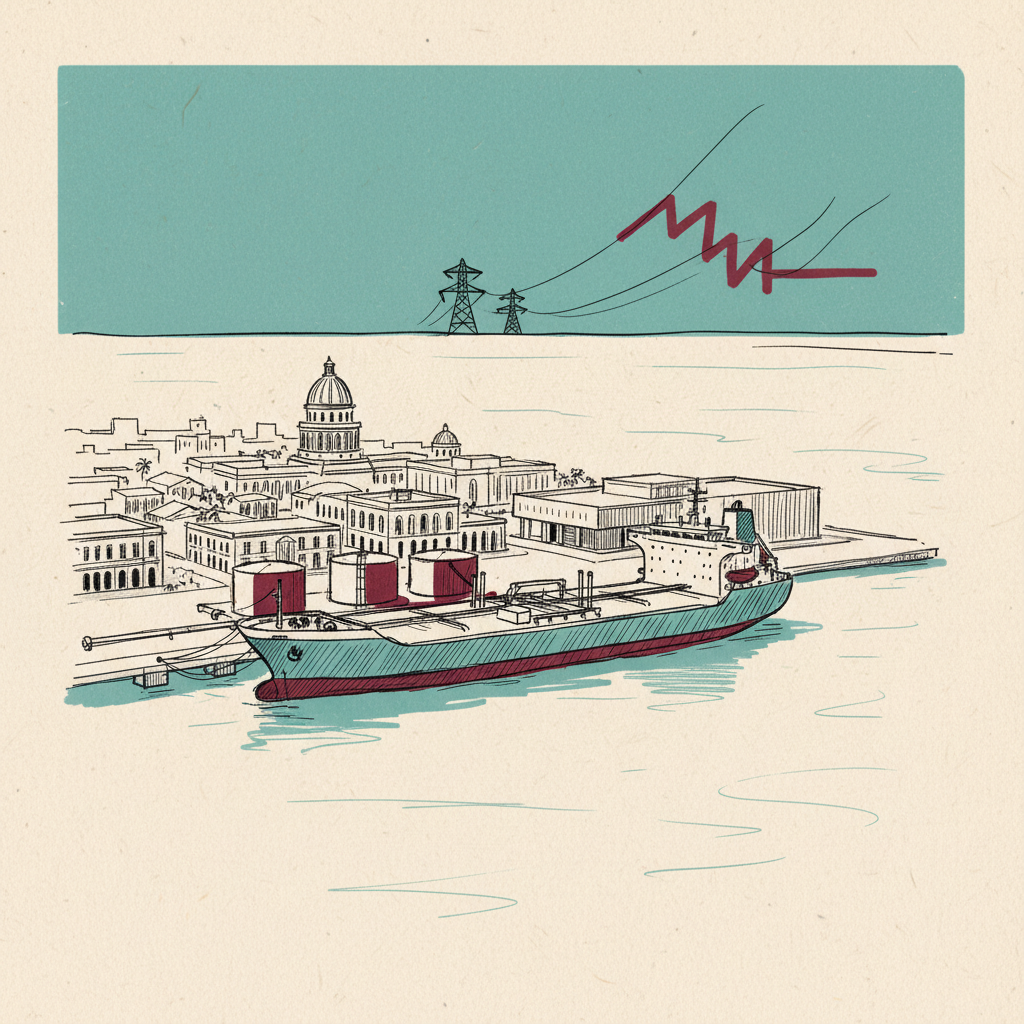
Havana
Cuba's capital and government seat; site of the 2026 compound utility collapse and first cacerolazo protests.
Havana's power system remained fragile on 2 August, when a fault at a city substation triggered Cuba's sixth total blackout of 2026.
Last refreshed: 22 September 2026 · Appears in 1 active topic
How close is Havana to a full breakdown of basic services in 2026?
Timeline for Havana
Mentioned in: Cuba lets foreign firms hire directly
Cuba DispatchMentioned in: Havana mother held over water posts
Cuba DispatchMentioned in: Felton fault splits Cuba's east again
Cuba DispatchBackground
Havana is Cuba's capital, largest city and seat of its government, Communist Party leadership and major state enterprises. It also contains The National grid control centre, which decides electricity allocation when supply is short. In April 2026, Havana received four blackout-free days while eastern provinces faced outages of up to 24 hours.
The city remains the country’s main political, administrative and economic centre. Its concentration of state institutions makes developments in Havana relevant beyond municipal life, while its grid priority has made service allocation a persistent source of tension with eastern provinces.
Havana’s 2026 utility failures exposed the limits of that priority. The 2 August grid collapse began at a Havana substation, after repeated national system failures had already reduced the capital’s ability to shield residents from shortages.
Havana's utilities remain exposed
On 3 June, gas supplies failed across most of Havana after electricity and water outages, disrupting milk deliveries for an estimated 100,000 children. The episode showed how fuel shortages could disable household services and food distribution at the same time.
The vulnerability persisted on 10 July, when a transmission-line failure brought down Cuba's National Grid and only 12.6 per cent of Havana had power restored afterwards. A Havana substation fault then triggered the sixth nationwide collapse on 2 August, making the capital an origin of failure rather than merely a place affected by shortages.
The capital's custody system faces scrutiny
On 14 July, the Cuban Human Rights Observatory named Havana's provincial prosecutor, penitentiary directorate and Supreme Popular Court president as responsible for explaining Luis Manuel Otero Alcántara's custody after his sentence expiry. The group said it had received no official information on his whereabouts since 7 July.
Otero reached Miami on 18 July after US humanitarian parole was approved, but no Cuban court record accounted for the period between his prison release and departure. On 23 July, state television attacked him before Havana's 25 July reporting deadline to the UN Committee on Enforced Disappearances.
How bad was Cuba's power deficit in mid-July 2026?
Why did Havana lose power on 10 July 2026?
Why did the price of cooking gas rise in Cuba in July 2026?
Why does Havana have electricity when the rest of Cuba does not?
Are there protests happening in Havana right now?
Why is there no gas or water in Havana in June 2026?
What is the Meteor 2026 civil defence drill?
Why is Havana hosting three parallel US diplomatic tracks?
What happened at Havana Cathedral on 9 May 2026?
Was Havana affected by Cuba's 14 May 2026 grid split?
Where will the Sovcomflot Universal unload its diesel in Cuba?
Why does Havana have fewer blackouts than the rest of Cuba?
How many consecutive blackout-free days did Havana have in April 2026?
When did a US government aircraft last land in Havana before April 2026?
Where are the US-Cuba diplomatic talks in 2026 being held?
What happened at Havana port in March 2026?
How long are Havana's power cuts in 2026?
What is the black market dollar exchange rate in Cuba?
Why are gas, water, and electricity failing in Havana?
What happened at Havana Cathedral in May 2026?
Who attended the Havana Cathedral pontifical anniversary mass?
Written with AI from Lowdown's published reporting. Not individually reviewed by an editor. Updated 22 September 2026. Editorial standards.