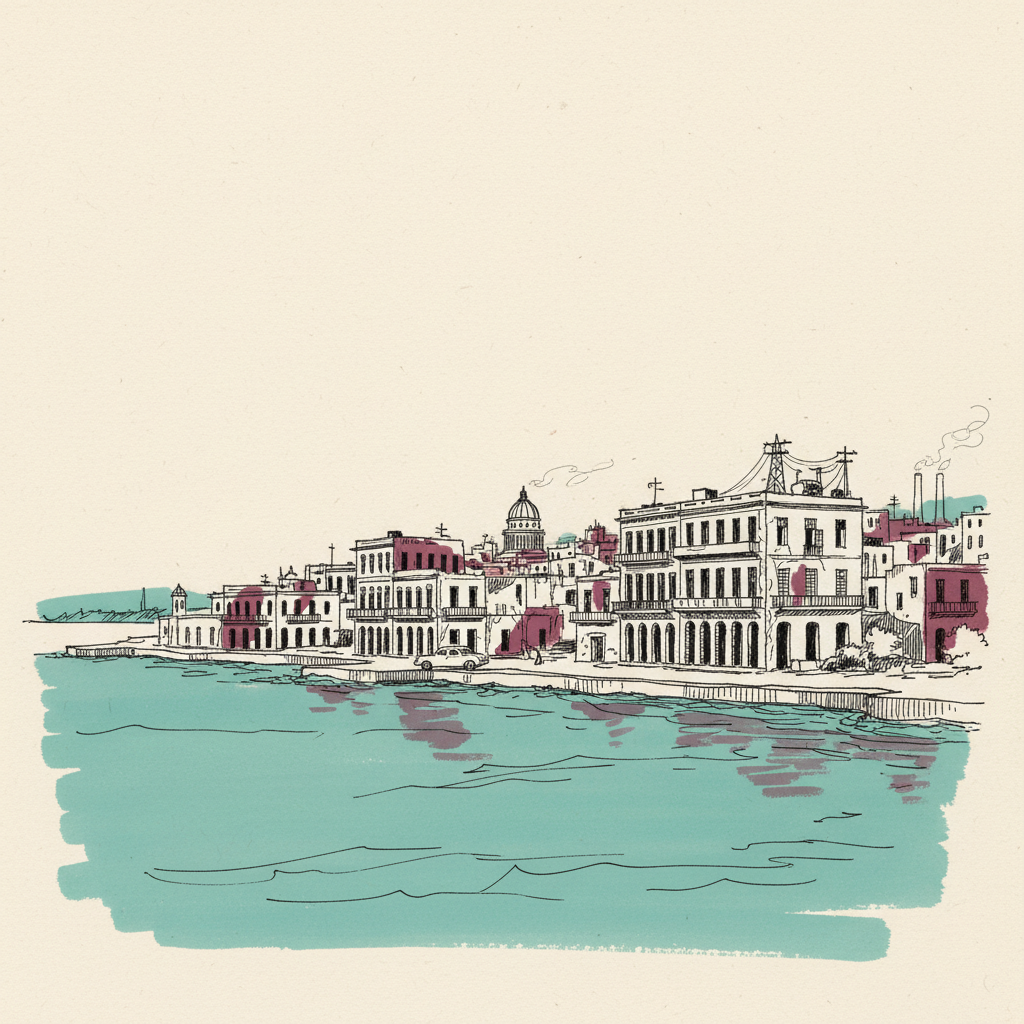
Cuba
Caribbean socialist state under US embargo; President and CUPET both now on OFAC SDN list.
On 4 September, Cuba made direct hiring by foreign firms optional, loosening a state employment bottleneck while retaining control over exit permits and currency conversion.
Last refreshed: 22 September 2026 · Appears in 4 active topics
Can Cuba survive US sanctions on its president and its oil company simultaneously?
Timeline for Cuba
Mentioned in: Cuba's dollar rises as the euro falls
Cuba DispatchPublished a revised decree permitting direct hiring by foreign-invested firms
Cuba Dispatch: Cuba lets foreign firms hire directlyMentioned in: Cuban tourism falls 62 per cent
Cuba DispatchRussia declines Cuba's BRICS upgrade bid
Cuba DispatchBackground
Cuba is a Caribbean one-party socialist state governed by the Communist Party. Its economy remains heavily state-directed, while its government faces a long-running US embargo and a newer sanctions campaign. On 7 May, US measures formally placed the newer Cuba sanctions regime alongside the existing Cuban Assets Control Regulations.
Cuba depends on imported fuel to meet demand beyond its domestic output. Cuba produces less oil than its economy needs. The shortfall leaves Cuba reliant on imported fuel, linking external financial pressure to the reliability of electricity, transport and essential services.
Cuba loosens foreign hiring rules
On 3 and 4 September, Decree-Law 128/2026 and Decree 325 made it optional for foreign firms to recruit Cuban staff through the state employment agency. The change removes one barrier for investors seeking to employ workers directly.
On 18 June, Cuba had already legalised private banks, dollar accounts and non-bank payment institutions as part of a wider reform package. The hiring change extends that opening, but the state agency still controls exit permits and currency conversion, so Cuba retains decisive control over the workforce foreign firms depend on.
Sanctions widen Cuba's financial isolation
For Cuba, the 3 September US Treasury action put its state trade-finance bank under sanctions, alongside Fidel Ernesto Castro Calis and four traders in fuel and mining. The action reached trading intermediaries that help connect Cuba's state economy to external suppliers and payments.
On 4 June, Washington had also designated President Miguel Díaz-Canel, his family members and the armed forces ministry. For Cuba, the accumulating measures raise the cost of maintaining foreign commercial links, even where a counterparty is not itself named on a sanctions list.
Cuba's power system remains fragile
On 27 August, Cuba faced a fault at the Felton power station disconnected eastern provinces from Holguín to Guantánamo and contributed to a forecast 2,060-megawatt deficit against 3,200 megawatts of demand. The outage showed that regional failures can still disrupt much of the island.
On 2 August, a Havana substation fault triggered Cuba's sixth full blackout of 2026 after seven generating units were already offline. For Cuba, recurrent failures constrain daily life, industry and tourism while leaving little operational reserve for repairs or new shocks.
How many political prisoners does Cuba hold as of July 2026?
Why did Cuba's national grid collapse twice in July 2026?
How many Cuban entities did the US sanction on 13 July 2026?
How much did Cuba raise cooking gas prices in July 2026?
Are there protests in Cuba in 2026?
Why is Cuba running out of gas and water in 2026?
Why did Visa and Mastercard stop working in Cuba?
What is the current Cuban peso exchange rate?
What is GAESA and why does the US want to shut it down?
What is Executive Order 14404 on Cuba?
Did Marco Rubio meet the Pope about Cuba?
When did Venezuelan oil supply to Cuba actually stop?
How much fuel does Cuba consume each day?
Why did Cuba's national grid fragment on 14 May 2026?
Did Cuba release any political prisoners in its 2026 amnesties?
How does Cuba's central grid prioritise electricity during blackouts?
Is Cuba's electricity situation improving in April 2026?
What happened at the US-Cuba Havana talks in April 2026?
What is OFAC General Licence 134B and why does Cuba benefit?
How many Cuban prisoners were released in the 2026 talks?
Is Russia still supplying oil to Cuba in 2026?
What is EO 14380 and how does it affect Cuba?
Why is Cuba having so many power cuts in 2026?
Is there a diplomatic channel between Cuba and the United States in 2026?
What caused the blackouts and protests in Cuba in 2026?
Why did the United States sanction Cuba's oil company in 2026?

Written with AI from Lowdown's published reporting. Not individually reviewed by an editor. Updated 22 September 2026. Editorial standards.