Skip to content
Iran Conflict 2026
21APR

Tehran converges on 'table of surrender'

3 min read
10:51UTC

Lowdown Bureau / Diplomatic. Pezeshkian, Ghalibaf and Baqaei anchored the English-facing posture on refusal while a parallel channel stayed open in Farsi.

ConflictDeveloping
Key takeaway

Three institutional voices converged on refusal the day a US destroyer fired into an Iranian vessel.

President Masoud Pezeshkian told state media on Monday that Iran has 'deep historical mistrust' of the United States and that 'Iranians do not submit to force'. Speaker of Parliament Mohammad Bagher Ghalibaf accused Donald Trump of trying to turn negotiations into a 'table of surrender' . Foreign ministry spokesman Esmaeil Baqaei demanded the 'immediate release of the Iranian vessel, its sailors, crew and their families' after the American boarding of the Touska, and framed the US blockade as 'a criminal act and a violation of the ceasefire'.

The three voices cover the three institutional pillars of the Iranian state. Pezeshkian is the civilian reformist president elected on a platform of re-engagement. Ghalibaf is the principlist speaker, close to the Revolutionary Guard and a former IRGC commander. Baqaei is the foreign ministry's public face, speaking for Abbas Araghchi's diplomatic track. Convergence from all three on maximalist framing on the same day is unusual; the three institutions have spent this war feuding in public, most visibly when Ghalibaf, Baqaei and Tasnim issued contradictory positions on negotiations last weekend.

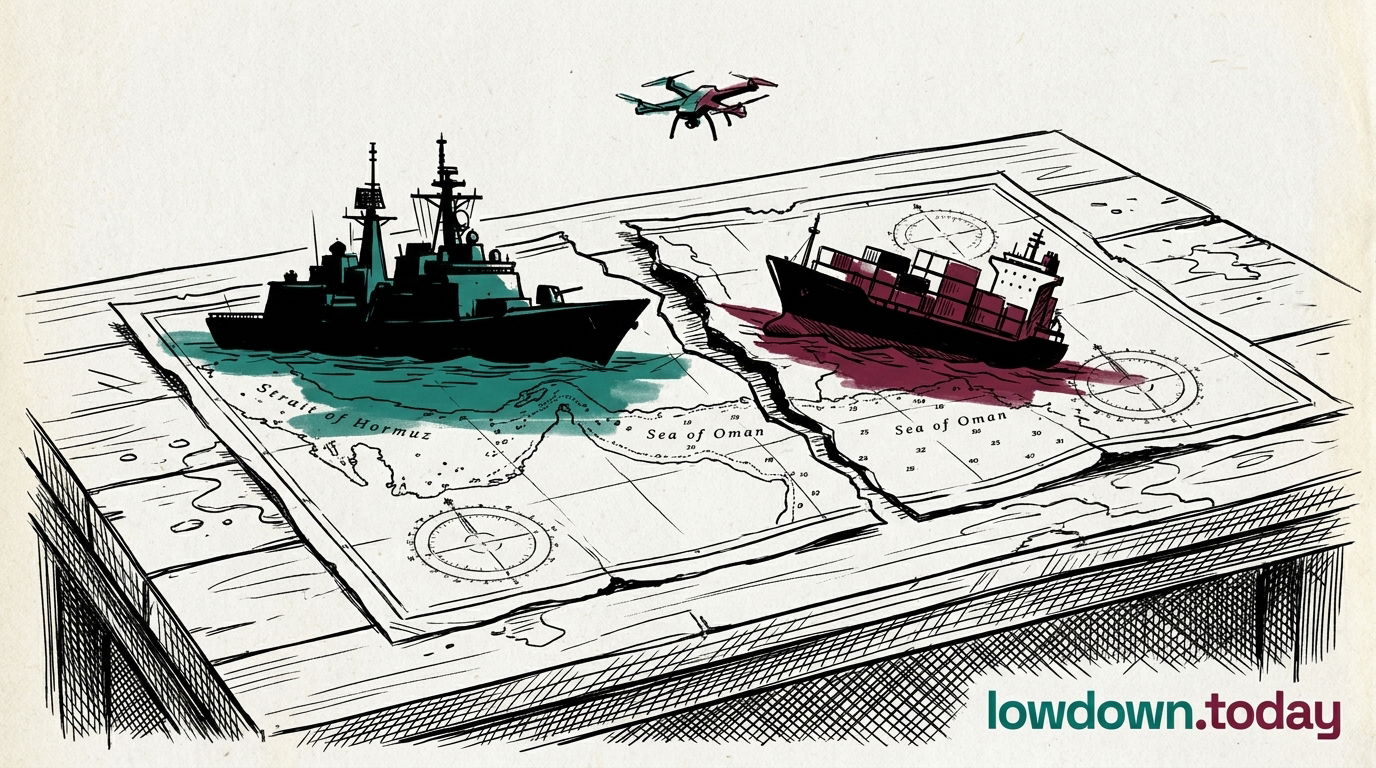
Touska produced the alignment. A US Navy destroyer firing into an Iranian-flagged cargo vessel's engine room, then Marines boarding, is the kind of action the three institutional blocs react to identically regardless of their internal position on talks. The demand for ship-and-crew release is now a precondition Tehran has planted in the public record; any Iranian negotiator walking into Islamabad without it in the opening text loses domestic standing. The hardening locks in a new entry condition for talks without closing the channel.

Deep Analysis

In plain English

Three senior Iranian officials said publicly harsh things about the US on 20 April. President Pezeshkian said Iran 'does not submit to force'. Parliament Speaker Ghalibaf called US terms a 'table of surrender'. Foreign Ministry spokesman Baqaei called the US blockade a 'criminal act'. This is partly a domestic audience strategy. Iran is a country where politicians face real consequences for appearing weak in negotiations; Supreme Leader Khamenei has already stated nuclear weapons are non-negotiable, and hardline MPs are watching closely. Strong public rhetoric allows Iranian officials to accept a compromise deal without looking like they caved. The key signal to watch is not what Iranian officials say in English-language press statements, but what they tell domestic Farsi media; which has sometimes carried more conciliatory signals (see the Baqaei Fararu interview, event 9 in this briefing).

What could happen next?
  • Meaning

    The three-official public hardening on 20 April followed the established pre-Islamabad signalling pattern: domestic maximalism to create political cover for the private flexibility the channel requires.

  • Risk

    Ghalibaf's 'table of surrender' framing, directed at conservative MPs rather than the diplomatic track, increases the domestic political cost of any uranium transfer agreement; regardless of what Araghchi negotiates in Islamabad.

First Reported In

Update #75 · Ceasefire ends in the water, a day early

CNN· 21 Apr 2026
Read original
Causes and effects
This Event
Tehran converges on 'table of surrender'
The public hardening from Iran's three top civilian voices sets the rhetorical floor for any Wednesday Islamabad round without closing the channel in fact.
Different Perspectives
Global South governments (Indonesia, Brazil, South Africa)
Neutrality was possible when the targets were military. 148 dead schoolgirls made it impossible — no government can explain that away to its own citizens.
Trump administration
Oscillating between claiming diplomatic progress and threatening escalation, while deploying additional ground forces to the Gulf.
Pakistan government
Pakistan government
Positioning as indispensable mediator by confirming indirect talks, but unable to bridge the substantive gap between both sides' incompatible demands.
Israeli security establishment
Fears a rapid, vague US-Iran agreement that freezes military operations before the IDF achieves what it considers full strategic objectives. A senior military official assessed the campaign is 'halfway there' and needs several more weeks.
Iraqi government
Iraqi government
Iraq's force majeure is the position of a non-belligerent whose entire petroleum economy has been paralysed by a war between others — storage full, exports blocked, production being cut with no timeline for resumption.
Russia — Ambassador Vassily Nebenzia
Moscow calibrated its position between Gulf states and Iran: abstaining on Resolution 2817 rather than vetoing it, signalling it would not block protection for Gulf states, while refusing to endorse a text that ignores the US-Israeli campaign it regards as the conflict's proximate cause. Russia proposed its own ceasefire text — which failed 4-2-9 — allowing Moscow to claim the peacemaker role while providing Iran with satellite targeting intelligence, a duality consistent with its approach in Syria.