Skip to content
You can now search across every topic, entity and event.What's new
Moscow
Nation / PlaceRU

Moscow

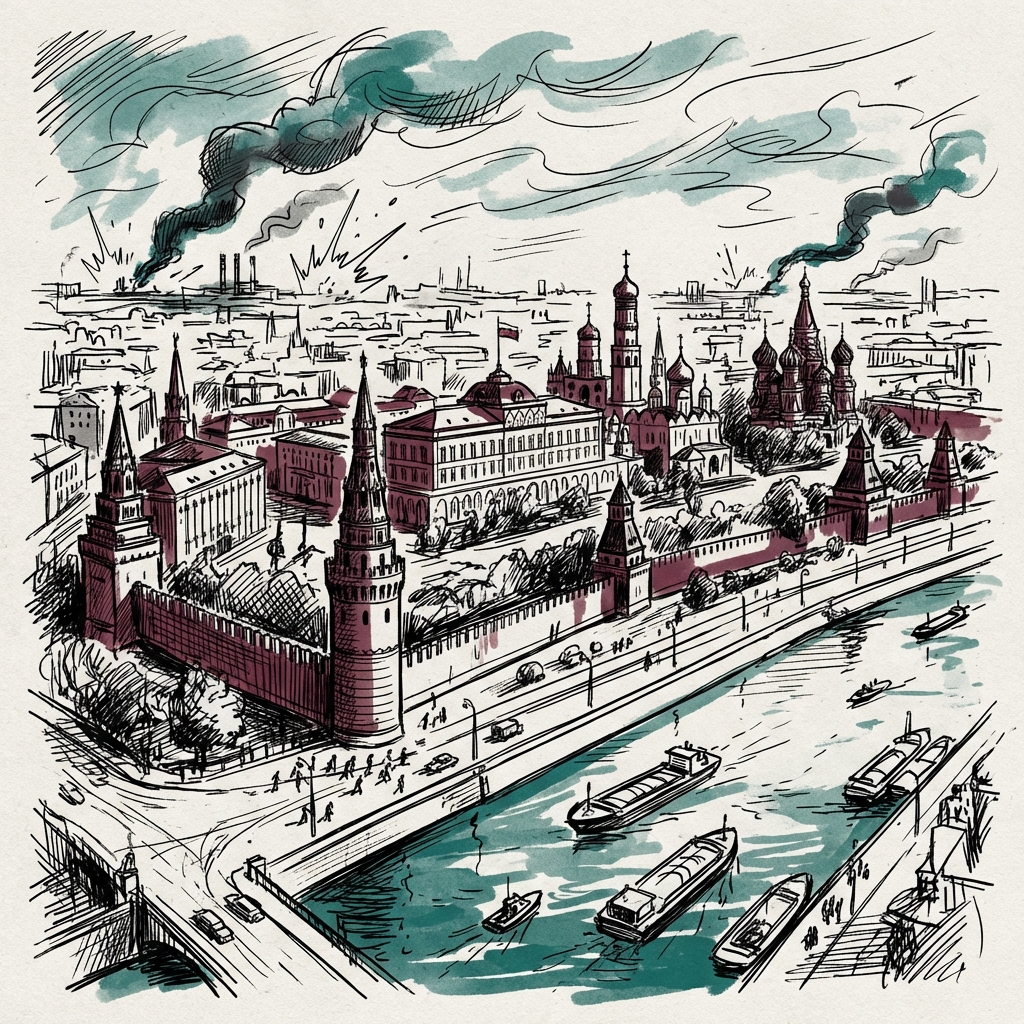
Capital of Russia; seat of the Kremlin directing the war in Ukraine and Moscow's parallel role as Iran's logistics partner.

Moscow let its own diesel export ban run past 31 July 2026 with no fixed end date, Deputy PM Alexander Novak tying any lifting to an unspecified market-recovery signal rather than a calendar deadline.

Last refreshed: 3 August 2026 · Appears in 2 active topics

Key Question

Ukrainian drones shut a refinery ten miles from the Kremlin: can Moscow hold its line?

Timeline for Moscow

View full timeline →

Background

Moscow is the capital of Russia and the seat of the Kremlin, generating around 20% of Russian GDP and directing both the war in Ukraine and Russia's parallel role as a logistics and diplomatic partner to Iran through the Iran conflict.

Oil and gas revenue is central to Kremlin finances, and 2026 has been a volatile year for that income: Q1 oil revenue fell 38.3% year-on-year under sanctions and price pressure, before a Hormuz-driven price spike lifted May's oil and gas revenue 32.4% year-on-year to 678.9bn roubles. Deputy Prime Minister Alexander Novak has repeatedly cut the government's own 2026 GDP forecast over the year, most recently to 0.4% from 1.3%.

Moscow has responded to falling export revenue with export restrictions rather than price support alone, banning gasoline exports from April and extending a Diesel Export Ban to producers as well as traders from July, moves that protect domestic fuel supply after refinery strikes but that also remove Russian barrels from a market already short of Russian crude.

Key Issues
Export policy

Moscow drops its own export deadline

Moscow widened its Diesel Export Ban to cover producers as well as traders on 8 July, a tightening that landed the same day the European diesel refining margin hit a record $60.17 a barrel; Russian seaborne diesel exports had already fallen 39% in June before the ban formalised the drop.

The 31 July Deadline this desk had modelled for that ban to lapse passed on 25 July with Novak instead citing an unspecified market-recovery signal, and the parallel gasoline ban was pushed out to end-2026. Moscow is choosing to keep the export restriction open-ended rather than accept the fuel-shortage domestic politics of lifting it, even as the policy props up the margin its own crude no longer earns.

Budget squeeze

Urals trades below Moscow's own budget line

Russia's federal budget assumes a $59-a-barrel Urals price; on 6 July Urals held near $51.25, roughly $20 below Brent and further below Moscow's own fiscal benchmark than the $10-15 gap of the past two years. A week later the crude was still stuck in the high-$40s to mid-$50s, with one tracker reading $48.95 while Brent climbed roughly $6 over the same run, widening the gap Moscow has to fund against rather than closing it.

The squeeze is arriving without any single new sanctions trigger: Urals had been trading $11-22 above the EU's $44.10 price cap only weeks earlier, so the fall to the high-$40s reflects the broader crude sell-off pulling Brent down as much as enforcement.

Common Questions
Is Moscow running out of petrol in 2026?
Petrol queues that began in occupied Crimea spread into Russia proper after the Kapotnya refinery strike. On 28 June 2026 Putin personally acknowledged 'queues at gas stations' and extended the gasoline export ban to 31 July.Source: Lowdown Russia-Ukraine War 2026 briefing
Why did a Ukrainian drone strike hit a refinery near Moscow?
On 18 June 2026 Ukrainian drones struck the Kapotnya refinery, ten miles from the Kremlin and the source of roughly 40% of the Moscow region's petrol, as part of a wider campaign against Russian oil infrastructure. Russian air defences scrambled 555 interceptor drones in response.Source: Lowdown Russia-Ukraine War 2026 briefing
How is the Russian economy doing in 2026?
May oil and gas revenue rose 32.4% year-on-year on a Hormuz price spike, but Russia cut its 2026 GDP growth forecast to 0.4% and major firms slashed capital spending, signalling strain.Source: SPIEF
Why did Putin reject meeting Zelenskyy in June 2026?
At SPIEF on 5 June 2026 Putin saw 'no point' in Zelenskyy's proposed face-to-face meeting and repeated that a treaty on Russia's terms, including all of Donetsk, must be settled first.Source: event
Did Ukraine attack the Baltic Fleet near St Petersburg?
Yes. Over 400 Ukrainian drones struck the Baltic Fleet's Kronstadt base outside St Petersburg overnight into 6 June 2026, hitting the corvette Boikyi; Moscow did not dispute the strike.Source: event
Did Trump accept Russia as the custodian for Iran's nuclear stockpile?
No. At a 27 May 2026 Cabinet meeting, Trump rejected both Russia and China as potential custodians for Iran's 440.9 kg stockpile of 60%-enriched uranium, eliminating the only third-country storage arrangement on the table.Source: Lowdown Iran Conflict 2026 briefing
How has Ukraine damaged Russia's oil refining capacity in 2026?
Ukrainian drone strikes have halted or reduced operations at nearly all major central Russian refineries including Syzran, Kirishi, Moscow, Ryazan, Yaroslavl, and Kstovo — affecting roughly 25% of total Russian refining capacity, with gasoline output down 30% and diesel down 25% as of May 2026.Source: Lowdown Russia-Ukraine War 2026 briefing
Is Russia supplying weapons to Iran in the 2026 war?
Yes. RFE/RL reported Russian Ilyushin Il-76 transport aircraft flying radar systems, electronic-warfare components, and aviation parts into Mehrabad and Bandar Abbas at high tempo in late April 2026. The Pentagon assessed China-Russia support as the reason Iran's military remained operational after the February strikes.Source: RFE/RL / Pentagon assessment
What happened when Iran's Foreign Minister visited Moscow?
Abbas Araghchi met Putin at the Kremlin on 25-27 April 2026. Putin declared the US war 'absolutely unprovoked aggression' and Russia called the US naval blockade unlawful. No joint statement was signed. Russian Il-76 aircraft were simultaneously flying military components into Iran.Source: Kremlin / RFE/RL
Who is Kirill Dmitriev and why is he in Washington?
Kirill Dmitriev is head of the Russian Direct Investment Fund and the Kremlin's back-channel to Washington. He met US officials around 9-10 April 2026 on Ukraine peace terms and US-Russia economic cooperation, with no Ukrainian representative present.Source: event
How does Orbán losing affect Russia?
Orbán's defeat in the 12 April 2026 Hungarian election removes Moscow's most reliable EU blocking partner. Hungary's vetoes on sanctions packages and the €90 billion Ukraine loan are now expected to be lifted by incoming PM Péter Magyar.Source: event
How is Russia funding the war in 2026?
Russia allocated 38-40% of federal spending to defence in 2026. The National Wealth Fund shed billions in January-February. On 16 April the US killed the GL134A oil waiver worth roughly $150 million per day and redesignated Rosneft and Lukoil under sanctions.Source: CREA, US Treasury
Is Russia making more or less money from oil in 2026?
Both. CREA found Russia's average Urals crude price fell to $63.18 a barrel in June 2026, down 26% month-on-month, yet oil-product revenue rose 14% to its highest since June 2024 because tight global supply lifted prices even as Russian volumes fell.Source: CREA
Why did Russia ban its own diesel exports in July 2026?
On 8 July 2026, Deputy PM Alexander Novak extended Russia's fuel-export controls to producers as well as traders for the first time, banning diesel exports outright. The ban's original 31 July expiry has since been dropped, so it now has no fixed end date; it ratified a fall already under way, with seaborne diesel exports down 39% month-on-month in June.Source: Lowdown Russia-Ukraine War 2026 briefing
How have US sanctions affected Russia's oil revenues in 2026?
Russian oil revenues fell 38.3% year-on-year in Q1 2026. The non-renewal of GL-134A closed a channel worth roughly $150 million per day. Rosneft and Lukoil were redesignated SDN in a coordinated US-UK-EU action on 16 April 2026.Source: Lowdown Iran Conflict 2026 briefing
What sanctions did the US impose on Russia during the Iran conflict?
On 16 April 2026, the US confirmed General License 134A (worth ~$150m/day in Russian oil revenue) would not be renewed, and Rosneft and Lukoil were redesignated under SDN in a coordinated US, UK, and EU action.Source: US Treasury / OFAC
What was Putin's Easter ceasefire in 2026?
Putin issued a decree on 9 April declaring a 32-hour Orthodox Easter ceasefire effective 11-12 April 2026. His published Kremlin calendar showed no US contacts for nine days around the decree. Ukraine's General Staff logged violations; Russia claimed 10,721 Ukrainian violations.Source: Kremlin calendar
Source Material
