Skip to content
Briefings are running a touch slower this week while we rebuild the foundations.See roadmap
Iran Conflict 2026
29MAR

Day 30: Iran hits aluminium plants; Hormuz emptying

4 min read
09:10UTC

Iran hit aluminium smelters in Abu Dhabi and Bahrain on 28 March, the first non-energy industrial targets of the Gulf war, while AIS data recorded just one commercial transit through the Strait of Hormuz in 24 hours. As the conflict enters its second month, Tehran is prosecuting an economic war across hydrocarbons, industrial commodities, and electronic warfare simultaneously, while the US-Israeli alliance fractures over whether the objective is regime change or nuclear degradation.

Key takeaway

Iran is converting military attrition into permanent legal, economic, and geographic architecture designed to outlast any ceasefire.

This briefing mapped
Loading map…
Military
Economic
Diplomatic
Humanitarian
Domestic

Iranian missiles hit two of the Gulf's largest aluminium smelters, opening an economic warfare front beyond hydrocarbons for the first time in the conflict.

Sources profile:This story draws on mixed-leaning sources from United Arab Emirates and France
United Arab EmiratesFrance

IRGC missiles and drones struck Emirates Global Aluminium in Abu Dhabi and Aluminium Bahrain on 28 March, the first attacks on non-energy industrial targets. Emirates Global produced roughly 4% of global aluminium output in 2025.

Iran classified both plants as "affiliated with US military and aerospace sectors." That elastic dual-use logic covers almost any Gulf industrial site. The target category has no ceiling. 

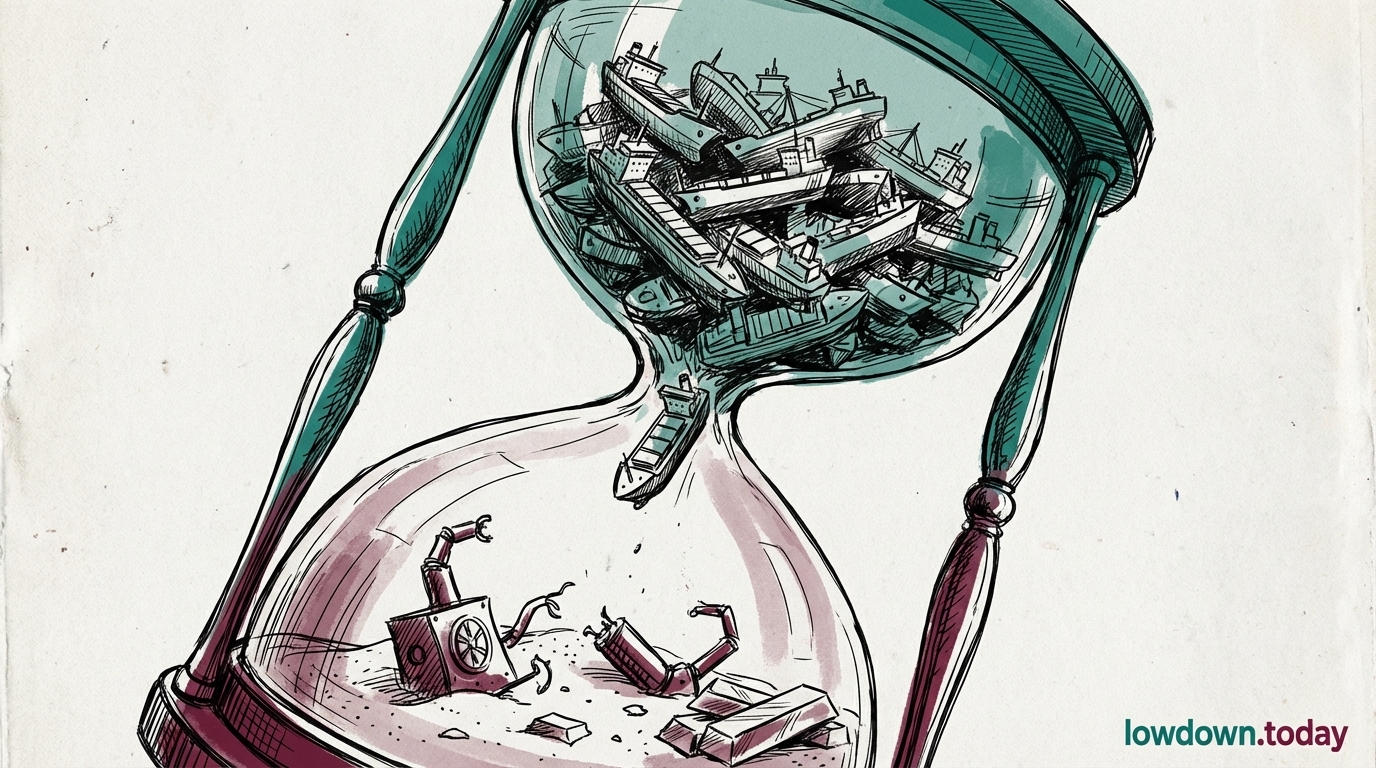
AIS vessel tracking data confirms what diplomatic language obscures: the Strait of Hormuz is effectively shut, with a single commercial transit recorded in a full day.

Sources profile:This story draws on neutral-leaning sources

AIS tracking shows 1 commercial ship transit through the strait of Hormuz in 24 hours, against a pre-war baseline of 30-50. Pakistan's 40-ship bilateral deal covers under 2% of the roughly 2,000 stranded vessels.

The IEA's March report puts disrupted exports at nearly 20 million barrels per day. Its 400 million barrel reserve release covers roughly 20 days of this shortfall. 

The US Vice President told Israel's Prime Minister he was overselling regime change, then went on a podcast to declare victory and promise more war in the same breath.

Sources profile:This story draws on centre-left-leaning sources from Israel
Israel

Vice President JD Vance said on 28 March Iran's military is "effectively destroyed" and a third of its missiles gone, then told Netanyahu to stop "overselling regime change."

The US wants nuclear degradation and Hormuz reopened; Israel wants Tehran's government replaced. Iran exploits that gap: every escalation forces the 2 allies to negotiate before they can act. 

Pakistan, Turkey, Egypt, and Saudi Arabia launched the war's most ambitious diplomatic effort, but Iran's non-negotiable sovereignty claim over Hormuz leaves the core dispute structurally deadlocked.

Sources profile:This story draws on neutral-leaning sources

US and British maritime authorities confirm an electronic warfare corridor stretching 2,500 kilometres across two of the world's three critical sea lanes. There is no safe detour.

Sources profile:This story draws on neutral-leaning sources

US Maritime Administration Advisory 2026-004 confirmed severe satellite navigation jamming from Hormuz into the Red Sea near Bab al-Mandeb: 2 of the world's 3 critical shipping chokepoints simultaneously.

Vessels diverted from Hormuz face degraded navigation at Bab al-Mandeb. That strait handles 4.5 million barrels per day. The Cape detour adds 10-14 days and up to $1 million. 

The second Houthi missile and drone attack on Israel in a single day confirms staged escalation, with Bab al-Mandeb closure declared openly as the next step.

Sources profile:This story draws on mixed-leaning sources from Qatar
Qatar

The Houthis fired their 2nd missile and drone barrage at Israel on 29 March, one day after their first. Houthi deputy minister Mohammed Mansour explicitly threatened to close Bab al-Mandeb.

Iran holds Hormuz at 1 end of the shipping corridor; Houthis hold Bab al-Mandeb at the other. 2 barrages in 24 hours signals a sustainable operational tempo. 

Islamabad secured passage for 20 more vessels, but the deal covers a fraction of the queue and preserves Iran's legal claim over the strait.

Sources profile:This story draws predominantly on Iran state media, with sources from Iran
Iran

Pakistan secured a 2nd bilateral Hormuz deal: 20 more vessels at 2 per day, bringing the total to roughly 40 ships against 2,000 stranded. Prime Minister Shehbaz Sharif held talks with President Masoud Pezeshkian.

40 ships is under 2% of the queue. Every bilateral deal concedes that Hormuz passage flows from Iranian permission, not international law. Iran gains a legal precedent at negligible cost. 

Sources:PressTV

An unprecedented 24-hour ultimatum with a civilian evacuation perimeter suggests the IRGC is either preparing to strike or testing how quickly the US can be forced into a compliance decision.

Sources profile:This story draws on centre-leaning sources from Israel
Israel
LeftRight

The IRGC declared Gulf-based US and Israeli universities "legitimate targets" on 29 March, issuing a 24-hour ultimatum expiring 30 March. It told staff to stay 1 kilometre from campus, unprecedented in IRGC targeting doctrine.

The same signal preceded the Diego Garcia launch, after which Iran struck a target 4,000 kilometres away. 

Hengaw, the most credible independent source on Iranian casualties, has not published since Day 25. The gap itself is a signal worth tracking.

Sources profile:This story draws on centre-left-leaning sources from Qatar
Qatar

Kurdish rights group Hengaw published its 7th Iranian civilian casualty report on 24 March and has been silent for 5 days. The projected toll sits at 7,300-7,800 against Iran's official count of 1,937.

Cause unknown: restricted access, network disruption, or a methodological pause. No independent source now tracks casualties during the war's heaviest phase. 

Sources:Al Jazeera

The Prince Sultan Air Base strike added 15 more wounded, and seventy-five percent of all casualties suffer traumatic brain injuries that have received almost no domestic coverage.

Sources profile:This story draws on centre-left-leaning sources from Qatar
Qatar

US Central Command confirmed 13 killed and at least 315 wounded as of 29 March. 75% or more carry traumatic brain injuries from blast waves, mirroring the 2020 Al Asad strike in Iraq.

In 2020 the Pentagon revised "0 casualties" to 110 TBI cases over 4 months. No independent casualty tracking exists, and no real-time TBI breakdown has been published. 

Sources:Al Jazeera

Protests spread across three cities as civil society groups and former parliamentarians joined, though numbers remain well below Gaza-era demonstrations.

Sources profile:This story draws on mixed-leaning sources from France
France

Police arrested 21 demonstrators in Tel Aviv, Haifa, and Jerusalem on 28-29 March. Standing Together, Peace Now, and Women Wage Peace joined alongside former parliamentarians for the first time.

Numbers remain small against the hundreds of thousands who marched during the Gaza war. Groups with legal teams and media access have a track record of scaling protests over time. 

The UN's highest peace and security body has issued no statement on Iran, Yemen, or Lebanon since 26 March, paralysed by the certainty of Russian and Chinese vetoes.

Sources profile:This story draws on centre-left-leaning sources from Qatar
Qatar

The UN Security Council issued no statements on Iran, Yemen, or Lebanon in the 72 hours to 29 March. Russia and China would veto any resolution targeting Iran.

During the 2023-24 Gaza war the Council at least convened emergency sessions. This 72-hour silence leaves the conflict without a ceasefire framework or any body empowered to impose one. 

Sources:Al Jazeera

The figure comes from the US government's own reporting, a rare admission of civilian destruction at industrial scale that sits uneasily beside claims of precision targeting.

Sources profile:This story draws on centre-left-leaning sources from Qatar
Qatar

More than 93,000 civilian properties in Iran have been damaged by US-led strikes, according to figures from Secretary of State Rubio's own State Department. Iran's official death toll stands at 1,937, including 230 children.

The source matters: this figure comes from Washington, not Tehran. CENTCOM logged over 10,000 targets struck and 9,000-plus flights since 28 February. The property figure sits alongside the administration's own precision-targeting claims. 

Sources:Al Jazeera

Western intelligence said Russian drones would reach Iran by the end of March. It is 29 March, and no source has confirmed or denied delivery. The Prince Sultan strike used 29 drones of unknown origin.

Sources profile:This story draws on neutral-leaning sources

Western intelligence placed completion of Russian drone deliveries to Iran at 'end of March.' EU High Representative Kaja Kallas confirmed the delivery timeline at the G7 on 26 March. The Prince Sultan Air Base strike on 27 to 28 March used 29 drones; whether any were Russian-supplied is unknown.

Confirmation of Russian drone delivery completion would represent direct Russian material participation in attacks on US forces, a threshold that changes the conflict's geopolitical character. 

Sources:EU News

Oil climbed 4.2% to $112.57 as the Houthi attacks added a second chokepoint threat to a market already pricing in near-total Hormuz closure.

Sources profile:This story draws on mixed-leaning sources from United States
United States

Brent crude settled at $112.57 on 28 March, up $4.56 on the day, as Houthi forces entered the conflict for the first time. WTI crossed $100. The 51% monthly gain was already the largest single-month rise since mid-2021.

Iran's parliament was expected to finalise a Hormuz toll bill that week, embedding the $2 million per-vessel charge in domestic law. Goldman Sachs put a $14-18 per barrel geopolitical risk premium inside the price already. 

Closing comments

Escalation trajectory is upward across all domains. Military: Houthi entry, university ultimatum, aluminium strikes. Economic: near-total Hormuz closure, aluminium supply disruption, oil at $112. Electronic: GNSS denial spanning 2,500 kilometres. Legal: Majlis toll bill and IMO notification advancing. Diplomatic: Islamabad talks structurally deadlocked. The convergence of the 82nd Airborne's theatre arrival (expected by approximately 1 April), the 6 April power grid deadline, and the university ultimatum expiry on 30 March creates a 48 to 72-hour window of maximum escalation risk.

Different Perspectives
Iran
Iran
Iran struck Gulf aluminium plants, issued a university ultimatum, and advanced Majlis legislation codifying Hormuz sovereignty while rejecting indirect talks, as more than 93,000 civilian properties are damaged and the official death toll reaches 1,937. Tehran is converting each military setback into a new legal or economic front designed to outlast any ceasefire.
United States
United States
Vance declared Iran's military effectively destroyed while simultaneously promising the war would continue and rebuking Netanyahu for overselling regime change; 13 US personnel have been killed and 315 wounded, 75% with traumatic brain injuries receiving minimal coverage. Washington is fighting over victory definitions with its ally and its own casualty narrative simultaneously.
Israel
Israel
Netanyahu was publicly dressed down by Vance for overstating the probability of regime change, then accused of smearing the Vice President after the call leaked. Israel wants the Iranian government gone; the US does not.
Pakistan
Pakistan
Islamabad secured a second bilateral Hormuz deal covering 20 additional ships while hosting the Islamabad Four summit. Each bilateral deal reinforces Iran's sovereignty framing rather than challenging it.
Houthis / Yemen
Houthis / Yemen
The Houthis fired a second missile and drone barrage at Israel within 24 hours and explicitly threatened Bab al-Mandeb closure as the next staged step. Activation followed the day Iran published its five conditions.
Gulf States (Saudi Arabia / UAE)
Emirates Global Aluminium and Aluminium Bahrain were struck by Iranian missiles, extending the targeting doctrine from energy to civilian industrial assets. Gulf industrial zones now require the same air defence reallocation as oil fields.

