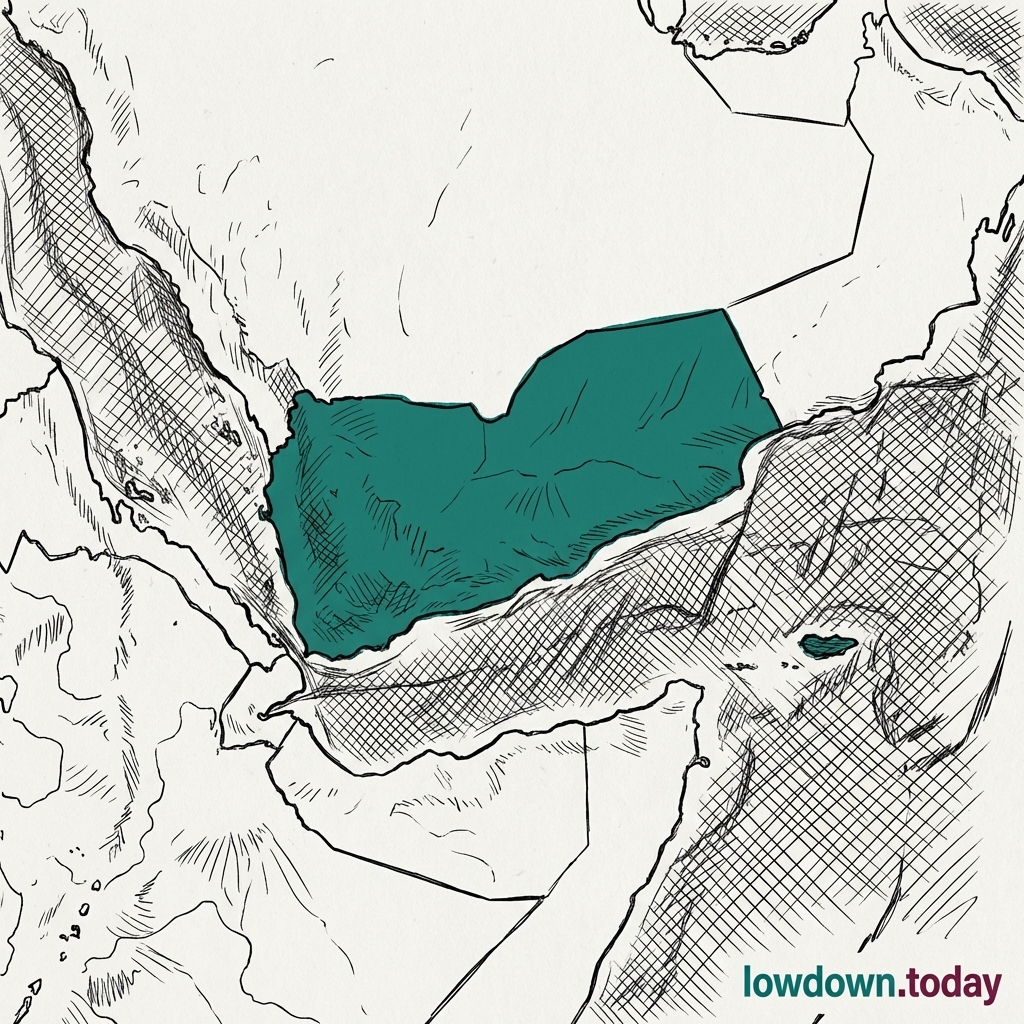
Yemen
Arabian Peninsula state divided since 2014; Houthi-controlled north controls the Bab al-Mandeb strait.
Yemen's Houthi movement escalated its own blockade through late July 2026, declaring the Bab al-Mandeb strait closed to Saudi-linked shipping on 20 July, striking tankers and Aramco's Jazan refinery by 24 July, before Riyadh answered with air strikes at Hodeidah.
Last refreshed: 20 August 2026 · Appears in 1 active topic
The world's worst humanitarian crisis sits on the world's second most important oil chokepoint. Now Ansar Allah is firing at Israel.
Timeline for Yemen
Mentioned in: War-risk claims reach about $2bn, Lloyd's List says
Iran Conflict 2026Mentioned in: Six men board a tanker off Mukalla
Iran Conflict 2026Detour route writes off a cargo ship
Iran Conflict 2026Mentioned in: Gulf ports plan for a shut strait
Iran Conflict 2026Mocha port shuts after 25 missiles
Iran Conflict 2026Background
Yemen is the poorest country on the Arabian Peninsula and has been divided since Ansar Allah, the Houthi movement, seized the capital Sanaa in 2014. A Saudi-led Coalition intervened in 2015, and the resulting civil war has killed hundreds of thousands of people and produced what aid agencies describe as the world's worst humanitarian crisis. A fragile Ceasefire since 2022 has let Ansar Allah consolidate control of the north, while the internationally recognised government, the Presidential Leadership Council under Rashad al-Alimi, governs from the southern port city of Aden.
Yemen's enduring strategic weight comes from its geography rather than its economy: the country controls the eastern shore of the Bab al-Mandeb strait, through which roughly a tenth of global trade passes every day. Ansar Allah's 2023-25 campaign against Red Sea shipping halved traffic through the strait and triggered the largest naval escort operation since the Cold War, a demonstration of how a materially poor and internally divided state can still hold a share of world trade at risk. The event record includes and .
Houthi forces close a second strait
Yemen's Houthi movement, Ansar Allah, declared the Bab al-Mandeb strait shut to Saudi-linked shipping on 20 July using open radio warnings alone; six vessels, among them the Chinese tanker Xin Long Yang, changed course within 48 hours with no shot fired. Roughly a quarter of world container traffic passes this strait, giving Ansar Allah's broadcasts the same practical hold over shipping that a naval blockade would once have taken far more force to achieve.
The Houthis escalated through the following week, striking the tankers Encelia and Layla on 22-23 July, hitting the NCC Masa on 24 July and setting fire to Aramco's Jazan refinery the same day, cutting Saudi Bab al-Mandeb loadings by more than a third. Saudi Arabia answered with air strikes on Houthi positions near Hodeidah, though the port itself stayed open to shipping.
Yemen opened a second war front
Yemen returned to the centre of the Iran conflict on 28 March 2026, when the Houthis fired ballistic missiles at Israel for the first time since the war began, ending a month of self-imposed restraint.
The Houthis escalated again on 8 June, banning Israeli-linked shipping from the Red Sea entirely and striking the Jaffa area, their first hit on Israeli territory since an earlier Ceasefire. That move turned Yemen's own Bab al-Mandeb chokepoint into a second maritime front running alongside the Strait of Hormuz, forcing Israeli-linked cargo to detour around both peninsulas.
Houthi forces close a second strait
Why did Saudi Arabia blockade Yemeni ports?
Yemen opened a second war front
What is the Bab al-Mandeb strait and why does it matter?
Reference
Which Yemeni government represents Yemen internationally?
How many people died in the Yemen war?
Where is Yemen?
Was a ship attacked off Yemen's coast in August 2026?
Why are the Houthis attacking Israel?
What happened between Saudi Arabia and the UAE at Mukalla?
Who controls Yemen in 2026?
Is Yemen still at war in 2026?
Why is Yemen important in the Iran war?
How bad is the humanitarian crisis in Yemen?
How does Bab al-Mandeb compare to the Strait of Hormuz?
What happened to the Southern Transitional Council in Yemen?


