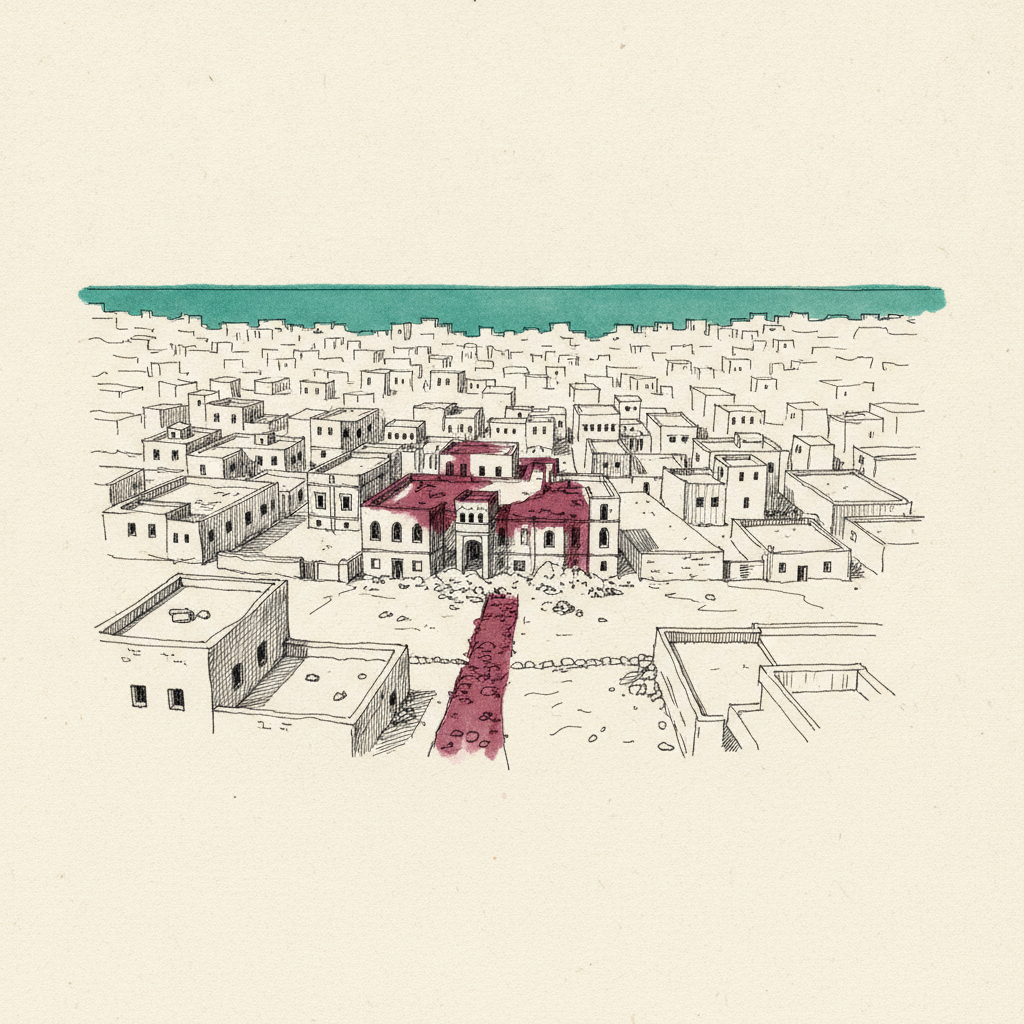
Gaza
Palestinian coastal enclave devastated by Israel's military campaign since October 2023.
Gaza remains under Israeli military presence and blockade in 2026, more than two years after the war began, with reconstruction and any lasting Ceasefire still contested. Its demolition doctrine, Beit Hanoun and Rafah cited as models, was explicitly extended to Lebanon's border villages from March 2026.
Last refreshed: 17 August 2026 · Appears in 1 active topic
What is the structural link between Gaza, Hamas, and Iran's Quds Force in 2026?
Timeline for Gaza
Mentioned in: Iran's parliament claims the strait too
Iran Conflict 2026Mentioned in: Saudi nuclear deal, conditioned by post
Iran Conflict 2026Mentioned in: Qatar summons Iran yet keeps mediating
Iran Conflict 2026Mentioned in: US and Iran halt fire, sign nothing
Iran Conflict 2026Background
Gaza is a 365 sq km Palestinian territory on the eastern Mediterranean coast, bordered by Israel and Egypt. It has been governed by Hamas since 2007 and held under Israeli blockade for the same period; the 7 October 2023 Hamas attack on southern Israel triggered the war that has devastated it since, with the UN estimating over 46,000 Palestinians killed.
Gaza carries two concurrent legal processes: an International Court of Justice case under the Genocide Convention (South Africa v. Israel) and International Criminal Court arrest warrants for Israeli officials. Neither has resolved the territory's status, and reconstruction remains contested more than two years after the war began.
Hamas's dependence on Gulf funding to rebuild has shaped its posture beyond Gaza's own borders: during the 2026 Iran conflict it publicly urged Tehran not to target Gulf states, an unusual public constraint for Iran's closest Palestinian ally.
Gaza's demolition model reaches Lebanon
Defence Minister Israel Katz ordered 'accelerated demolition of Lebanese houses in border villages' in March 2026, citing the 'Beit Hanoun and Rafah models' developed in Gaza, and said residents 'will not return south of the Litani.' Human Rights Watch identified three potential war crimes in the resulting Lebanon operations: forced displacement, wanton destruction and targeting of civilians.
The methods first developed to deny return in Gaza are now codified as replicable military policy elsewhere, and Katz's written order gives HRW documented intent it did not have before, narrowing the legal cover available to arms-supplying governments.
Why are Gaza-based individuals appearing in OFAC SDN lists in 2026?
How many people have been killed in Gaza?
What is happening in Gaza?
What is the Gaza model of warfare Israel is using in Lebanon?
What is Hamas's position in the 2026 Iran conflict?
Is there a ceasefire in Gaza?
Why did Hamas tell Iran not to attack Gulf states in 2026?
What legal cases are being pursued over Gaza?
What is the relationship between Iran and Hamas?
