Skip to content
You can now search across every topic, entity and event.What's new
Iran Conflict 2026
24JUN

Day 117: Iran and Oman claim the strait; US says no

5 min read
09:14UTC

Iran and Oman signed a joint statement in Muscat creating a standing committee to manage Hormuz shipping and set fees, hours after Rubio landed in the UAE saying Washington will not accept tolls. The same day the IMO began evacuating roughly 11,000 stranded seafarers and transits hit a war-high of 36. Trump says Iran agreed to inspections; Iran says no meeting happened.

Key takeaway

Iran signed two institutions and closed three negotiating tracks on a day Washington produced only contradictions.

This briefing mapped
Diplomatic
Humanitarian
Domestic
Economic
Legal
Military

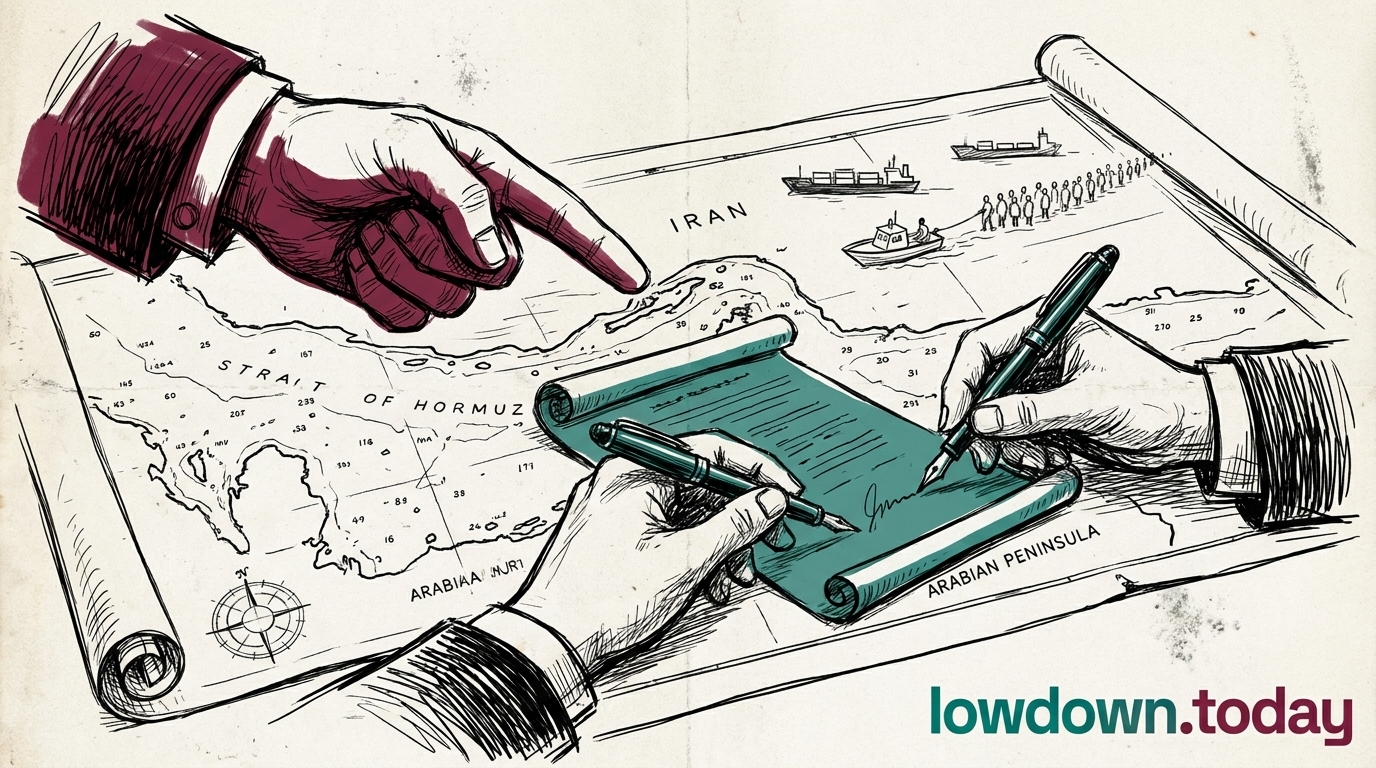
Sultan Haitham bin Tariq signed a joint statement with Iran's foreign minister in Muscat on 23 June, creating a standing committee to set fees on the Strait of Hormuz, hours after Rubio said Washington will not accept tolls.

Sources profile:This story draws on neutral-leaning sources

Sultan Haitham bin Tariq of Oman and Iran's Foreign Minister Abbas Araghchi signed a joint governance document in Muscat on 23 June creating a standing committee with authority to set fees on the strait of Hormuz; the world's most critical oil chokepoint. The Sultan's personal signature made this a head-of-state commitment, not a ministerial one.

The committee converts Iran's previous unilateral toll claim into a two-state demand that Washington cannot dismiss as Iranian extremism. US Secretary of State Marco Rubio landed in the UAE the same day and declared America will not accept those fees, leaving the two positions in direct confrontation. 

The International Maritime Organisation launched a coordinated evacuation of roughly 11,000 stranded seafarers from the Persian Gulf on 23 June, working with Iran, Oman and the United States as transits hit a war-high of 36.

Sources profile:This story draws on neutral-leaning sources

The International Maritime Organisation launched a coordinated evacuation of roughly 11,000 stranded seafarers from the Persian Gulf on 23 June, after 14 deaths during months of closure. Transits through the strait of Hormuz had recovered to a war-high of 36 vessels on 22 June, up from just 12 on the day the oil-sanctions waiver was issued.

The 36 vessels a day is still less than 40% of the pre-war rate of 94. Mines and absent insurance cover keep the strait physically restricted even as the diplomatic situation has eased. 

Trump posted that Iran had agreed to highest-level nuclear inspections; within hours Iran's foreign ministry said no meeting with the IAEA chief had taken place and no protocol existed.

Sources profile:This story draws on centre-left-leaning sources from United States and Israel
United StatesIsrael

Trump posted on 23 June that Iran had fully agreed to IAEA nuclear inspections. Iran's foreign ministry spokesman Esmail Baghaei denied any meeting or agreement had taken place within hours. The IAEA chief Rafael Grossi said inspections 'will happen' but gave no date.

The real issue is 440.9 kilograms of uranium enriched to 60% purity that inspectors have been unable to account for since February. That is roughly 60% of the way to weapons grade. Until inspectors can physically verify where it is, no one outside Iran knows what remains. 

Tasnim News Agency, tied to the IRGC, argued that nuclear ambiguity prevents American action and that letting inspectors in would only benefit the enemy, reframing the standoff as deliberate deterrence.

Sources profile:This story draws on centre-left-leaning sources from Israel
Israel

An IRGC-linked news outlet called Tasnim published a doctrinal explanation on 23-24 June for why Iran refuses to let nuclear inspectors into sites bombed during the conflict. The argument: nuclear uncertainty about what Iran has and where it is kept stops the United States from attacking again. Letting inspectors in would remove that protection.

This reframes Iran's inspection refusal from a procedural delay into a deliberate military strategy. The IRGC; not Iran's civilian president; controls the nuclear sites in question. Once this doctrine is publicly stated, offering inspection access becomes a political cost the civilian government cannot easily absorb. 

Marco Rubio arrived in the United Arab Emirates on 23 June declaring Washington will not accept tolls on the Strait of Hormuz, the same day Iran and Oman signed a committee to set them.

US Secretary of State Marco Rubio landed in Abu Dhabi on 23 June and declared America will not accept Hormuz tolls; hours after Iran and Oman signed a joint committee to set exactly those fees. His Gulf tour continues to Kuwait and a Gulf Cooperation Council (GCC) session in Bahrain on 25 June.

The GCC meeting is the first formal Gulf response to the Islamabad ceasefire deal. Its outcome will reveal whether Washington can hold the six Gulf monarchies together on a no-fees position, or whether Oman's co-signature on the Muscat committee has already fractured that front. 

Iran said it had agreed to release $12 billion in frozen funds in two tranches from Qatar and Iraq; a senior US official called the characterisation spin and said no money moves without Iranian compliance.

Sources profile:This story draws on mixed-leaning sources from United States and United Arab Emirates
United StatesUnited Arab Emirates

Iran announced on 23 June it had agreed to receive $12 billion in frozen funds in two $6 billion tranches from Qatar and Iraq. A senior US official called the characterisation 'spin', saying no money would move without Iranian compliance. Iran's UN Ambassador Ali Bahreini rejected any conditions.

The $12 billion represents years of seized Iranian oil revenue. The dispute is not about the amount; both sides acknowledge the figure; but about the rules: the US demands compliance first; Iran demands unconditional release. No legal instrument exists yet to clear either tranche. 

The Foundation for Defense of Democracies found that General License X carries no escrow, no value cap, no buyer list and no reporting, functioning as a 60-day safe harbour for Chinese refiners.

Sources profile:This story draws on neutral-leaning sources

The Foundation for Defense of Democracies (FDD) found that General License X; the US oil-sanctions waiver signed on 22 June; has no escrow, no value cap, no approved-buyer list, and no transaction-reporting requirement. FDD estimates roughly a third of Iran's annual oil revenues, about $12.4 billion, reaches the IRGC and armed forces.

The licence effectively gives Chinese refiners and banks already buying Iranian crude a 60-day legal cover for existing behaviour, rather than creating new enforcement conditions. No bank or trader had publicly disclosed a transaction under GL X by 24 June. 

The fifth round of Israel-Lebanon talks opened at the State Department on 23 June, ran over eight hours with no joint statement, and turned on Israeli maps for a model zone south of the Litani.

Sources profile:This story draws on neutral-leaning sources

Lebanon-Israel Round 5 talks opened at the US State Department on 23 June, ran eight hours and produced no joint statement. Israel tabled maps for a model zone south of the Litani River; Lebanese President Joseph Aoun demanded full Israeli withdrawal. The talks moved to the Pentagon on 24 June.

Iran has made a Lebanon ceasefire its precondition for nuclear sub-talks, so Round 5's failure keeps the wider Iran-US deal stalled. A final session was set for 25 June. 

Sources:Shafaq News

Israeli strikes killed at least 27 Lebanese around 23 June; Hezbollah fired more than 175 projectiles in 24 hours and a drone killed a female Givati Brigade soldier at the border.

Sources profile:This story draws on centre-left-leaning sources from Israel
Israel

IDF strikes killed at least 27 Lebanese around 23 June while Hezbollah fired 175+ projectiles in 24 hours. A Hezbollah drone killed a female Givati Brigade soldier at a south Lebanon border position. The UN records 12 children killed or injured in Lebanon daily despite the ceasefire.

Netanyahu's order for the IDF to hold south of the Litani keeps Iran's Lebanon precondition for nuclear talks unmet. The casualty figures are the daily cost of the stalled Round 5 talks running simultaneously in Washington

The US Senate voted on 23 June to halt the military campaign against Iran, with four Republicans breaking ranks to join Democrats; the measure carries no legal force.

Sources profile:This story draws on centre-leaning sources from United Kingdom
United Kingdom
LeftRight

The US Senate voted on 23 June to halt the military campaign against Iran, with four Republicans joining Democrats. The War Powers Resolution's mechanics give the vote no legal force and it does not reach Trump for a signature. The White House called it ineffectual.

Four Republicans breaking ranks is the strongest congressional signal yet that a deal lacking a published US legal instrument cannot count on Republican votes. Trump warned the dissenters they 'have to be educated'. 

Sources:Reuters

Trump ordered a Justice Department probe into oil-company gouging on 24 June, accusing firms of not cutting pump prices as Brent crude slid to $76.14.

Sources profile:This story draws on neutral-leaning sources

Brent Crude fell to $76.14 on 24 June, its third consecutive daily decline, as UAE oil exports recovered to roughly 85% of pre-conflict levels and tanker transit confidence grew. Trump ordered a Justice Department investigation into oil-company price gouging.

The oil price fall prices in the partial Hormuz reopening rather than a full one: mines remain, war-risk insurance is still elevated, and GL X lapses on 21 August. The market is pricing 60-day relief, not a permanent settlement. 

Iranian President Masoud Pezeshkian ruled out any negotiation over Iran's ballistic missile programme on 23 June, closing one of the deal's three deferred tracks before the talks window opened.

Sources profile:This story draws on centre-left-leaning sources from Qatar
Qatar

Iranian President Masoud Pezeshkian ruled out negotiations over Iran's ballistic missile programme on 23 June, closing one of the three tracks the Islamabad MOU had deferred to a 60-day talks window. The other two deferred tracks; enrichment levels and stockpile accounting; remain formally open.

The IRGC, not Pezeshkian, controls the missile programme. His statement aligns civilian government posture with IRGC red lines before the talks window opens, reducing the civilian government's room to offer missiles as a later concession. 

Sources:Al Jazeera
Closing comments

Sideways through early July: Iran has closed the missile track, sealed nuclear sites via Tasnim doctrine, and signed two bilateral instruments, while Washington has produced zero new legal paper beyond the 60-day GL X (lapsing 21 August 2026). The re-escalation trigger is a GCC Bahrain communique on 25 June explicitly naming the Muscat committee, which would pressure Oman to split from its Gulf partners and incentivise the IRGC to activate PGSA fees before the 17 August date. The de-escalation trigger is Grossi securing a specific inspection date for Fordow or Natanz before 21 August, which would require the IRGC to publicly reverse the Tasnim doctrine it published 24 hours ago.

AI-assisted, human-edited under the editorial responsibility of Bannermedia Ltd. Reviewed by Ed Woodcock on 24 June 2026. Editorial standards.

Different Perspectives
Iran (civilian government)
Foreign Minister Araghchi co-signed the Muscat Hormuz committee on 23 June while spokesman Baghaei denied any inspection meeting had taken place, positioning the civilian government as simultaneously building new institutions and blocking the MOU's central verification commitment. President Pezeshkian aligned the civilian position with the IRGC's missile red line before the 60-day talks window opened.
Islamic Revolutionary Guard Corps (IRGC)
Tasnim News Agency, the IRGC's affiliated outlet, published a doctrinal statement on 23-24 June explaining that nuclear ambiguity prevents American action and that granting inspectors access to war-damaged sites would only benefit the enemy. The doctrine converts the inspection refusal from a procedural delay into a stated military strategy the civilian government cannot override.
United States
United States
Rubio declared in Abu Dhabi that Washington will not accept Hormuz tolls the same day Iran and Oman signed a committee to set them; Trump posted that Iran had agreed to inspections hours before Iran denied any meeting occurred. Four Senate Republicans voted to halt the Iran campaign, exposing the deal's thin domestic legal base.
Oman
Oman
Sultan Haitham bin Tariq signed the Muscat Hormuz fee committee in person on 23 June, a head-of-state commitment that converts Oman from a passive mediator into a co-governing coastal authority, while simultaneously cooperating with the IMO-led evacuation of 11,000 stranded seafarers. Oman's co-signature fractures the GCC's unified no-fees front before the Bahrain session.
Israel
Israel
Netanyahu ordered IDF forces to hold south of the Litani on 23 June as Israeli strikes killed at least 27 Lebanese and Hezbollah fired 175 projectiles, maintaining the fighting that keeps Iran's Lebanon ceasefire precondition for nuclear talks unmet. Israel's intransigence on Lebanon is, in structural terms, the IRGC's most effective blocking mechanism for the MOU.
Lebanon and civilians
Lebanese President Joseph Aoun told Washington's Round 5 talks that Beirut would accept nothing less than full Israeli withdrawal, as the UN recorded 12 children killed or maimed in Lebanon daily despite the ceasefire. The civilian population absorbs the daily cost of a stalled diplomatic track that the parties insist is still running.