Skip to content
You can now search across every topic, entity and event.What's new
Iran Conflict 2026
24JUN

Iran and Oman claim the strait

3 min read
09:14UTC

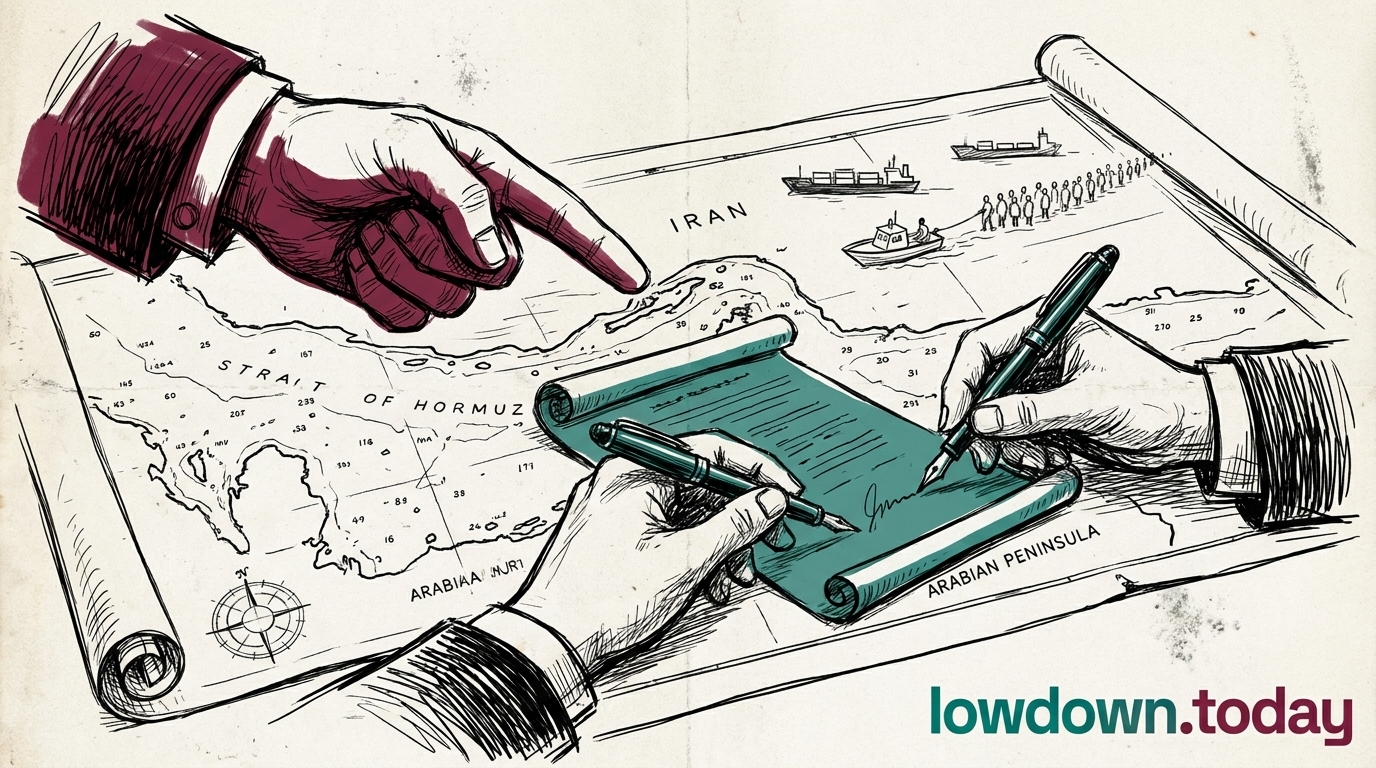
Sultan Haitham bin Tariq signed a joint statement with Iran's foreign minister in Muscat on 23 June, creating a standing committee to set fees on the Strait of Hormuz, hours after Rubio said Washington will not accept tolls.

ConflictDeveloping
Key takeaway

Iran and Oman signed a Hormuz fee committee the same day Washington said no state may charge.

Iran and Oman signed a joint statement in Muscat on 23 June creating a standing committee between their foreign ministries to administer Strait of Hormuz shipping and determine transit fees "in alignment with international standards" 1. Sultan Haitham bin Tariq, Omani Foreign Minister Badr Albusaidi, Iran's Foreign Minister Abbas Araghchi and parliament speaker Mohammad Bagher Ghalibaf put their names to it in person. the strait is the 33-kilometre chokepoint through which roughly a fifth of the world's seaborne oil passes, and the question of who may charge to use it has run unresolved since the war began.

The Sultan's personal signature, head-of-state level rather than ministerial, escalates the consultations Baghaei first announced on 18 May into a formal institution with named signatories and fee-determination authority. The founding language, "the sovereignty and sovereign rights of the two coastal nations" 2, positions the pair as co-governing authorities over a waterway Washington insists no state may charge to use.

That framing carries weight beyond the rhetoric. A coastal-state body that sets fees pre-empts both the US position and the European multilateral framework drafted at the UK's Northwood Headquarters. It also routes around Iran's own unilateral Persian Gulf Strait Authority (PGSA), the body that mandated transit insurance and reserved fees from 17 August , while Oman simultaneously reaffirmed its backing for the Islamabad MOU and gave Tehran the Arab cover The Gulf monarchies have withheld.

Deep Analysis

In plain English

The Strait of Hormuz is a 33-kilometre shipping lane between Iran and Oman through which roughly one-fifth of the world's oil passes every day. Until now, every country agreed that no single nation owned it; ships could pass freely under international maritime rules. On 23 June, Iran and Oman signed a document creating a joint committee that can set fees for using the strait. They are two of the three countries whose coasts border the strait, so together they claim the right to govern it. This matters because the United States and most shipping nations argue no country can charge for passage through an international strait. If Iran and Oman enforce fees, every tanker carrying oil from the Gulf; including those supplying Europe and Asia; faces a new toll. The US Secretary of State arrived in the region the same day and said America will never pay those fees, leaving a direct standoff between the two positions.

Deep Analysis
Root Causes

The Iran-Oman committee reflects a specific structural gap in the 1982 UN Convention on the Law of the Sea (UNCLOS): transit passage rights through international straits bind the 169 states that ratified UNCLOS, but Iran never ratified it.

Tehran instead relies on its own 1934 and 1959 maritime boundary treaties with Oman, which pre-date the transit-passage doctrine. The 23 June committee grounds its fee authority in those bilateral treaties rather than UNCLOS, giving the arrangement domestic legal standing in both states even if it conflicts with international maritime law as the US and EU interpret it.

Oman's co-signature also reflects the failure of Bessent's 28 May threat to sanction Oman over toll facilitation. Muscat backed down verbally then, but the 23 June signing shows the retreat was tactical: Sultan Haitham waited until the Islamabad MOU gave the committee a treaty hook ('navigation services' charges permitted after 60 days) before committing his personal signature.

Escalation

The committee's signing escalates the Hormuz governance dispute from an IRGC unilateral toll claim to a bilateral state instrument backed by a head-of-state signature. The IRGC's own PGSA is now supplemented, not replaced, by a civilian-diplomatic vehicle. This makes it harder for Washington to dismiss the toll question as Iranian extremism and harder for moderate Gulf states to oppose it without directly challenging Oman.

What could happen next?
  • Precedent

    If no international body invalidates the committee before it begins operating, two coastal states will have established that joint governance of an international strait can override transit-passage norms, creating a template replicable in the Bab el-Mandeb (Djibouti-Eritrea-Yemen) and the Turkish Straits.

    Medium term · Reported
  • Risk

    The GCC session in Bahrain on 25 June faces a split between Oman (co-signatory) and the four Gulf monarchies that formally rejected the PGSA in May. Any GCC communique that fails to name the committee risks legitimising it by omission.

    Immediate · Assessed
  • Consequence

    Rubio's no-tolls declaration, issued hours after the signing, now requires a concrete enforcement mechanism; either sanctions on Omani toll-facilitation or naval interdiction; neither of which Washington has signalled it will use against a fellow US partner state.

    Short term · Reported
First Reported In

Update #137 · Iran and Oman claim the strait; US says no

WANA (West Asia News Agency)· 24 Jun 2026
Read original
Causes and effects
Different Perspectives
Turkiye
Turkiye
Erdogan followed the Pakistani delegation to Jeddah for an instrument that has not been signed. Ankara's entry widens Saudi Arabia's defence architecture beyond the existing Pakistan pact, adding a second non-Gulf military partner mid-conflict.
Oman
Oman
Muscat is the corridor's broker but has published nothing about the arrangement Fars describes on its behalf. The account leaves Oman administering outbound traffic only, a narrower role than the shared route its mediation has rested on since 1979.
Pakistan
Pakistan
Islamabad sent Sharif, Munir and Dar to Jeddah to widen a defence commitment it has honoured in cheaper registers since March, when Dar invoked the Saudi mutual defence pact. Jeddah tests whether that hedge becomes a binding trilateral instrument with Turkiye.
United States
United States
Washington rejected the Majlis Hormuz bill outright while CENTCOM's own tally kept climbing to 49 vessels redirected since 14 July. Both instruments tightened in the same week Trump promised the strait would reopen soon.
Iran
Iran
Iran's foreign ministry is selling a phased Hormuz corridor through Oman and denying any percentage cargo tariff, while its own Majlis is legislating fines to 20% and a bar on Israeli-linked cargo. The two accounts, from the same government, do not agree with each other.
Saudi Arabia
Saudi Arabia
Riyadh published a target forecast, not an attribution, for the campaign it says the Najran strike previewed. That keeps an Article 51 case available while it formalises a trilateral defence architecture with Pakistan and Turkiye.




